




India's idea of a citizen's rights is older than the modern vocabulary of "human rights”. It runs from the Vedic injunction that the king is bound by dharma and ṛta (cosmic order), through the Mahābhārata's statement that the ruler exists for the protection of the people, through the Arthaśāstra’s detailed process of justice, to detailed examples of how justice was administered in the Tamizh land. Citizens’ rights are not about entitlements from the state but the duties of the state and the duties of the citizen. The machinery of justice, from the sabhā of the Vedic period to the dharmasthīya courts of the Arthaśāstra, the avai of the Tamizh country and the Mughal qāḍī, was always expected to be impartial, evidence-based and proportionate. This machinery was not an independent entity set apart from the ruler but an integrated rule of law that involves the ruler, councillors, judges, scholars, and the citizen. The machinery did not use the word “rights,” but instead made the ruler answerable to the people, his council, and to Dharma itself. Similarly, the people were answerable to their own Dharma. It is the guaranteed consequential Karma, the positive and negative effect of their choices, from following or not following their Dharma that guided behaviour.

The Ṛgveda's ideal is ṛta. This is the divine, moral, and cosmic order that even the Devatās obey. A king or rājan who violates this order loses legitimacy. The Saṃjñāna Sūkta of Ṛgveda 10.191, the last hymn of the whole collection, calls for the assembly to deliberate with one mind and one purpose, and is routinely cited as an early textual root of consultative governance. The emphasis sets the tone for the assembly to work for a common purpose without selfish, narrow-minded, ego-centric motives.

Featuring:





The sabhā and samiti were assemblies that chose, advised, and at times removed the King…
The sabhā and samiti were assemblies that chose, advised, and at times removed the King from power. As Atharvaveda 3.4 describes it, a king is chosen by the people. It stipulates the disposition, behaviour, and expectations of the King. Through such verses, the King is conditioned to become a servant of the state and the people and not necessarily the overlord.

The Bṛhadāraṇyaka Upaniṣad (1.4.14) makes this explicit. Dharma, to which all are equally subject, is the power above the ruling power, by which even the weak may prevail over the strong as if through the king. The King’s individual aspirations, preferences, and motivations are inconsequential before Dharma.

The King is asked to look at the world as one family or vasudhaiva kuṭumbakam…
The King is asked to look at the world as one family or vasudhaiva kuṭumbakam and to wish for the welfare of all beings as seen in the traditional śānti prayer. Later Indian jurists and the Supreme Court have repeatedly cited these as universalist statements and as indigenous roots of human dignity. The Hindu civilisation is the only one that wanted welfare for all creatures including animals and plants. It did not distinguish between adherents and non-adherents of the religion.
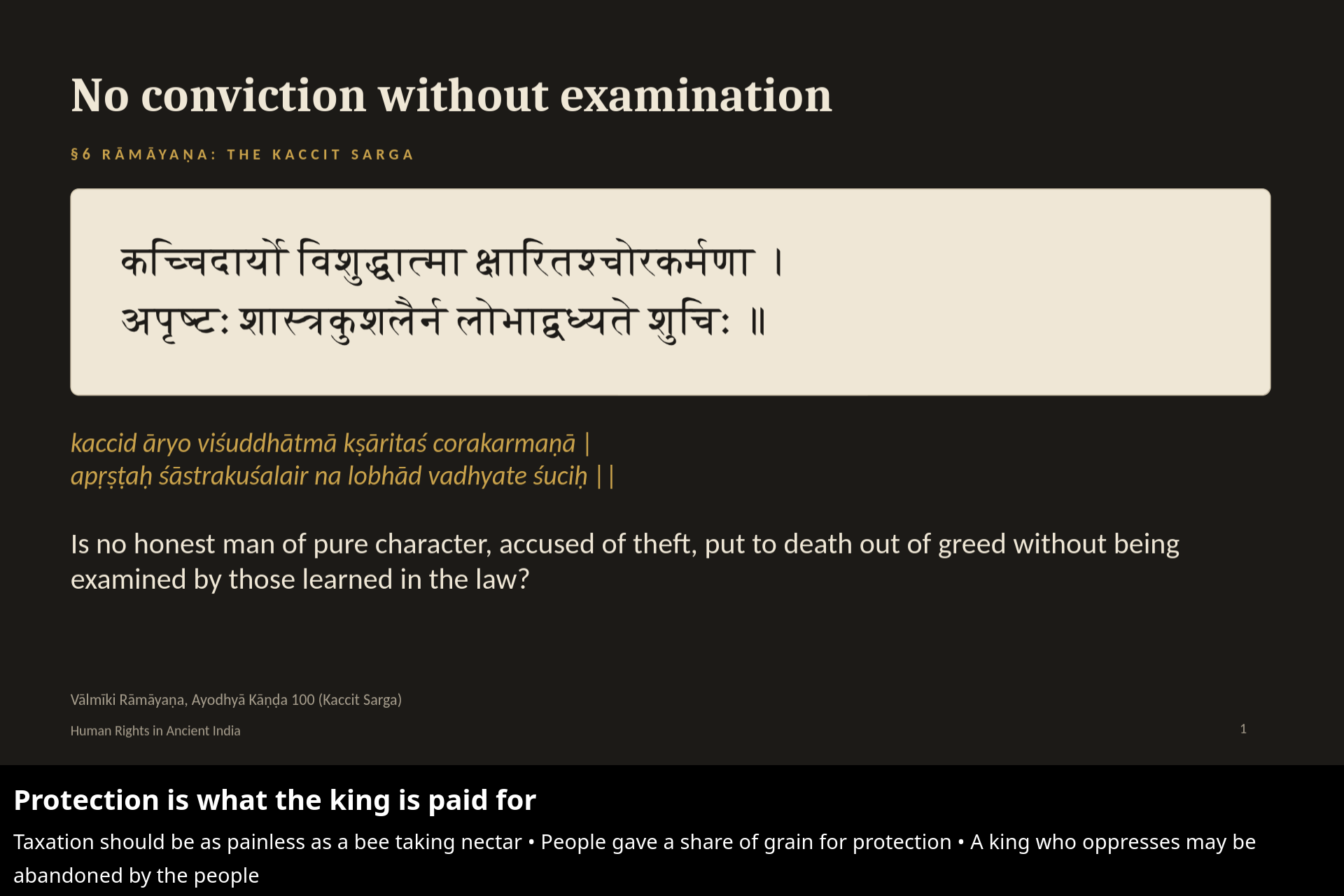
But how do we measure that the kingdom is in conformance with Dharma? In The Kaccit Sarga of the Ayodhyā Kāṇḍa sarga 100 of the Vālmīki Rāmāyaṇa sets out the conditions of a just kingdom. When Bharata comes to bring back his brother Rāma to Ayodhyā, Rāma's piercing questions reveal not just his knowledge of Dharma but also the standards that it recommends. He asks whether the King protects the weak, whether the judges take bribes, whether the innocent is punished while the guilty is spared, and whether the treasury is used for the benefit of the people. One question states the rule against conviction without trial. Rāma asks whether an honest individual of pure character is accused of theft and put to death out of greed and without examination by legal scholars. These are the standards by which Rāma’s kingdom or Rāmarajya is considered the gold standard of good governance. Where no one was poor. No one was afflicted by anything. No one lived in fear. Even the ruler remained bound by the opinion of the people, which took precedence over even his family and personal desires.


Featuring:




How such ideals can be achieved is outlined in different parts of the Mahabharata. In the Udyoga Parva 34.17, called Vidura Nīti, Vidura tells the Emperor Dhṛtarāṣṭra that the expenses of administering the kingdom are met through taxation, which must be as painless as a bee taking nectar. In the Shanti Parva or Book 12, Bhīṣma, lying on a bed of arrows and ready to die, expounds the largest and most exhaustive treatise on politics, administration, and governance known to man. His central premise is that the King exists for prajāpālana or the protection of the people. He cites the story of Manu in adhyāya or chapter 67 where the people voluntarily gave a sixth of their grain and a tenth of their merit to the king in return for protection. In Anuśāsana Parva, Bhiśma says in 61.32–33 that the king who oppresses his subjects may be abandoned or killed by the people like a mad dog. Therefore, protection is not an optional virtue the king may choose to display selectively. It is the consideration for which he is paid, and its failure dissolves his title.


While taxation brings in revenue to fund the administration of the kingdom, Dharma also equips…
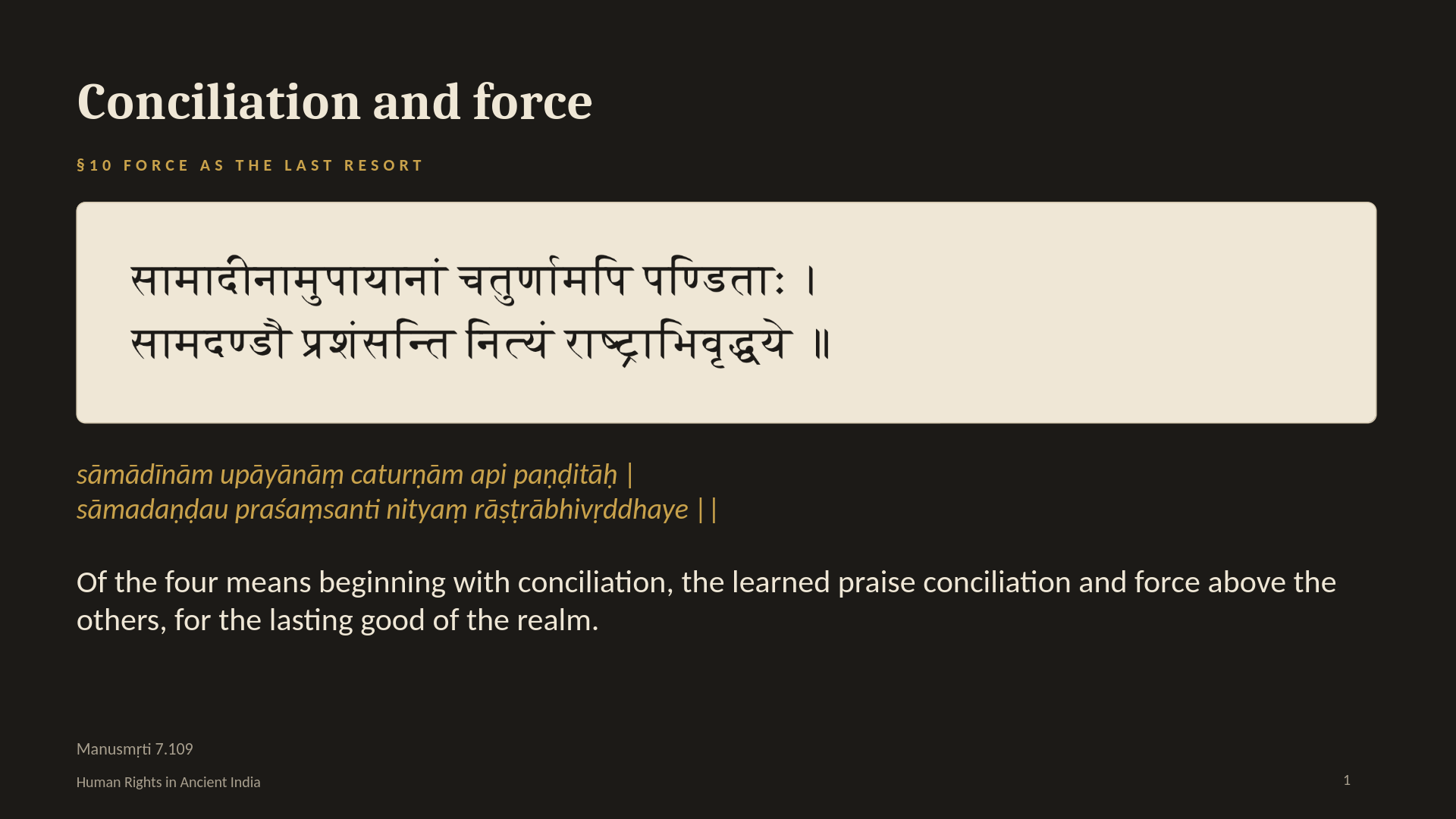
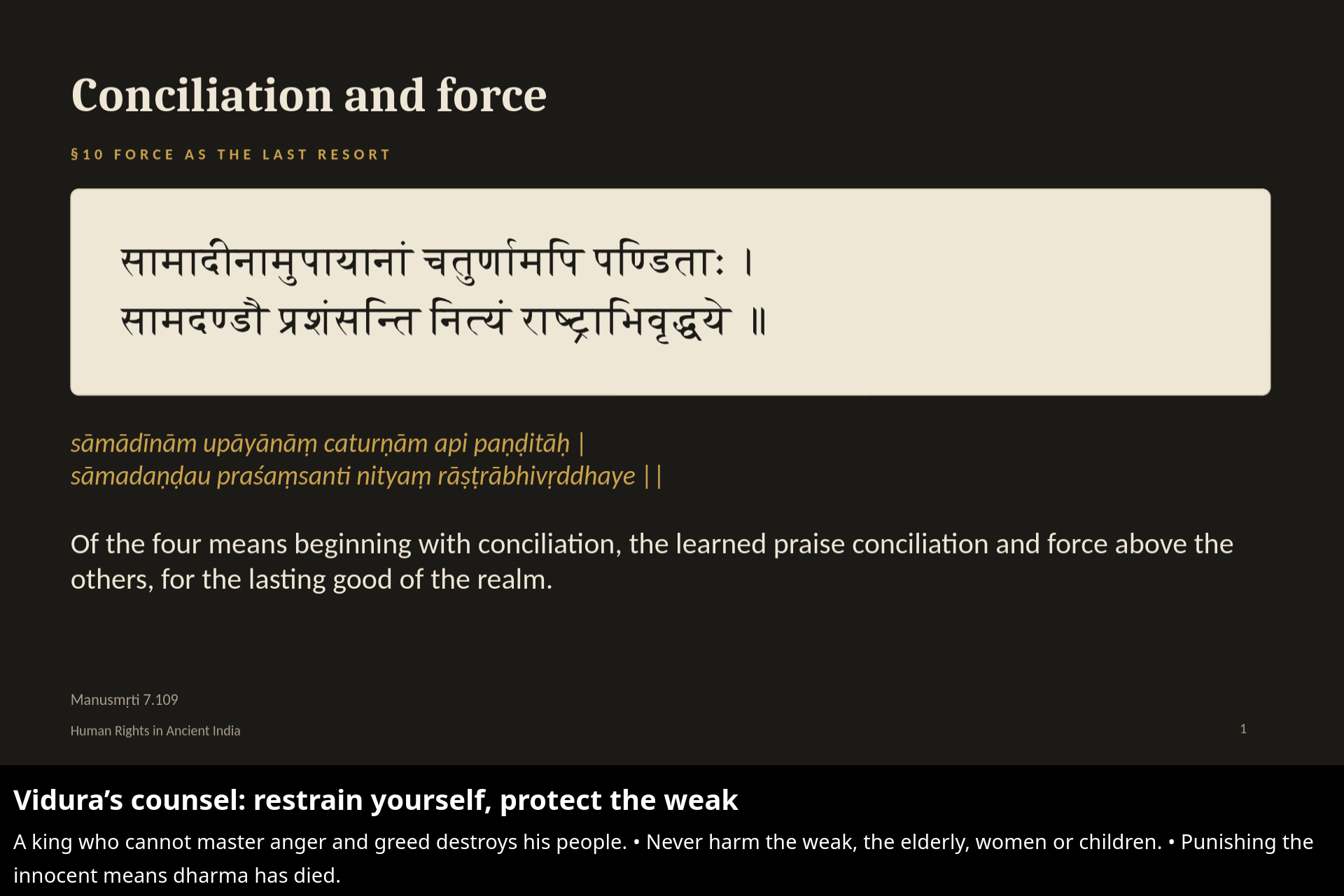
While taxation brings in revenue to fund the administration of the kingdom, Dharma also equips him with seven tools. In the Sabhā Parva adhyāya 5, on the eve of the Rājasūya, Nārada visits Yudhiṣṭhira's new hall and puts to him more than a hundred questions on the conduct of the kingdom. Two of these, questions the Emperor on his employment of these tools against his enemies. The four commonly known upāyas or tools are sāma (conciliation), dāna (gift or concession), bheda (dividing the opposition) and daṇḍa (force). The lesser known ones are māyā or stratagem, upekṣā or calculated neglect, leaving an adversary to his own devices, and indrajāla or deception and display. Upekṣā is what Napoleon is famously said to have advised: “Don't interrupt an enemy when he is making mistakes.” Indrajāla is what a modern state would call information operations or warfare including disinformation campaigns.


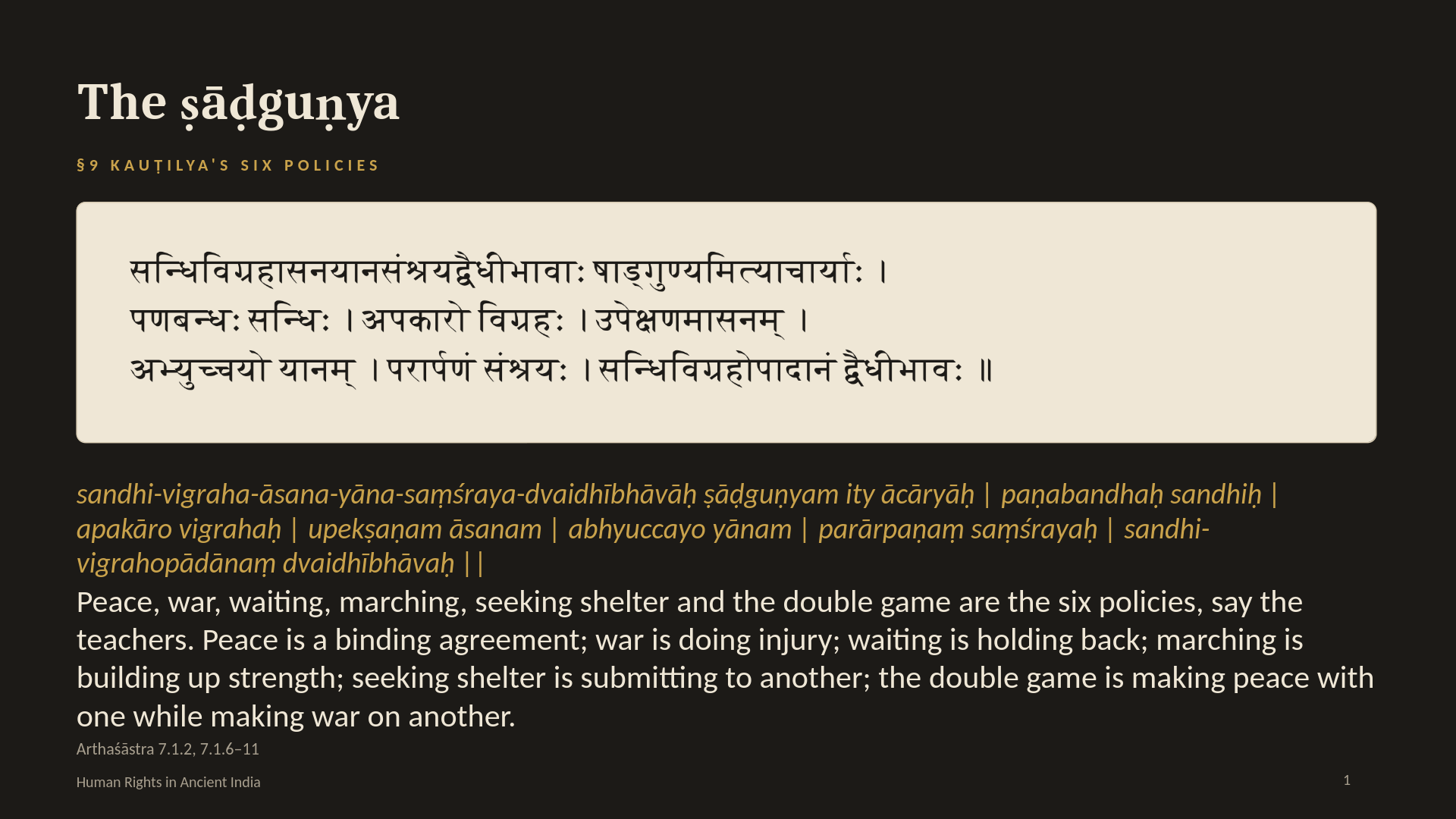
Kauṭilya's six guṇas are the six policies by which the options in foreign policy are weighed. He sets out the ṣāḍguṇya at the head of his book on foreign policy and defines each in turn. The six are: making peace with a binding agreement, declaring war to inflict injury, waiting for the right time and opportunity, marching to create pressure and building strength, seeking shelter under someone’s strength through submission, and playing the double game by making peace with one and making war on another. These are the six policies. The Manusmṛti also discusses these six.


Featuring:


Several important conclusions stand out. First, the daṇḍa is the last resort and the king…
Several important conclusions stand out. First, the daṇḍa is the last resort and the king who uses it first fails miserably. The concept is that, force may be necessary but not as the first resort. In the Bhīṣma and Droṇa Parvas, warriors were forbidden from attacking a fleeing, wounded, unarmed or sleeping enemy, a charioteer, or a non-combatant. In modern language, we would call this the equivalent of international humanitarian law. Second, the use of bheda, māyā and indrajāla against those who threaten the state is expressly lawful: the ruler who divides a hostile combination, outwits it, or counters its propaganda is doing what the texts require of him, not what they forbid. Third, waiting or upekṣā, or āsana among the six policies, is something that Deng Xiaoping famously advocated for China— “hide our capacities and bide our time.” In many ways, this is exactly what India is doing in 2026, sitting out the war between Russia and Ukraine and the war waged against Iran by the US and Israel.



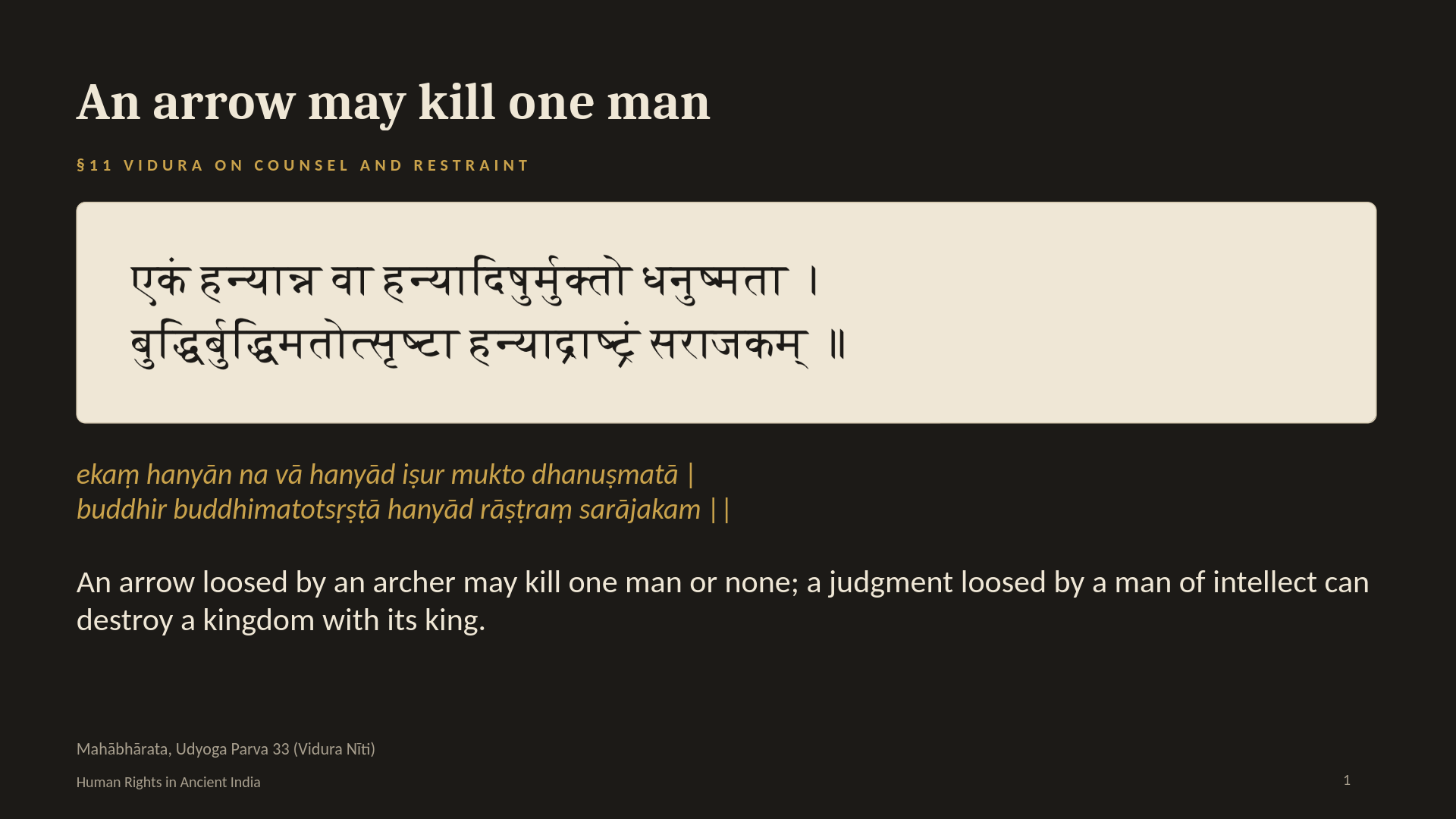
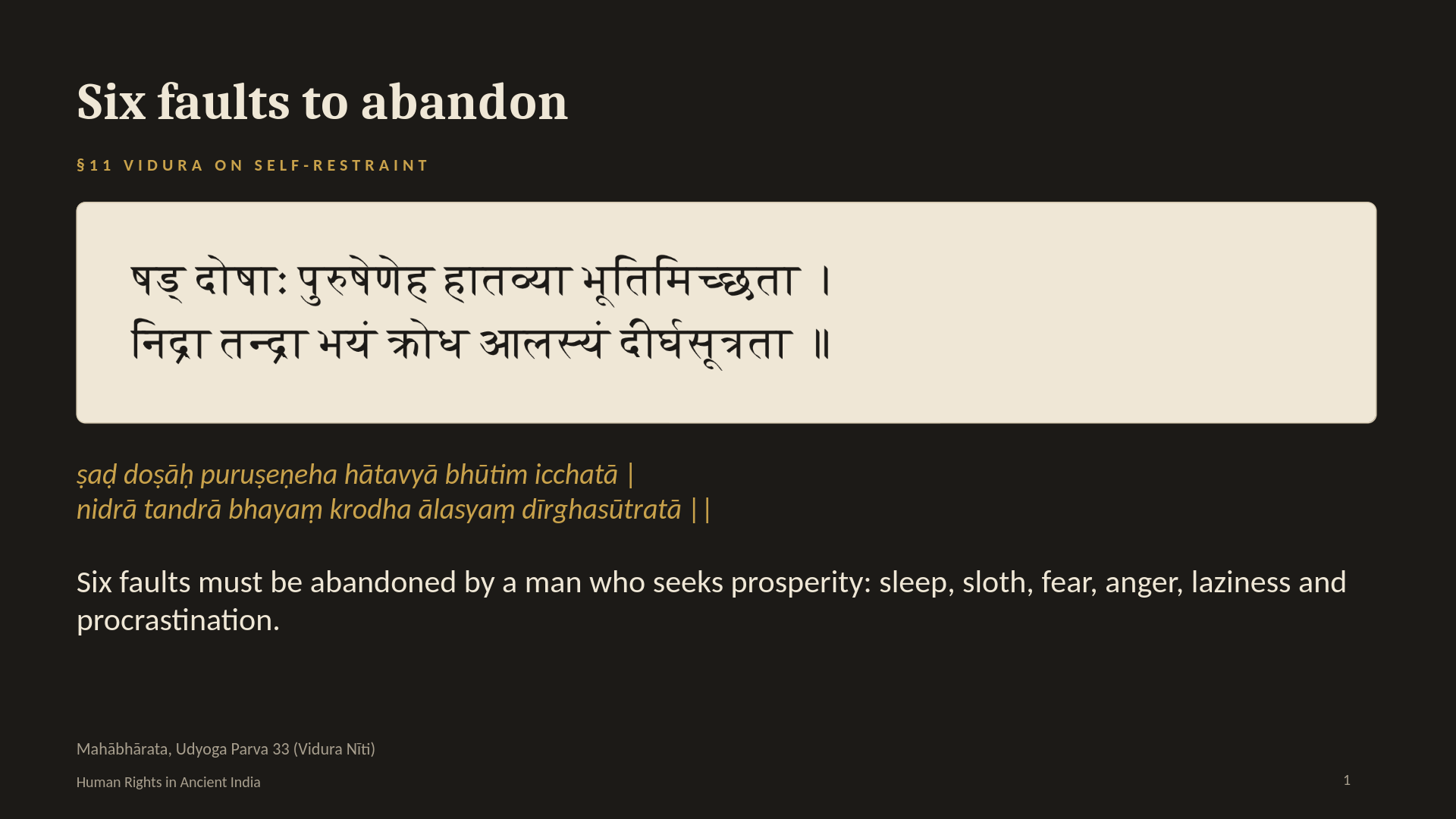
Vidura repeatedly counsels Dhṛtarāṣṭra on self-restraint. Vidura says that a King who cannot control his own anger, greed, and partiality will destroy his people. Vidura says a king must never harm the weak, the dependent, the elderly, women, children, brāhmaṇas, and anyone who has sought refuge. He warns that a kingdom where the innocent are punished and the guilty go free is one where dharma has died. Straying away from these values will bring destruction on the kingdom.
An important concept that is reinforced in different ways, is that this is not a…
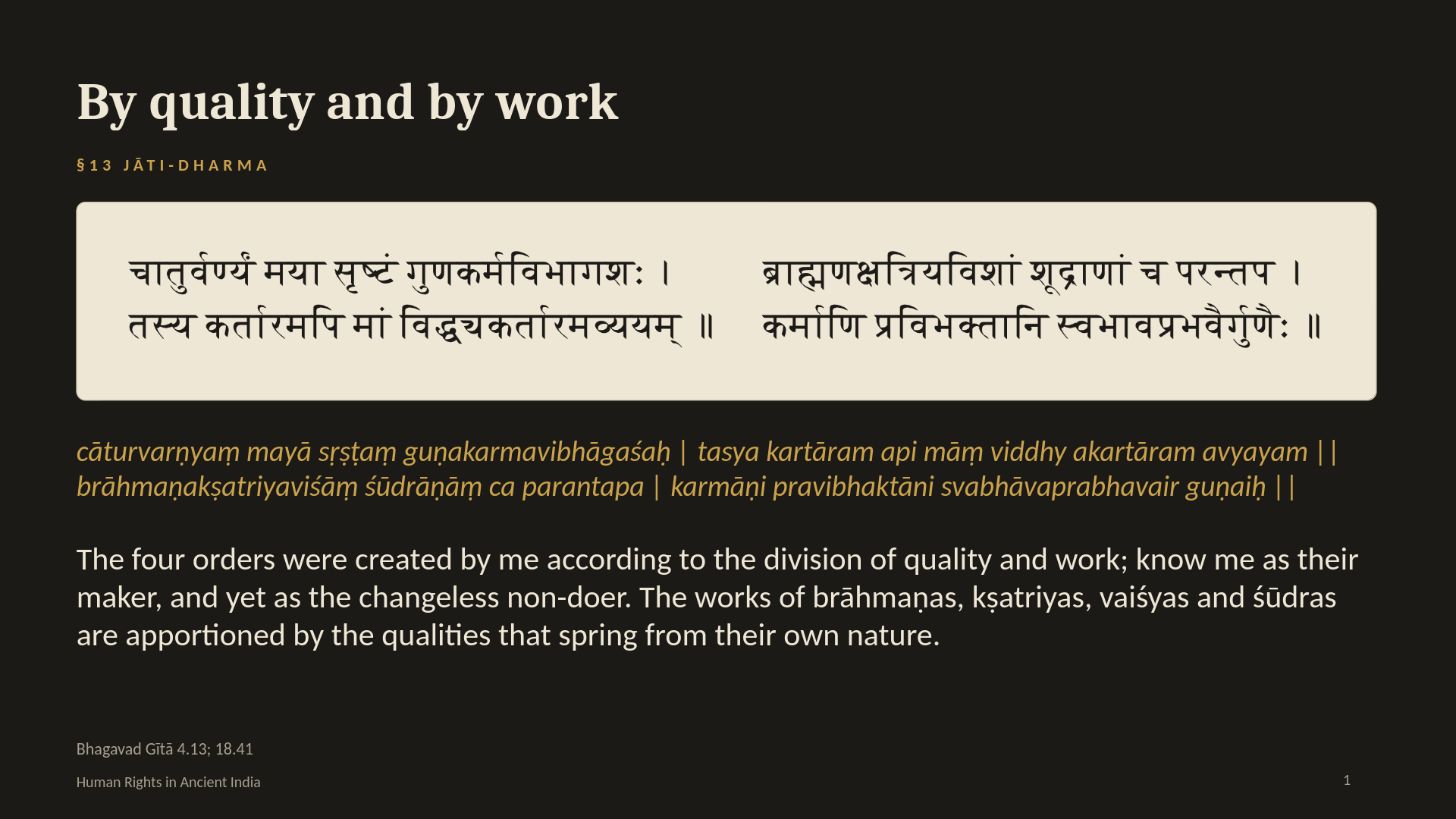
An important concept that is reinforced in different ways, is that this is not a civilisation of entitlements. It is about dharma, or the responsibility of the state and the citizen. Every subject has their own svadharma or self-dharma and this is different from the king's rājadharma but no less binding. The rights the Hindu texts secure to citizens are inseparable from the duties they lay on them. Firstly, there is jāti-dharma, where the individual has responsibility to the community into which they are born. Hindu belief system says that a person is born into a family and with certain innate skills based on their previous Karma. But they control what they do and what kind of character they develop.


Featuring:

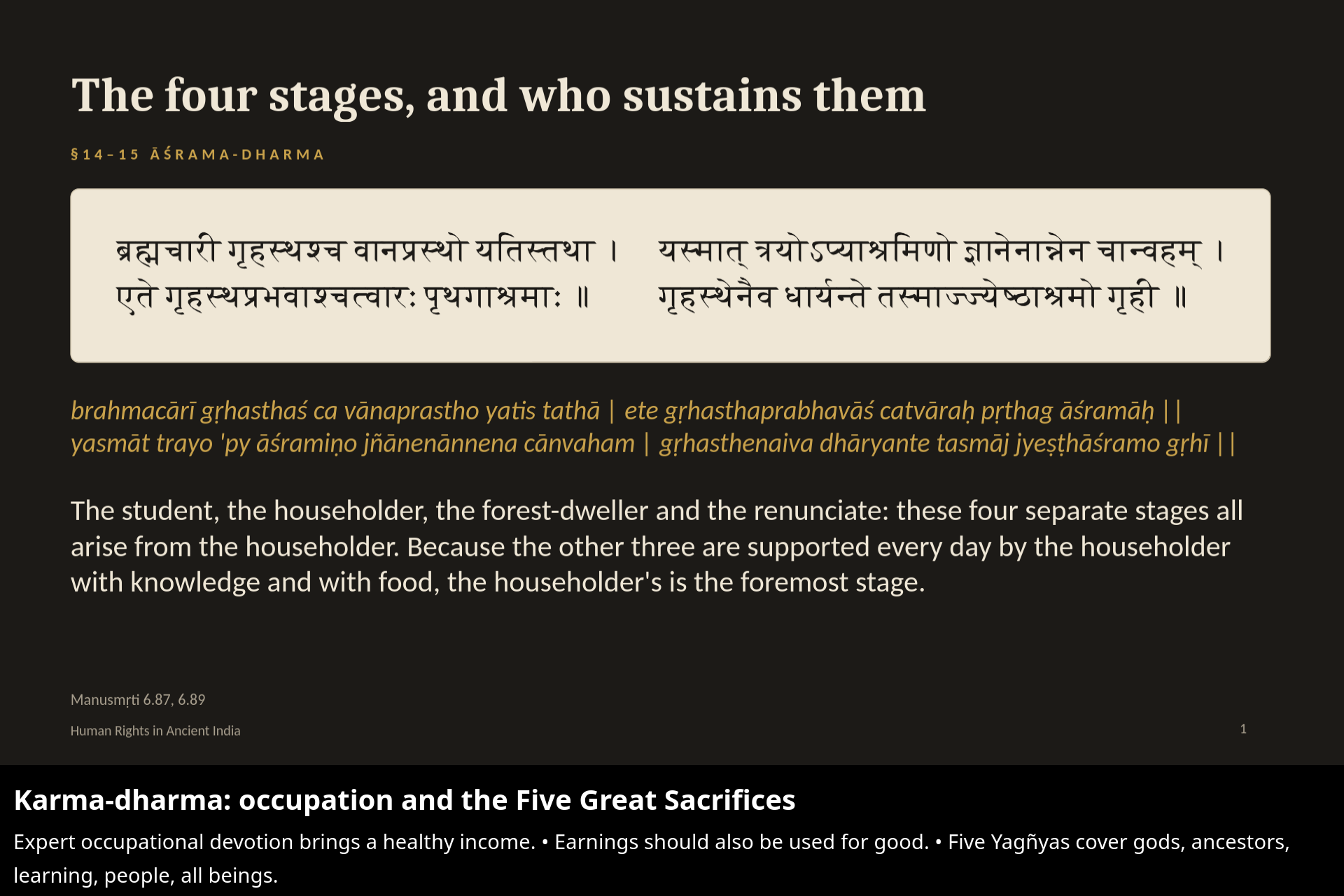
Secondly, there is the āśrama-dharma. There are four āśrama levels or stages in life.
The Brahmacharya āśrama is when an individual is a student, unmarried, and dedicated to learning. The second level, Gṛhasthāśrama, is the life of a householder. In this stage, the individual is married with or without children. The third level is Vānaprasthāśrama which is a retired life focused on getting to the fourth stage. The fourth level is Sanyāsāśrama which is renouncing the world to focus on the Divine and their own true nature.


Each of these āśrama levels has specific responsibilities. A Brahmachārī is expected to be mentally…
Each of these āśrama levels has specific responsibilities. A Brahmachārī is expected to be mentally unadulterated, focused on learning, and untouched by desires. A Gṛhastha is expected to be loyal and devoted to their family while focusing on doing good for all beings. Of the four levels, the people at this level are the ones who principally earn money. So, the burden is on them to fund the people in the other levels. A Vānaprastha dweller is focused on learning, leads a frugal life, and generally withdrawn from society. A Sanyāsi is someone who has given up all connections to the world and focuses on the Divine. This could be any or all of the many ways enunciated in detail in the Śrīmad Bhagavad Gītā. This may include prayer, scriptural study, humanitarian work, environmental safeguards, animal protection, etc.

Thirdly, each citizen is required to follow karma-dharma or occupational devotion. The citizen becomes an expert through such devotion and, with the right environment provided in the kingdom, can earn a healthy income. Apart from their familial needs, they are supposed to use their earnings for good. Śatapatha Brāhmaṇa and others define good actions as Pancha Mahayagñya or Five Great Ways of Sacrifice for Doing Good. These are Deva Yagñya or Divine responsibilities such as prayer, maintaining temples, performing sacrifices, etc. Pitṛ Yagñya is the responsibility towards our ancestors, which includes living parents and ancestors. Brahma Yagñya or Riśi Yagñya is the support of education, especially Vedic education. Manuśya Yagñya is the service towards humanity. Bhūta Yagñya is service towards all living beings, including the environment.

Featuring:

Fourthly, each citizen is expected to exhibit good character called guṇa-dharma. It includes everything from…
Fourthly, each citizen is expected to exhibit good character called guṇa-dharma. It includes everything from following legal procedures to fulfilling minimal responsibilities like paying taxes or voting, where the polity provides for it.
Fifthly, each citizen is expected to perform sādhāraṇa-dharma or behaviours expected of human beings. Maintaining cleanliness, developing contentment, self-discipline, self-study, and devotion to the Divine are considered the minimal expectation of every human. Patañjali covers this in detail in the Yoga Sūtras (2.32, the niyamas) and the details are available in this article on Yoga. Manu lists ahimsa or not injuring other beings, truthfulness, not taking what is another’s, purity, and restraining the senses.
It is in the interest of the King to ensure that people stay loyal to their svadharma. Order in the kingdom was not imposed from the throne alone. It rested on every person keeping to their own dharma, and on a king whose own dharma was to guard that right of the citizen to follow their dharma. This ancient form of the idea and other concepts are covered in Indian Constitution. A citizen's rights are matched by duties, and it is also why the tradition's remedy for a wrong was so often an appeal to the wrongdoer's dharma before an appeal to the king's daṇḍa.


