|
The Indian Analyst
|




South Indian Inscriptions |
EPIGRAPHIA INDICA
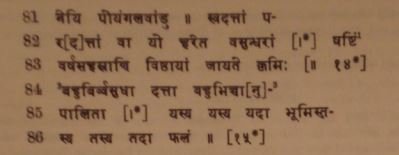
ABRIDGED TRANSLATION. Verse 1 praises king Kubja-Vishṇu, the ornament of the race of the Moon. His servant was Buddhavarman, the ornament of the Chaturthâbhijana, i.e. of a family belonging to the fourth (Śûdra) caste (v. 2 f.). (V. 4.) “ He to whom enemies bowed, (and who resembled) Vâsava (Indra) in happiness, protected the country west of the hill, which contained seventy-three villages, (and which he had) received through the favour of the king along with his royal emblems.” (V. 5.) “ After some ancestors had passed away, there was born from that family king Maṇḍa [I.], the crest-ornament of rulers of provinces (maṇḍalêśvara) ; (and) from Maṇḍana was born king Gaṅga.” His son was Maṇḍa [II.] (v. 6), who married Kundâmbikâ (v. 8). Their son was Buddharâja (v. 9). His sister Aṅkama was the wife of Râjêndra-Chôḍa, the son of Goṅka (v. 11 f.). (V. 13.) “ In the Śaka year counted by the powers (3), the Nandas (9), the sky (0), and the moon (1),─ (i.e. 1093),─ and at the great Saumyâyana,[4] the high-minded king Buddha himself gave to (the god) named Paṇḍîśa, who resides at Dhanadapura in the country of Velanâṇḍ[u], a field (of) two khaṇḍukas[5] in the town of Nâdiṇḍla for (providing) offerings uninterruptedly for a very long time, and a perpetual lamp.”
(Line 56.) “ Hail ! The glorious Mahâmaṇḍalêśvara Koṇḍapaḍmaṭi-Buddarâja, who was possessed of all the glory of such names as the Mahâmaṇḍalêśvara who has obtained the five great sounds ; the worshipper of the divine lotus-feet of Kulôttuṅga-Chôḍadêva ; the destroyer of hostile armies ; the lion of the mountain─ the Durjaya family ; a Hariśchandra in truthfulness ; a Paraśurâma on (keeping) vows ; Aniyaṅka-Bhîma ; a Râdhêya (Karṇa) in truthfulness ; a Gaṅgêya (Bhîshma) in purity ; Eladâyasiṁha ; a Nṛisiṁha in valour ; the season of spring to the forest─ virtuous men ; a Jayanta to (the eyes of) women ; a Brahmâ in wisdom ; the ruler (of the country) west of the hill ; he who delights in making gifts and in (fighting) battles ; he who is fond of musk ;[6] a Vatsarâja in (the management of) horses ; and a Cupid among kings,─ in the Śaka year 1093, on the occasion of the Uttarâyaṇa,─ gave to the god Paṇḍîśvara-Mahâdêva at Dhanadaprôlu 2 kha[ṇḍi] of land at Nâdiṇḍla for (providing) offerings.” (L. 73.) “ To the same god (he) gave 55 sheep for a perpetual lamp. Having received these (sheep),─ Sûrya-Bôya, the son of Châmena-Bôya, standing security,[7]─ Bhîmana-Bôya, the sonM __________________________________ | ||||||||||||||||||||||||||||||||||||||||||||||||||||||||||||||||||||||||||||||||||||||||||||||||
 º.
º. º.
º.| > |
|
>
|