|
The Indian Analyst
|




South Indian Inscriptions |
EPIGRAPHIA INDICA descendants of the Teliki family (l. 92). These were subdivided into a thousand families, ten of which are mentioned by name (l. 90 f.), and were hereditary servants of the Eastern Châlukya family (v. 38 f.). They were believed to have immigrated with the mythical king Vijayâditya of Ayôdhyâ[1] (v. 40) and to have settled at Vijayavâṭa[2] (the modern Bezvâḍa), which seems to have been the former capital of the Eastern Châlukyas (v. 41). The Bhâvanârâyaṇa temple at Bâpaṭla bears two inscriptions (Nos. 189 and 192 of 1897), dated in Śaka-Saṁvat 1076 and recording gifts by two merchants who were members of the Teliki thousand (Teliki-vêvuru). The first of these merchants belonged to the subdivision (gôtra) of the Musunûllu, and the second to that of the Velandunûllu, who are perhaps identical with the Velumanûllu of the Ṭêki plates (l. 90). I subjoin the beginning of the second inscription ; that of the first is identical with it. It will be seen from the following transcript that this caste claims to have ruled over the towns of Ayôdhyâ and Bejavâla, with both of which it is associated also in the Ṭêki plates (v. 40 f.). Svasti [||*] Y[a]ma-niyama-[dharmma]-pâ(pa)râ[ya*]ṇa-[B]rahma-saṁbhba(bha)va-Manuvaṁś-[â]di-śa(sa)kala-[śâstra]-viśâraduluṁ Ganakâpuray-Ayôdhyâpura-Ga[ja]pur-âdhi-nâyakulu[ṁ] satya-śauch-âbhimânulu [g]uru-dêva-pâd-ârâdhakulu Paulasti-bhagavatî-sthâna-pra[t]ishṭi(shṭhi)tulu si(sa)hasra-śâkh-ânvaya-gôtrul=aina śrîma[d*]-Bejavâla-sâ(śâ)sanul= aina Teliki-vêvurayâṁdu Velaṁdunûlla gôtruṁḍ=aina Sûri[se]ṭṭi, etc. The composer and the writer of the Ṭêki plates (l. 108 f.) were the same persons as in the case of the Chellûr plates (l. 114) and the Piṭhâpuram plates (l. 280) of Vîra-Chôḍa.
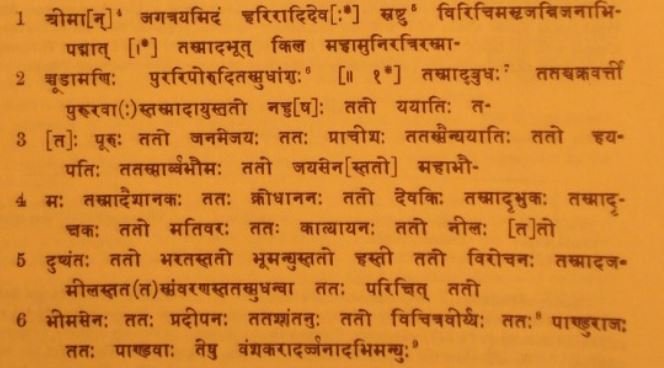
TEXT.[3] First Plate.
___________________________________________________ | ||||||||||||||||||||||||||||||||||||||||||||||||||||||||||||||||||||||||||||||||||||||||||||||||
 º.
º. º.
º. the vowel-sign u is attached to either s.
 : (l. 7).
 : have been entered subsequently.
 º.
º.
| > |
|
>
|