|
The Indian Analyst
|




South Indian Inscriptions |
EPIGRAPHIA INDICA
TRANSLATION.
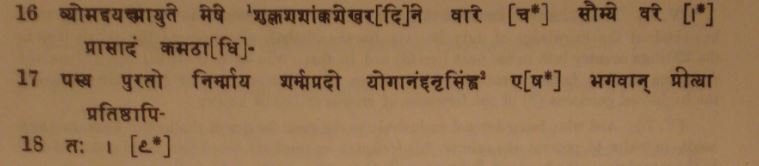
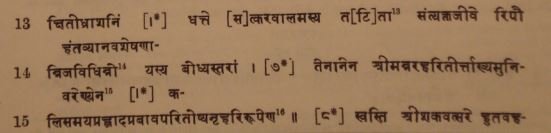
(Verse 1.) The god (Vishṇu), (who is) the recipient of the abundant dalliance of the goddess Kamalâ (Lakshmî),─ in order to protect those whose only refuse are his divine lotus-feet on the whole surface of the earth where men were oppressed by the suffering produced by the Kali (age), (and) where the rise of knowledge had ceased,[3]─ took birth (in the person of) a great saint (mahâtîrtha) named the holy Purushôttama, a pious ascetic (and) a leader of the wise.[4] (V. 2.) The commentary (bhâshya)[5] pronounced by this sage is, indeed, worthy of being repeated by crowed of chiefs of saints (tîrthika), (and) a goad on every frontal globe of the furious elephants─ proud disputants.[6] (V. 3.) From the pair of lotus-feet of this (Purushôttama), which is worthy to be worshipped by crowds of sages, was produced[7] the ascetic Ânandatîrtha, who caused the rising of the moon of wisdom,[8] (and) whose hand was adorned with a staff[9] held (in it), (and who was therefore) able to lead on the easily distinguishable path[10] the cows of Vyâsa,[11] which had been enticed on the wrong path by ignorant men.[12] (V. 4.) The charming speech proceeding from his mouth (and) consisting of words arranged in a charming manner resorts to the lotus-foot of (Vishṇu) the lord of Kamalâ, which destroys the fear of rebirth of (its) devotees. (V. 5.) The speech of the holy preceptor (Bhagavatpâdâchârya) Ânandatîrtha (leads) indeed (already) in this life to the attainment of the pair of lotus-feet of Hari (Vishṇu).
___________________________________________________________ | ||||||||||||||||||||||||||||||||||||||||||||||||||||||||||||||||||||||||||||||||||||||||||||||||
 is engraved very faintly. The letters can however be read from the
back of the estampage.
is engraved very faintly. The letters can however be read from the
back of the estampage.
 .
.

| > |
|
>
|