


South Asia. South Asia is a geographically diverse and densely populated region of Asia, comprising Afghanistan, Bangladesh, Bhutan, India, Maldives, Nepal, Pakistan, and Sri Lanka. At one time, the whole of South Asia, along with Myanmar, was considered the civilizational nation of Bhārat, now called India. Home to nearly two billion people, it is home to the towering Himalaya and Hindu Kush ranges, the fertile Indo-Gangetic plains, the arid landscapes of Afghanistan and Pakistan, the tropical forests of Bangladesh and Sri Lanka, and the island atolls of the Maldives. The region has a rich civilisational heritage shaped by Hinduism, Buddhism, Jainism, Islam, Sikhism, and other religious traditions.

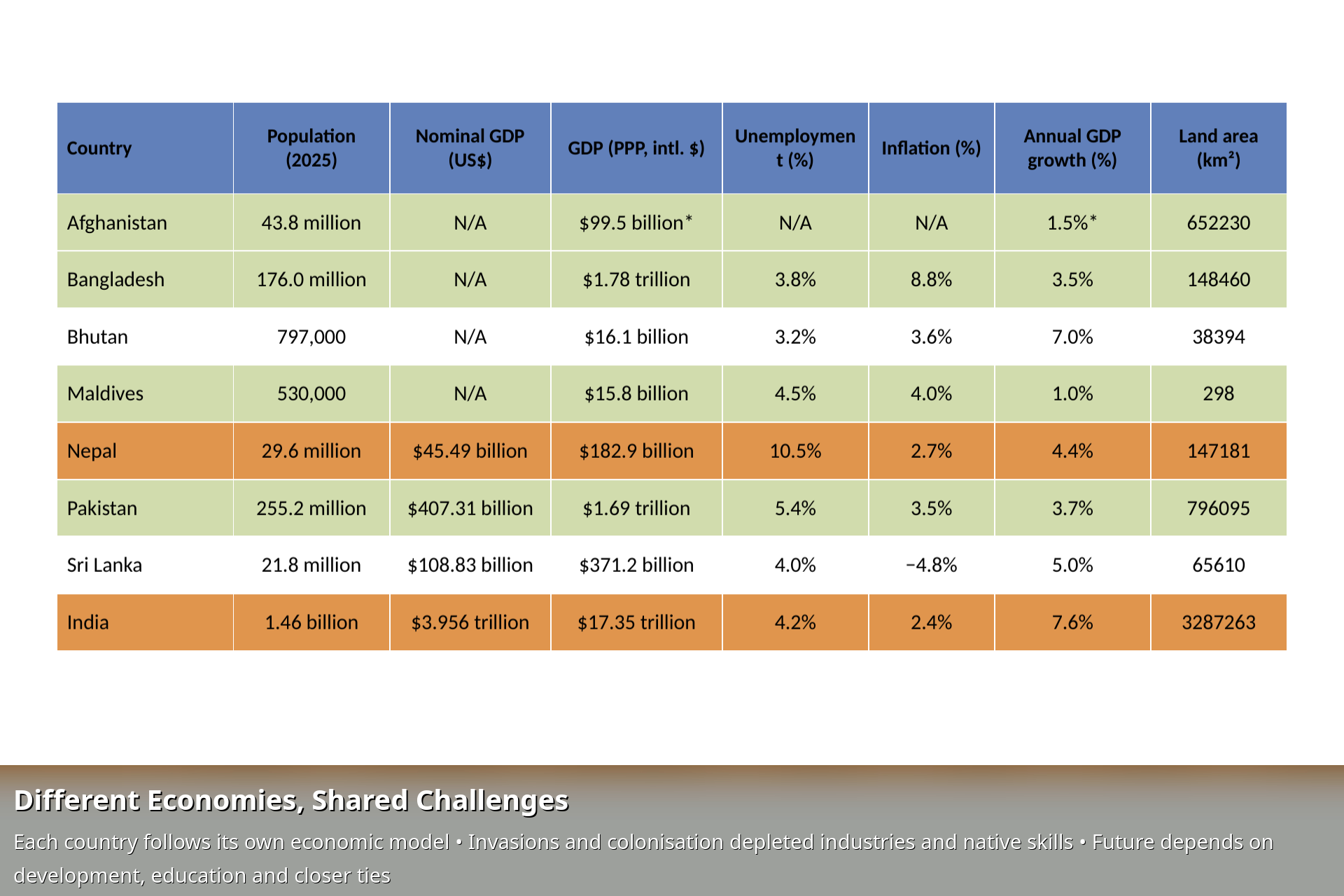
Snapshot of South Asian economies. It has millennia of trade, migration, and cultural exchange. Each country has a different economic model. India has a large, diversified, and rapidly expanding economy. Bangladesh has an export-dependent textile industry. Nepal and Bhutan leverage their hydropower potential through India’s funding and procurement of hydroelectricity. The Maldives is tourism-dependent. Sri Lanka is mostly tourism- and service-oriented. Pakistan is an economic basket case and mostly exports terror. Centuries of invasions from West and Central Asia, coupled with British colonisation, largely depleted well-developed industries and native skills. As a result, the region continues to face challenges such as poverty, uneven economic growth, employment, and infrastructure deficiencies. Its future will depend significantly on sustainable development, investment in education and healthcare, technological advancement, and stronger economic and diplomatic connections among its countries.
Featuring:





AfghanistanLocated at the intersection of Central and South Asia, Afghanistan is a landlocked country bordered…
Afghanistan
Located at the intersection of Central and South Asia, Afghanistan is a landlocked country bordered by Pakistan, Iran, Turkmenistan, Uzbekistan, Tajikistan, and Xinjiang of China. Its mountainous terrain, particularly the Hindu Kush, has shaped its history, settlement patterns, and transport links. Afghanistan possesses mineral resources, agricultural land in its valleys, and a long history of regional trade. But decades of conflict, political instability, and religious wars have severely constrained its economic development. Agriculture, livestock rearing, mining, and small-scale commerce remain important sources of livelihood. The country faces significant challenges in poverty reduction, food security, education, healthcare, and employment. Before the Taliban took over, India was the largest regional donor to Afghanistan, funding development projects across the country. Since then, it has sent humanitarian relief, including 47,500 tonnes of wheat, 200 tonnes of medical aid and vaccines, distributed with the UN World Food Programme. Improved infrastructure, political stability, and access to regional markets could greatly help Afghanistan leverage its strategic location and natural resources and transition towards economic growth.

BangladeshBangladesh is a densely populated country in the Ganga–Brahmaputra–Meghna delta, bordered largely by India, with…
Bangladesh
Bangladesh is a densely populated country in the Ganga–Brahmaputra–Meghna delta, bordered largely by India, with a smaller border with Myanmar and a coastline along the Bay of Bengal. Its fertile alluvial plains support intensive agriculture, particularly rice cultivation, while its rivers sustain fisheries, transport and livelihoods. Bangladesh has developed a major export-oriented garment industry, making manufacturing and international trade central to its economy. Agriculture, remittances from expatriate workers, and a growing services sector contribute to economic growth. Despite substantial progress in health, education, and poverty reduction, the country faces challenges in urban congestion, industrial working conditions, employment quality, environmental degradation, and religious intolerance. Its low-lying geography makes it particularly vulnerable to flooding, cyclones, river erosion, and rising sea levels.

BhutanBhutan is a small, landlocked Himalayan kingdom situated between India and Tibet. The steep mountains,…
Bhutan
Bhutan is a small, landlocked Himalayan kingdom situated between India and Tibet. The steep mountains, forested valleys, and extensive river systems support rich biodiversity. It also contributes to considerable hydropower potential, which it exploits through Indian financing and usage agreements. India budgeted ₹10,000 crore (more than US$ 1 billion) for hydroelectricity project investment by 2029. While giving annual aid of about ₹2,288.56 crore (about US$230 million) in its 2026–27 budget, India buys an equivalent value of hydroelectricity. Over 55% of Bhutan’s total Foreign Direct Investment comes from India. Tourism, agriculture and related services are also important revenue sources. The country is known for its developmental philosophy of Gross National Happiness. This concept places individual and national well-being, cultural preservation, and environmental conservation on par with economic progress. Bhutan has maintained extensive forest cover and pursued relatively cautious development policies. Bhutan faces challenges in employment, economic diversification, and migration management.

Featuring:


MaldivesThe Maldives is an island nation in the Indian Ocean. Located southwest of India and…
Maldives
The Maldives is an island nation in the Indian Ocean. Located southwest of India and Sri Lanka, it has a distinctive geography with numerous low-lying coral islands grouped into atolls. However, rising sea levels, coastal erosion, and degrading marine ecosystems make the Maldives highly vulnerable. Tourism is the principal driver of its economy, generating employment and foreign exchange. This industry also creates demand for transport, construction, and other services. Fisheries, especially tuna fishing, remain an important traditional economic activity. The country's natural beauty and marine biodiversity attract visitors from around the world. But heavy reliance on tourism exposes it to global economic disruptions and fluctuations in travel demand. For example, the island nation suffered greatly during the COVID pandemic as well as an Indian public boycott when Maldivian leaders, spurred by religious hatred, publicly badmouthed India as a country and Indians as a race. Despite rude behaviour from Maldivian ruling coalition leaders, India helped the island overcome financial liquidity and debt crisis by granting hundreds of millions of US dollars. In 2025, India also invested over half a billion US dollars in the Maldives’ infrastructure. Its development priorities include climate adaptation, sustainable tourism, waste management, food and energy security, reducing public debt, high infrastructure costs, and rising religious fundamentalism.

NepalNepal is a landlocked country situated between India and Tibet. It extends from the low-lying…
Nepal
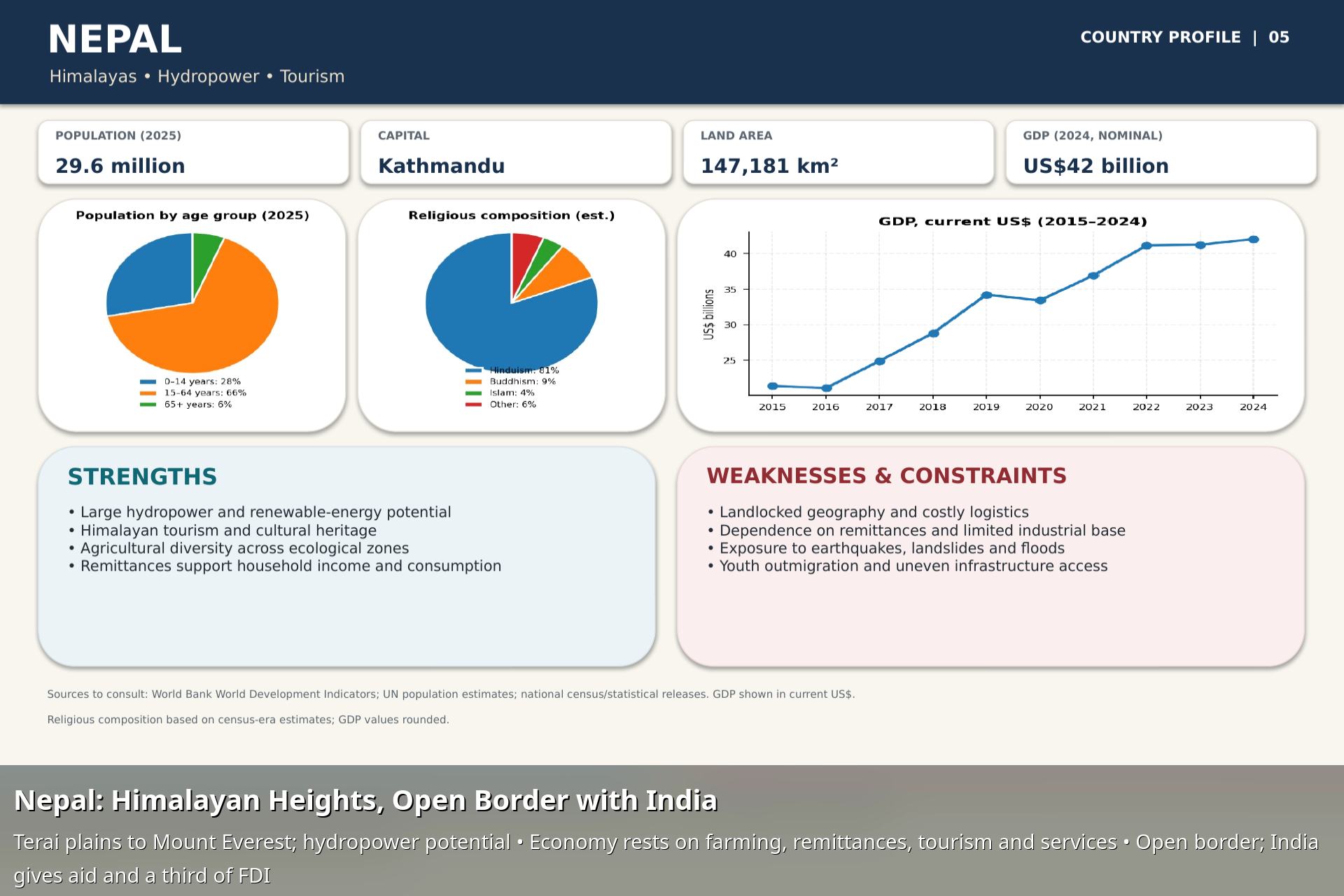
Nepal is a landlocked country situated between India and Tibet. It extends from the low-lying Terai plains to the Himalayan mountain range. The country is home to Chomolungma or Sagarmatha, now famously known as Mount Everest, the world's highest mountain above sea level. This dramatic variation in elevation gives Nepal exceptional ecological diversity and significant potential for hydropower, agriculture and tourism. The economy depends on agriculture, remittances from citizens working abroad, services, tourism and trade. Hindu and Buddhist traditions form the roots of its cultural heritage, while its mountains and trekking routes attract visitors internationally. Nepal has made progress in political representation, education and access to basic services, but it faces challenges in infrastructure, employment, industrial development, and outward migration. India allocated ₹800 crore (about US$85 million) in aid to Nepal in its 2026–27 budget and invested around US$809 million as Foreign Direct Investment in 150 projects. A third of total FDI received by Nepal comes from India. India and Nepal have an open-border arrangement that allows citizens of both countries to live and work in the other country with very few immigration restrictions. India has seven Gurkha regiments and 39 battalions with an estimated 32,000–40,000 Nepali citizens. Better transport links, investment in hydropower and more diversified domestic industries could strengthen its long-term economic prospects.
PakistanLike other South Asian countries, Pakistan was also a part of the Bharathiya civilisation state.…
Pakistan
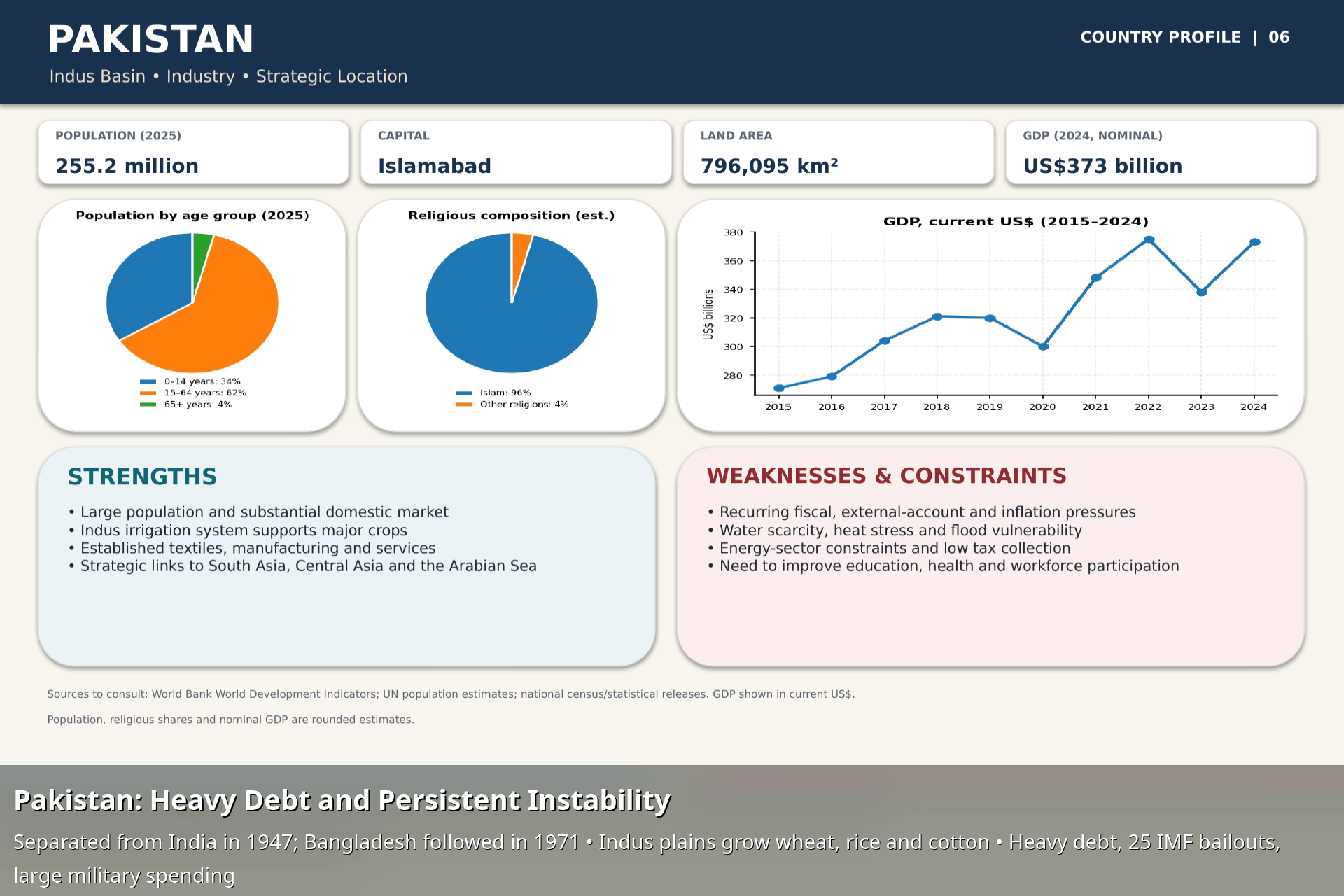
Like other South Asian countries, Pakistan was also a part of the Bharathiya civilisation state. But it separated from India in 1947 as a home to Muslims. Bangladesh was then called East Pakistan till it gained independence in 1971 with a new name and identity. Pakistan has India, Afghanistan, and Iran as its neighbours. With its illegal occupation of Kashmir, it also borders Xinjiang of China. Its geography ranges from the high mountains of the north, including parts of the Karakoram in its illegally occupied Kashmir and the Hindu Kush, to the fertile Sindhu (now called Indus) River plains, arid plateaus and coastal regions. Agriculture, textiles, manufacturing, services and overseas remittances from expatriate Pakistanis are important components of its economy. The Sindhu irrigation system supports major crops, including wheat, rice and cotton. The country claims to possess mineral resources, though this needs independent verification. It also claims to have renewable energy potential. Pakistan has a large, relatively young population, offering opportunities for economic expansion if education, skills and employment improve. However, most of the country’s money goes to service its large military. Many blame rampant corruption, which robs citizens of social amenities. Widespread mismanagement and misplaced priorities have nearly bankrupted its economy. It survives mainly on rolling debt agreements with Saudi Arabia, China, and the UAE. It owes billions of dollars to the World Bank, the Asian Bank, and the Islamic Development Bank. It has received 25 bailout packages from the International Monetary Fund. Persistent challenges include corruption, religion-oriented terrorism, inflationary pressures, fiscal constraints, energy shortages, water stress, climate-related disasters, and the need for sustained investment and economic stability. Pakistan is a very unstable country beset by insurgency in almost all its provinces and frequently teeters on the brink of disintegration.
Featuring:



Śrī LankaSri Lanka is an island nation in the Indian Ocean, located southeast of India.…
Śrī Lanka
Sri Lanka is an island nation in the Indian Ocean, located southeast of India. Its landscape includes central highlands, tropical forests, fertile agricultural areas and extensive coastlines. Positioned along major maritime trade routes, the country has a rich Hindu and Buddhist cultural heritage through millennia of commercial and cultural interaction with various Indian kingdoms. Its economy combines services, manufacturing, agriculture and tourism. Tea, rubber, coconut products, garments and other exports contribute to international trade, while tourism draws visitors to its beaches, wildlife reserves, historic cities and religious sites. While Sri Lanka has achieved comparatively strong social indicators in areas such as literacy and healthcare, its recent economic crisis exposed vulnerabilities in public finances, foreign-exchange availability and external debt management. During Sri Lanka’s recent economic crisis, India was by far the largest provider of assistance, with various financial packages, including more than US$7.5 billion in overall credit assistance and over US$880 million in grants. It also has an accumulated FDI investment of over US$2.94 billion. Economic recovery, export diversification, investment, and stable governance remain important priorities.

IndiaIndia is the largest country in South Asia by population, geographical area, and economy. It…
India
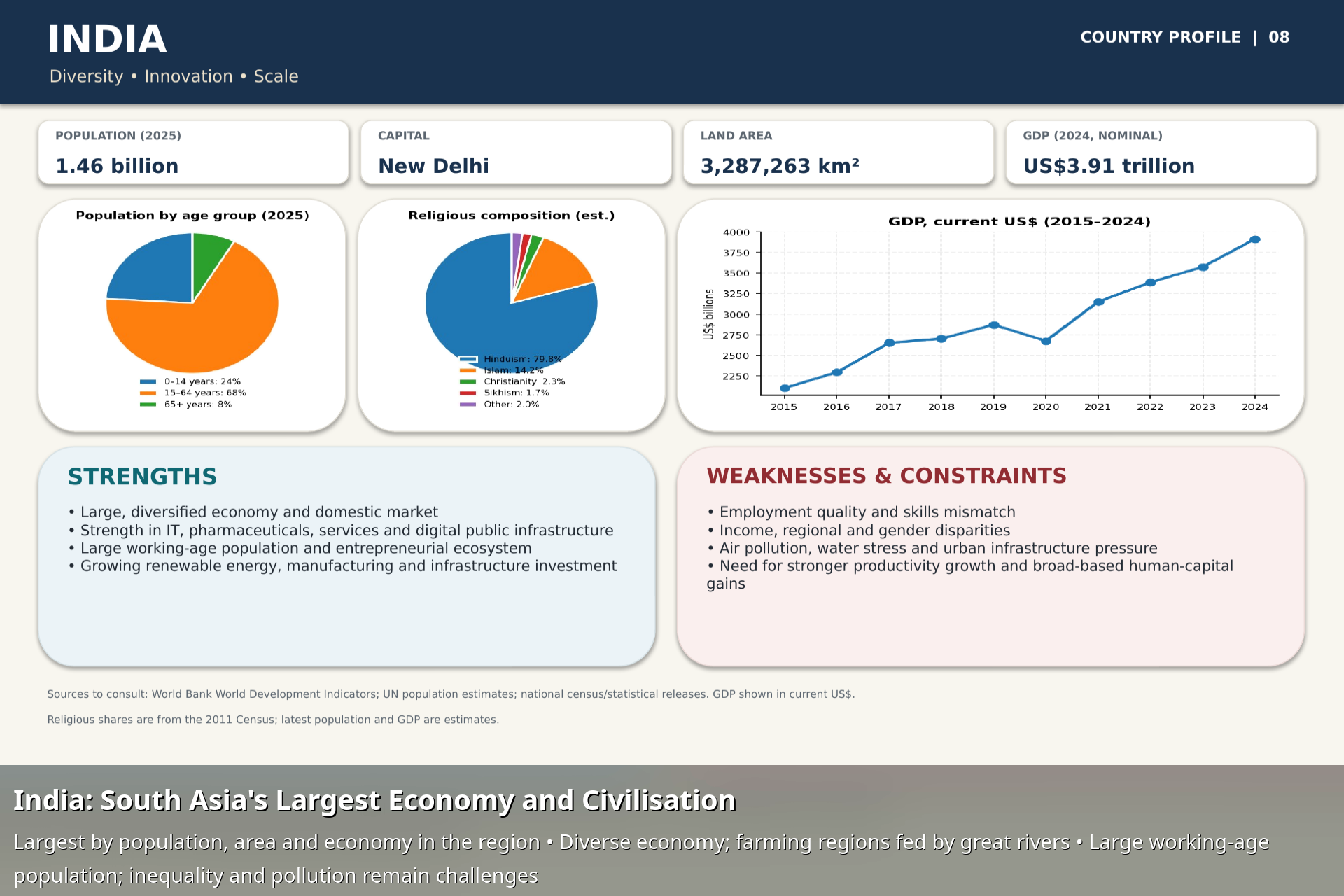
India is the largest country in South Asia by population, geographical area, and economy. It is the largest economy in South Asia, by both nominal GDP and purchasing-power parity. It stretches from the Himalayas in the north to the Indian Ocean in the south, bounded on the East by the Bay of Bengal and on the West by Sindhu Sāgar (Arabian Sea). It has multiple agricultural breadbasket regions, including the plains of the North irrigated by the Ganga and Yamuna, the Punjab in the West irrigated by the Sindhu River (Indus) tributaries, in the South by the Kaveri, Krishna, and Godavari Rivers, and in the East by the Brahmaputra River. Unlike other deserts, the Thar Desert is densely populated with many villages and towns. The Deccan Plateau is a vast elevated region of southern India, lying between the Western Ghats and the Eastern Ghats. Bounded by the Narmada River in the North, it extends across much of peninsular India with extensive river systems and long coastlines. India has a highly diverse economy spanning automobile, information technology, manufacturing, agriculture, pharmaceuticals, financial services, construction, oil refining, and a large domestic consumer market. It is the only surviving ancient civilisation and, over millennia, contributed philosophy, mathematics, astronomy, literature, art, and religious traditions that remain relevant even today. A large working-age population, propelled by expanding digital infrastructure and aspiration, are the right ingredient to accelerate development. At the same time, India must address wealth inequality, urban infrastructure, pollution, water security, and disparities in education and healthcare. According to Nigel Clarke, Deputy Managing Director of the International Monetary Fund (September 2026), India “has the potential to power the next wave of global growth.”