



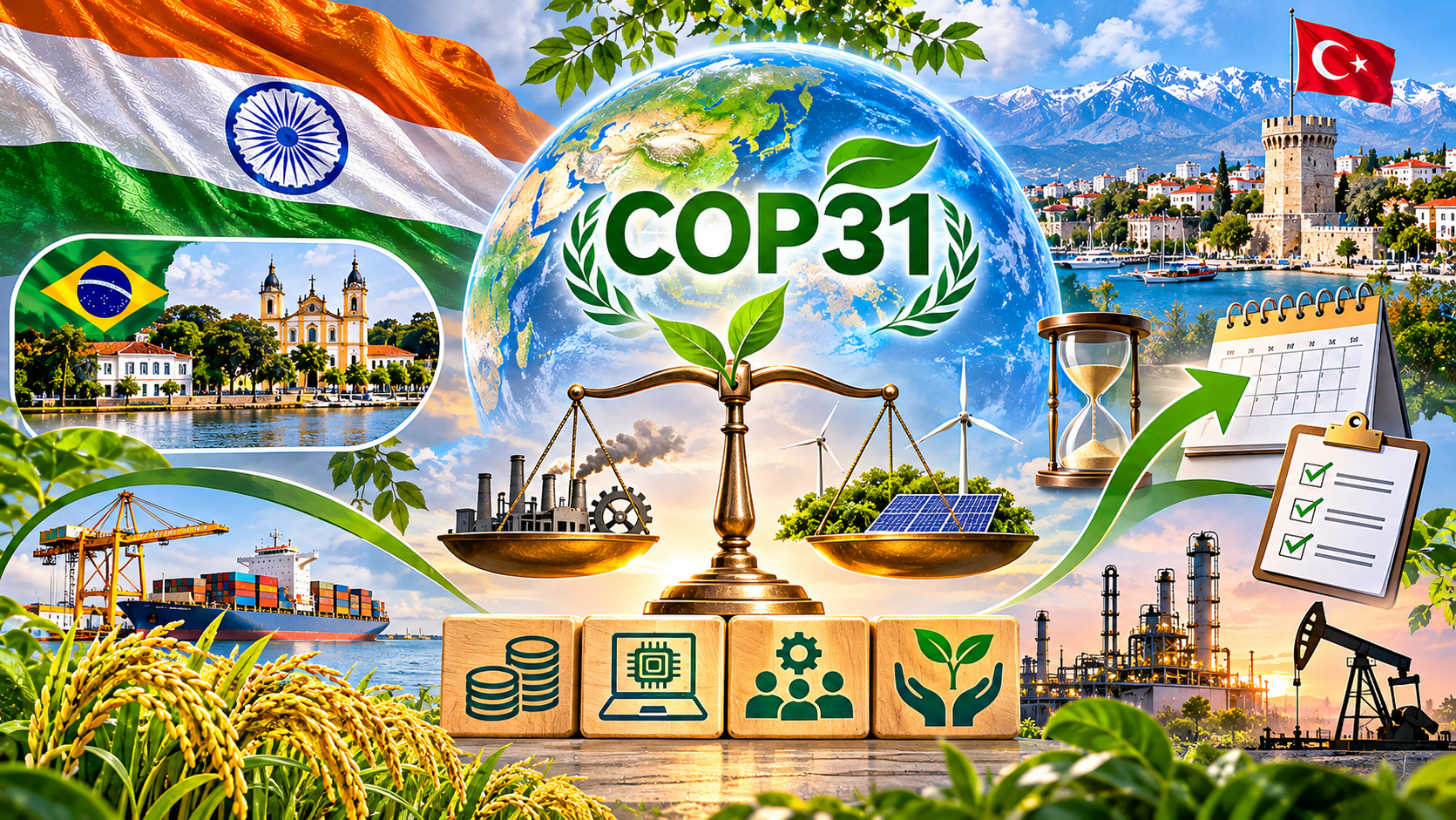
The thirty-first Conference of the Parties to the United Nations Framework Convention on Climate Change, or UNFCCC, called COP31, closed in Antalya, Türkiye, on 22 November 2026. The COP is the annual global summit at which nearly 200 countries negotiate action on climate change. COP31 closed without adopting its main political text, the proposed “Antalya Pact.” The talks ran from 9 November, overshot their deadline by about 48 hours, and became the longest UN climate summit on record. It was also the first COP held after the UN confirmed that the world is on course to overshoot 1.5°C. Several outlets called it the first breakdown of this kind since Copenhagen in 2009.
The collapse of the cover decision did not erase everything. Decisions on separate agenda items were adopted, including on adaptation, the Adaptation Fund, carbon markets, and transparency. A just transition decision kept the proposed Belém Action Mechanism inside the UN process, though its structure and funding were pushed to COP32.
Featuring:





Outside the formal text, Australia’s climate minister Chris Bowen said that more than 90 countries…
Outside the formal text, Australia’s climate minister Chris Bowen said that more than 90 countries had signed the presidency’s electrification pledge. Parties also agreed to hold dialogues in 2027 and 2028 on how the consensus-based process itself can be strengthened. This is a sign that the method of deciding is now under review.
The draft pact, although never adopted, shows where the debate stands. It acknowledged the expected overshoot of 1.5°C, reportedly a first for a UN climate text. It proposed raising electricity’s share of final energy use to 35% by 2035, from about 23% today. It set a large carbon-capture goal, reported as at least 500 million tonnes of CO₂ a year by 2035, and proposed an Antalya-to-Addis Ababa Roadmap on adaptation finance.
Featuring:



The decisive gap was fossil fuels. An early draft spoke of transitioning away from them,…
The decisive gap was fossil fuels. An early draft spoke of transitioning away from them, but the final version named no coal, oil, or gas. It only referred back to the 2023 Dubai agreement. The European Union, speaking through Ireland’s minister Darragh O’Brien, refused a text that, in his words, “greenwashes fossil fuels.” The UK, Norway, Panama, and island states such as the Marshall Islands and Vanuatu also objected. Russia and Saudi Arabia resisted any stronger wording. Since COP decisions need consensus, the pact fell.
Finance fared no better. The first draft proposed at least US$120 billion a year for adaptation by 2035. Later drafts kept only a promise to triple adaptation finance, with no baseline or figure. Loss and damage received no new pledges. A long-term finance decision was held up by the African Group, and a decision on the Global Environment Facility was delayed.
Featuring:



Accounts differ on how broad the opposition was. Peoples’ Review counts eight formal objectors, while…
Accounts differ on how broad the opposition was. Peoples’ Review counts eight formal objectors, while Vajiram & Ravi says more than 130 countries backed the EU’s stand. Either way, every unresolved issue now moves to Bonn in June 2027 and then to COP32 in Addis Ababa.
For developed countries, the outcome is a mixed ledger. The EU showed it was willing to walk away rather than accept weak language, something it had stopped short of doing at COP30 in Belém. That protects its position on fossil fuels, but at a cost. Civil society groups and developing countries accuse the same bloc of blocking progress on finance, adaptation, and just transition. The EU’s own record is also under scrutiny, since it has softened its 2035 car phase-out and delayed methane import rules during an energy crisis.
Featuring:

In the short term, rich countries avoid a new quantified adaptation commitment within the US$300…
In the short term, rich countries avoid a new quantified adaptation commitment within the US$300 billion a year they owe by 2035. In the longer term, they carry the reputational burden of unmet finance. The United States, having left the Paris Agreement and given notice to leave the UNFCCC, was absent, which leaves Europe to defend the developed-country position largely alone. Trade is becoming the next arena. The EU’s carbon border tax now faces a WTO panel brought by Russia, with 28 members watching as third parties.
The Global South is not one voice, and Antalya exposed the split. Small island states and Panama stood with the EU, because for them a text silent on fossil fuels is a threat to survival. Large emerging economies and oil producers opposed explicit phase-out language and put finance and equity first. The African Group noted that the draft did not recognise Africa’s special circumstances. As China’s delegation head put it, developing countries lost outcomes they wanted when the cover text failed.
Featuring:
What unites these countries is the money that did not arrive. Developing countries’ needs are…
What unites these countries is the money that did not arrive. Developing countries’ needs are estimated at US$455–584 billion a year, with adaptation alone needing US$310–365 billion a year by 2035. Without a quantified adaptation target or fresh loss and damage funds, vulnerable states such as Nepal may lean more on loans, adding to debt. The consolation is that the Antalya–Addis Ababa adaptation finance road map survives and the just transition mechanism is to be set up in phases, and that COP32 will be hosted in Addis Ababa, Ethiopia, in November 2027, where these demands will be central.
India spoke in Antalya for the Like-Minded Developing Countries and worked with the BASIC group. Its closing statement asked whose past and continuing emissions had used up the carbon budget. It argued that the draft set new targets for everyone while diluting the historical obligations of developed countries. It implied that the rich countries had refused to discuss finance in several negotiating rooms. Even so, India was prepared to let the text pass and later regretted that consensus was not reached.
Featuring:


The immediate effect on India is limited. No new binding language on coal or fossil…
The immediate effect on India is limited. No new binding language on coal or fossil fuels was adopted. Environment Minister Bhupender Yadav stressed that energy transitions must be nationally determined and that domestic climate action continues regardless. India also says it shaped draft wording that links methane action to food security and livelihoods.
The costs are less visible. India gains no additional adaptation or loss and damage finance despite its exposure to heat, floods, and crop losses. Its exporters still face the EU’s carbon border tax, which India has challenged repeatedly at the WTO.
Featuring:

COP31 will be remembered for the agreement it did not produce. The technical machinery kept…
COP31 will be remembered for the agreement it did not produce. The technical machinery kept moving, but the two questions that define climate politics, who stops burning fossil fuels and who pays, were left open. Developed countries held a line on ambition without matching it on finance. The Global South was left divided on fossil fuels and united in disappointment on money. India protected its policy space but gained little else. The real test now shifts to the Bonn climate talks and COP32 in Addis Ababa in 2027.
Sources: Down To Earth; IntelliNews; People’s Review; Open Magazine; Vajiram & Ravi; The Tribune; US News/Reuters
Featuring: