

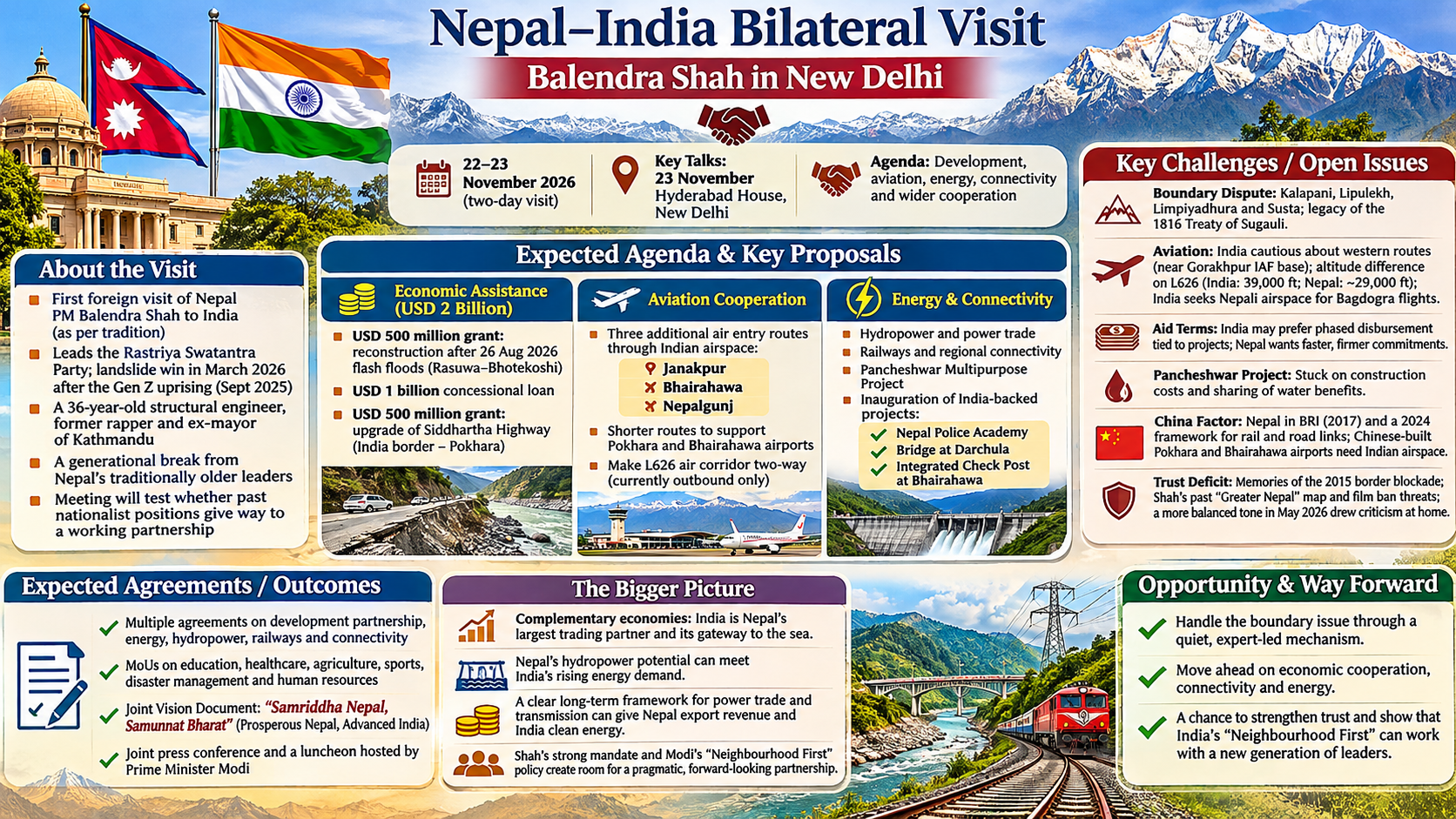
Nepal Prime Minister Balendra Shah is in New Delhi on a two-day bilateral visit to India on 22–23 November 2026. As is the custom with most of Nepal's leaders, his first foreign visit as Prime Minister is to New Delhi. Indian Prime Minister Narendra Modi will receive him at Hyderabad House for talks on 23 November.
Shah, a 36-year-old structural engineer, former rapper, and ex-mayor of Kathmandu, leads the Rastriya Swatantra Party, which won a landslide in the March 2026 elections after the Gen Z uprising of September 2025 brought down the K P Sharma Oli government. He represents a generational break. Traditionally, Nepali leaders are much older. From his mayoral years, he carries a record of sharp nationalist gestures against India. The meeting will give a first indication of whether that history will give way to a working partnership.
Featuring:





Economics is expected to dominate the agenda. Kathmandu has proposed a USD 2 billion assistance…
Economics is expected to dominate the agenda. Kathmandu has proposed a USD 2 billion assistance package, of which about USD 500 million would be a grant for reconstruction after the flash floods of 26 August 2026 that devastated the Rasuwa–Bhotekoshi corridor near the Tibet border. The proposal for the balance is a concessional loan of USD 1 billion or more and a further USD 500 million grant to upgrade the Siddhartha Highway linking the Indian border to Pokhara.
The second item on the agenda is expected to be aviation. Nepal wants three additional air entry routes through Indian airspace, at Janakpur, Bhairahawa and Nepalgunj. Most international flights currently enter at Simara after a long detour, which is expensive for airlines. Kathmandu wants additional entry points to shorten flights, improve traffic at the Pokhara and Bhairahawa international airports, and help bring development to other areas. Nepal also wants the L626 air corridor, open only to outbound flights since 2009, made two-way.
Featuring:


The third agenda item is expected to be energy and connectivity. Hydropower, power trade, railways,…
The third agenda item is expected to be energy and connectivity. Hydropower, power trade, railways, and the long-delayed Pancheshwar Multipurpose Project will likely be covered under this agenda point. Several India-backed projects are due for inauguration, including the Nepal Police Academy, a bridge at Darchula and an integrated check post at Bhairahawa.
Observers anticipate multiple agreements covering development partnership, energy, hydropower, railways and connectivity, alongside memoranda on education, healthcare, agriculture, sports, disaster management, and human resources. A Joint Vision Document titled "Samriddha Nepal, Samunnat Bharat" is expected to set long-term targets. A joint press conference and a luncheon hosted by Modi will follow the talks.
Featuring:


Notwithstanding the positive expectations, there are several open issues in the bilateral relationship. First, the…
Notwithstanding the positive expectations, there are several open issues in the bilateral relationship. First, the boundary dispute is the hardest problem and the least likely to be settled. Nepal claims Kalapani, Lipulekh and Limpiyadhura, which India administers, and the disagreement over Susta also remains. The quarrel traces to the 1816 Treaty of Sugauli and differing views on where the Kali River begins. It flared again in August 2025 when India and China agreed to resume the Kailash Mansarovar pilgrimage and border trade through Lipulekh, prompting diplomatic notes of protest from Kathmandu. The issue reportedly did not come up during Foreign Secretary Vikram Misri's recent visit to Kathmandu., which suggests both capitals may prefer to park it. Shah faces domestic pressure not to stay silent.
Second, the aviation issue is very contentious. India is cautious about the western routes because they pass near the Indian Air Force base at Gorakhpur. On L626, India has proposed that inbound flights cross at 39,000 feet, while Nepal wants about 29,000 feet. India in turn seeks Nepali airspace for civilian flights to and from Bagdogra in West Bengal. Kathmandu is open to this but wants a technical study first.
Featuring:


Third, the aid package raises a question of terms. India may agree in principle while…
Third, the aid package raises a question of terms. India may agree in principle while insisting on phased disbursement tied to specific projects. Nepal would prefer firmer, faster commitments, especially for flood reconstruction.
Fourth, Pancheshwar remains stuck on construction costs and the sharing of water benefits. Decades of delay have given anti-India politicians room to keep harping on promises on Pancheshwar that were never kept, despite India having helped Nepal on multiple fronts.
Featuring:


Fifth, behind every item sits China. Nepal joined the Belt and Road Initiative in 2017…
Fifth, behind every item sits China. Nepal joined the Belt and Road Initiative in 2017 and even signed a framework in December 2024 covering cross-border railway and road links. Chinese firms built the Pokhara and Bhairahawa airports that now need Indian airspace to become viable. New Delhi wants stable ties partly to limit Beijing's room for manoeuvre. Kathmandu wants to keep both relationships.
Sixth, trust is shaky. While India and Nepal have an open border that allows Nepalis to work in India unimpeded, anti-India politicians look to shape Nepali opinion by bringing up memories of the 2015 border blockade. As mayor in 2023, Shah displayed a "Greater Nepal" map and threatened to ban Indian films. However, his statement in parliament in May 2026 that encroachment had occurred on both sides marked a notable change of tone. Predictably, anti-India quarters criticised this notable change in position.
Featuring:

Regardless, the upside is considerable because the two economies are very complementary. India is Nepal's…
Regardless, the upside is considerable because the two economies are very complementary. India is Nepal's largest trading partner and its gateway to the sea. Nepal holds hydropower potential that a power-hungry northern India can absorb. A clear framework for long-term power trade and transmission would give Nepal export revenue and India clean energy.
Grants and cheap loans from India in the past have meant little to Nepal, which seems to value one hospital or airport built by China more.. Hence, India will have to negotiate hard and not necessarily rely on goodwill. What is given away free is not valued, and Nepal appears to illustrate this.
Featuring:
The biggest opportunity is Shah's strong mandate, with no coalition partners to placate and no…
The biggest opportunity is Shah's strong mandate, with no coalition partners to placate and no baggage from past negotiations. Modi has an interest in showing that India's "Neighbourhood First" policy can work with a new generation of leaders. A pragmatic prime minister in Kathmandu and a receptive one in Delhi could agree to handle the boundary through a quiet, expert-led mechanism while letting economic cooperation move ahead.
Sources: The Telegraph; BusinessLine; Deccan Herald; Outlook; Open Press; Business Standard
Featuring: