


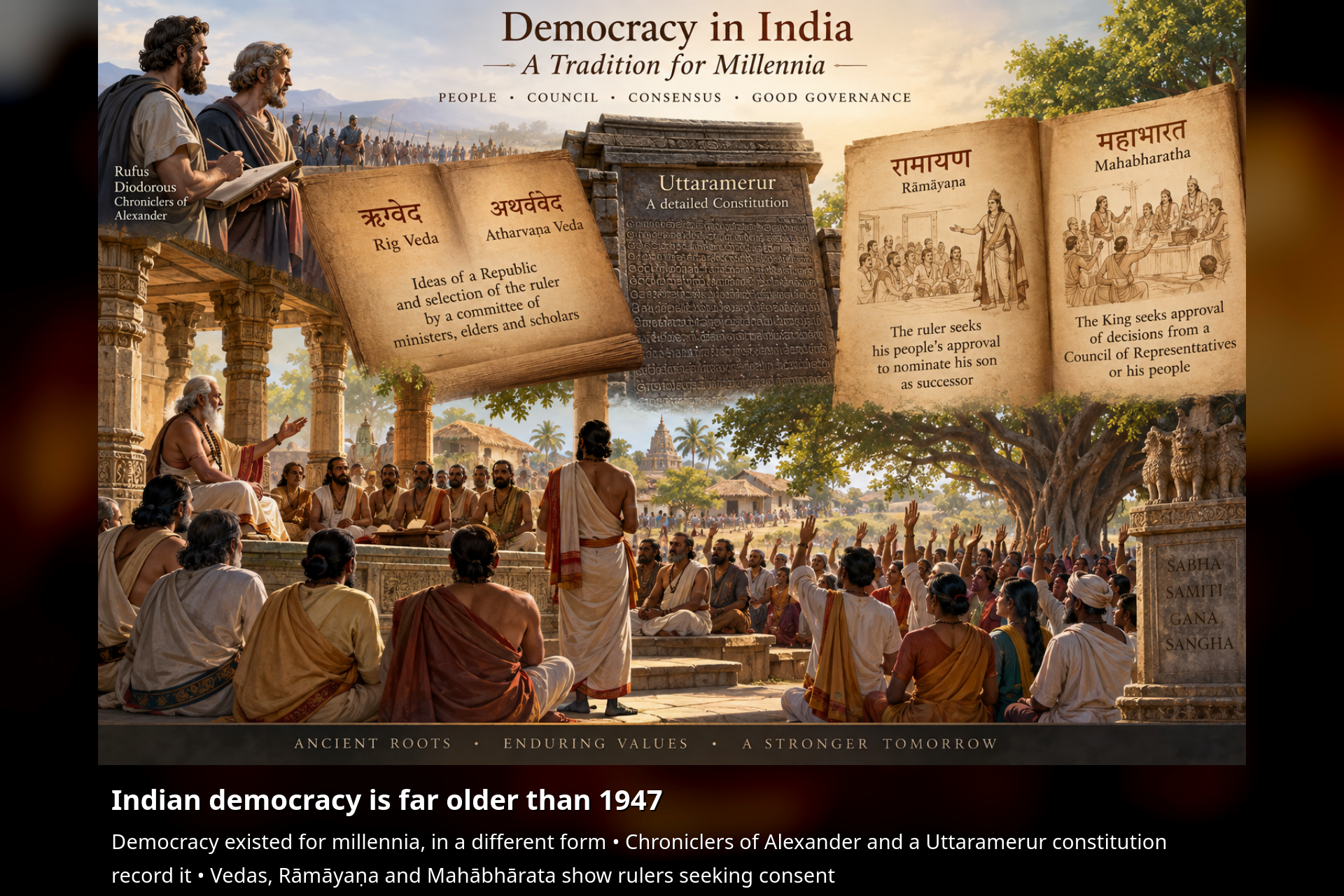
Contrary to modern perception, democracy in India did not start in 1947 when the country attained independence from the United Kingdom but existed for millennia albeit in a different form. An ancient form of democracy was documented by Rufus and Diodorus, chroniclers of Alexander of Macedon as well as by a detailed written constitution at Uttaramerur, inscribed in about 920 CE under the Chola king Parantaka I. The Ṛig and Atharvaṇa Vedas have definitions of a Republic and state cases where the ruler was chosen by a committee of ministers, elders, and scholars. The Rāmāyaṇa also provides an instance where the ruler asks his subjects to ratify his intention to nominate his son as his successor. The Mahābhārata also contains instances where the King seeks approval of decisions from either a Council of Representatives or of his people.
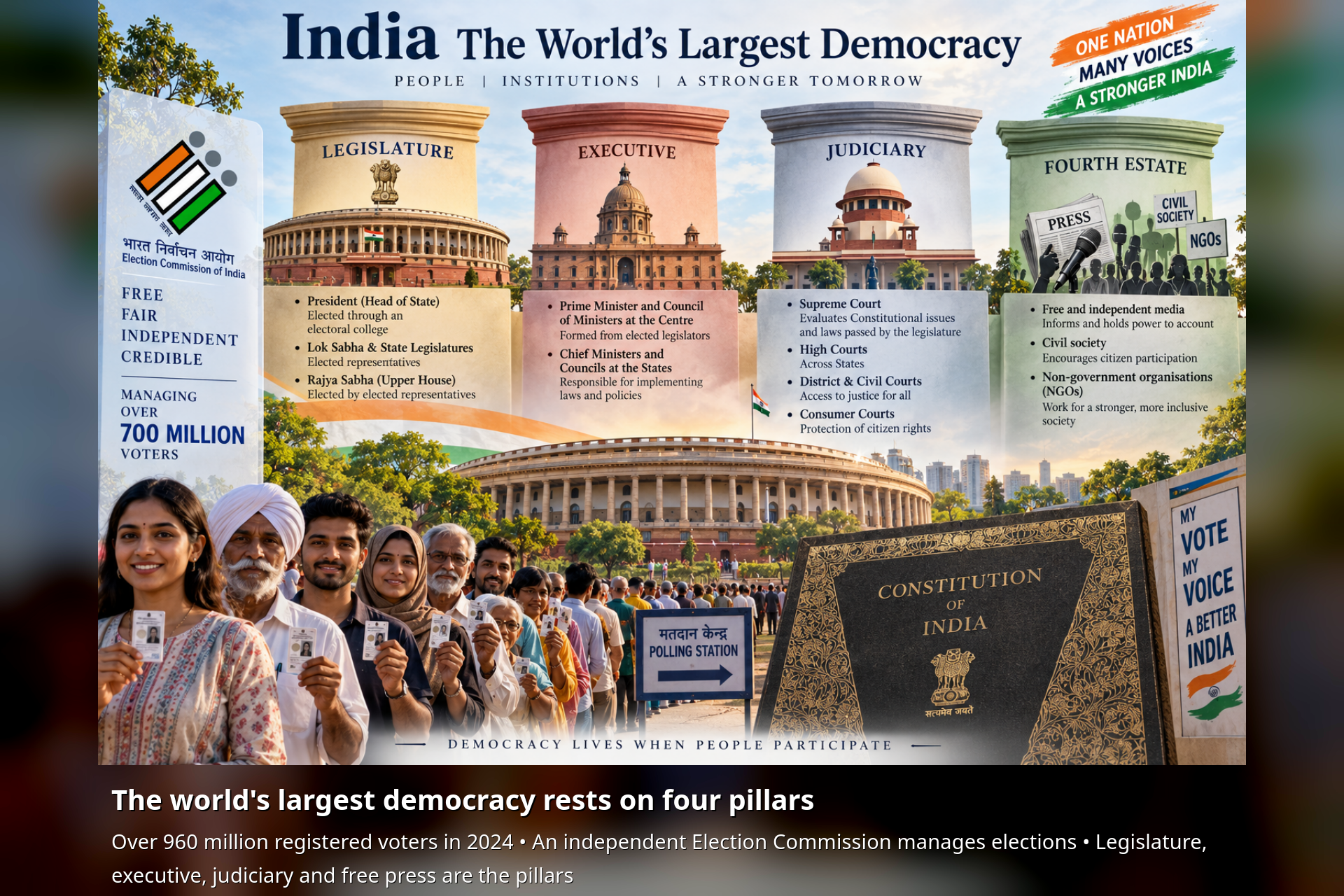
Modern-day India is the largest democracy in the world with over 960 million registered voters (2024). Elections are managed by an independent Election Commission of India (ECI) that cannot be manipulated by politicians, the administration, or officers of the government. The unique aspect of the Indian democracy is that it is built on four pillars. The Office of the President, the Head of State, is elected through an electoral college. The first pillar is the legislature, which consists of elected representatives at the national and regional level. In addition, there is an Upper House most of whose members are elected by the elected members of the State legislatures (twelve are nominated by the President). The second pillar is the executive formed from an elected set of legislators at the Central and State level. The third pillar is an independent multi-level judiciary ranging from the Supreme Court that evaluates Constitutional issues and laws passed by the legislature to the local Civil Court and consumer courts. The fourth pillar is the so-called fourth estate that consists of a free press, civil society, and non-governmental organisations.
Featuring:





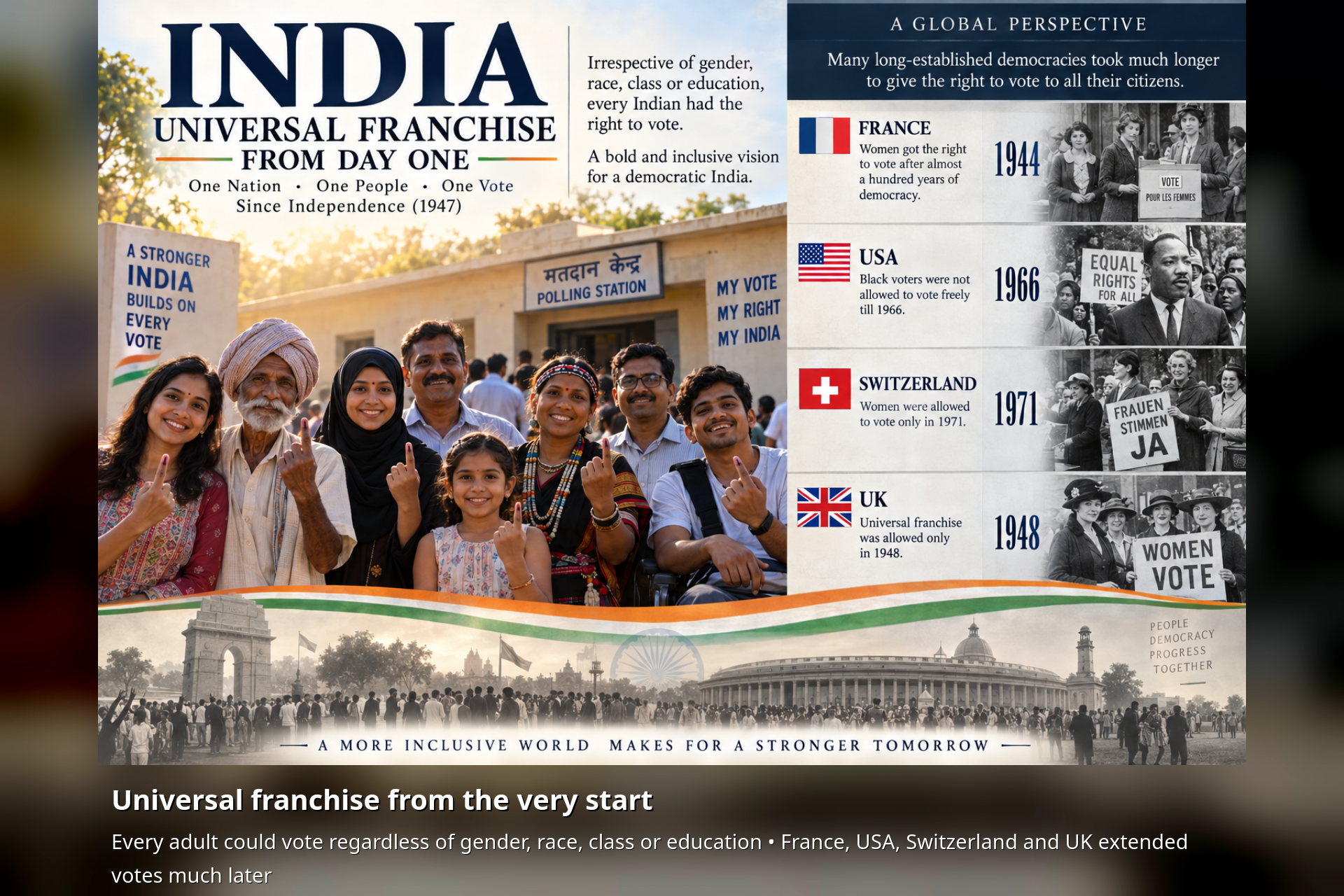
Unlike in most other countries, modern Indian democracy started with universal franchise. Irrespective of gender,…
Unlike in most other countries, modern Indian democracy started with universal franchise. Irrespective of gender, race, class, or education, every adult Indian had the right to vote. France allowed women to vote only in 1944, well over a hundred years after it became a democracy. Black voters in the USA were not allowed to vote freely till 1965. Switzerland allowed women to vote in federal elections only in 1971. The UK granted equal adult franchise in 1928 and abolished plural voting only in 1948.
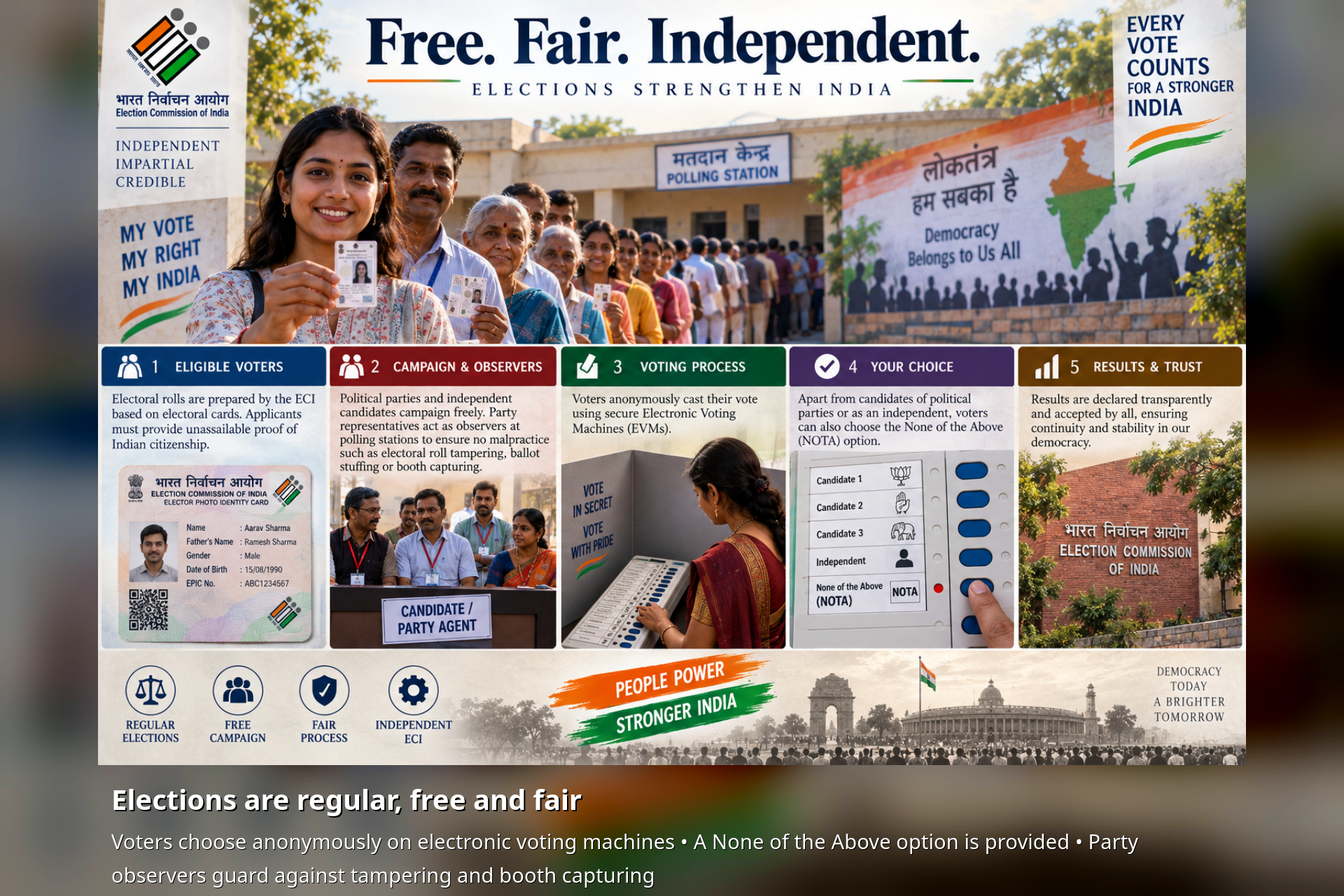
Elections in India are regular, free, and fair and managed independently by the ECI. Voters anonymously declare their choice of candidates through electronic voting machines. Apart from candidates representing a political party or standing as independents, the voters are also provided a None of the Above (NOTA) option. Electoral cards are issued by the ECI on the basis of the electoral rolls where an applicant has to provide unassailable proof that he or she is a citizen of India. During elections, political parties have representatives who act as observers and overseers to ensure that there is no electoral roll tampering, ballot stuffing, or booth capturing by unscrupulous elements.
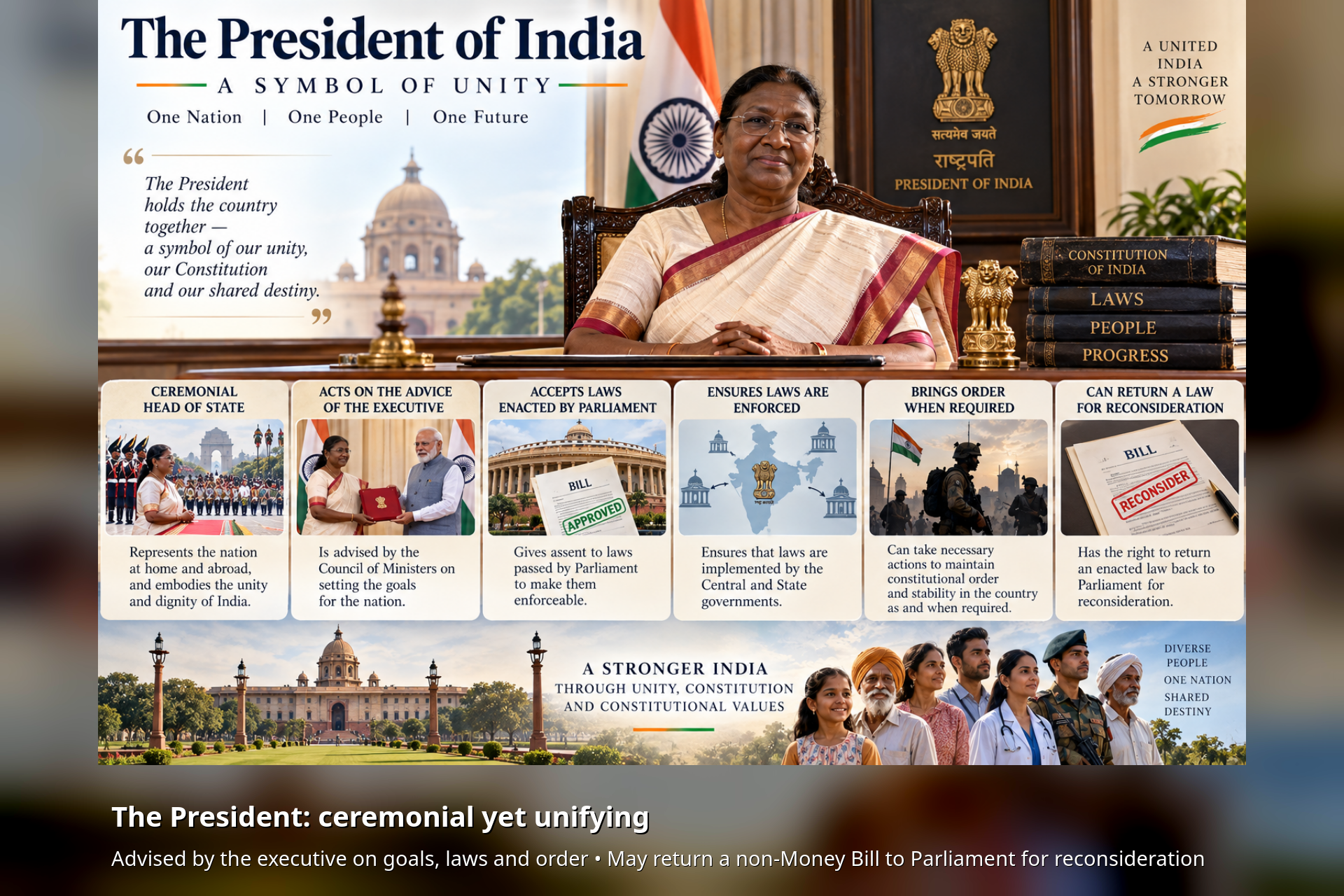
While the President is more of a ceremonial position, it is also a position that…
While the President is more of a ceremonial position, it is also a position that holds the whole country together. The President is advised by the executive on setting the goals for the nation, accepting laws enacted in the Parliament, enforcing laws on the Central and State governments, and also bringing order to the country as and when required. The President also has the right to return a Bill (other than a Money Bill) passed by Parliament back to it for reconsideration.
Featuring:




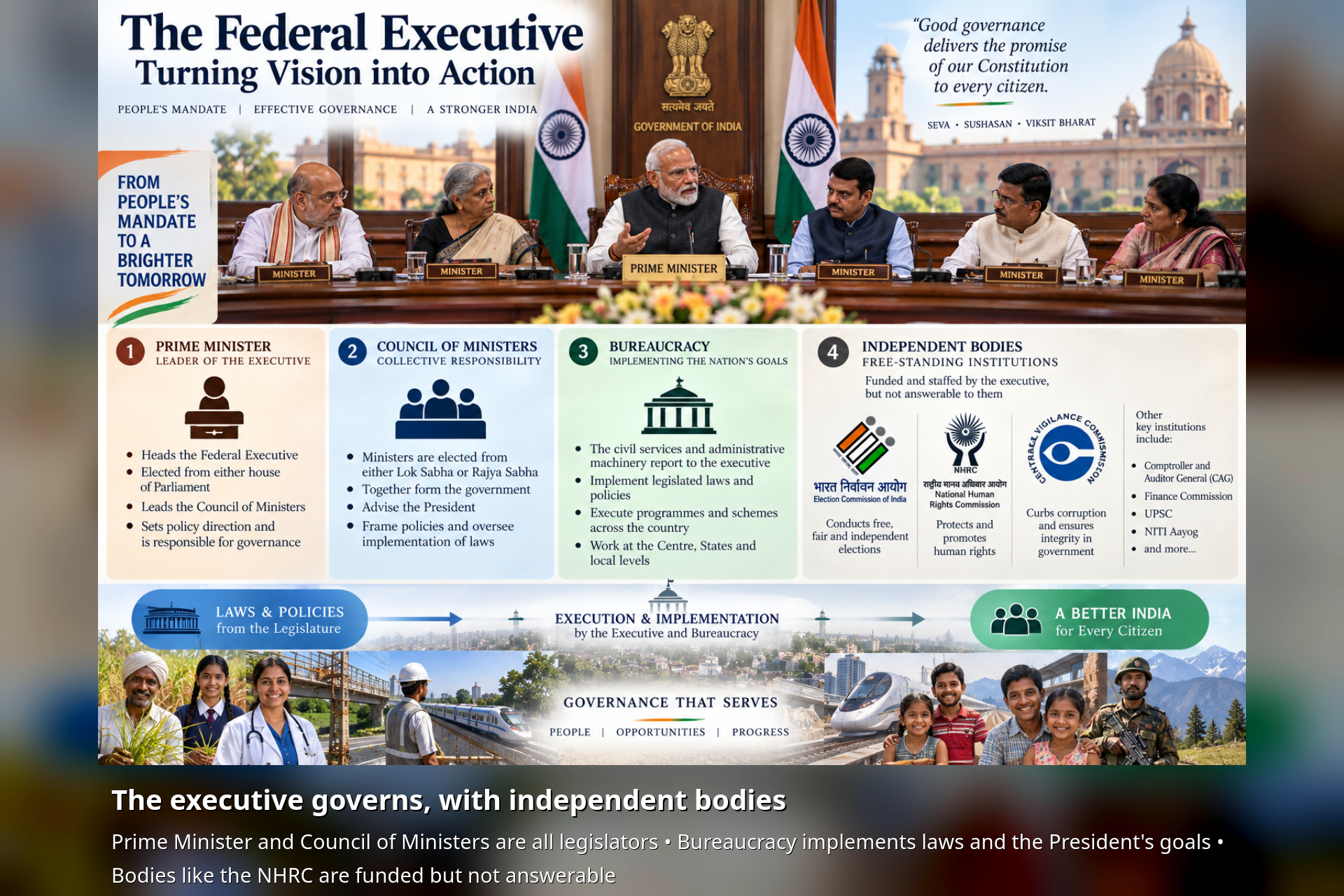
The Central Executive consists of a Prime Minister with a Council of Ministers who are all members of either house. The Bureaucracy reports to the executive to implement the legislated laws and fulfil goals expounded by the President. Key bodies such as the National Human Rights Commission (NHRC), Central Vigilance Commission, Election Commission, etc. act as free-standing entities funded and staffed by the executive but not answerable to it.
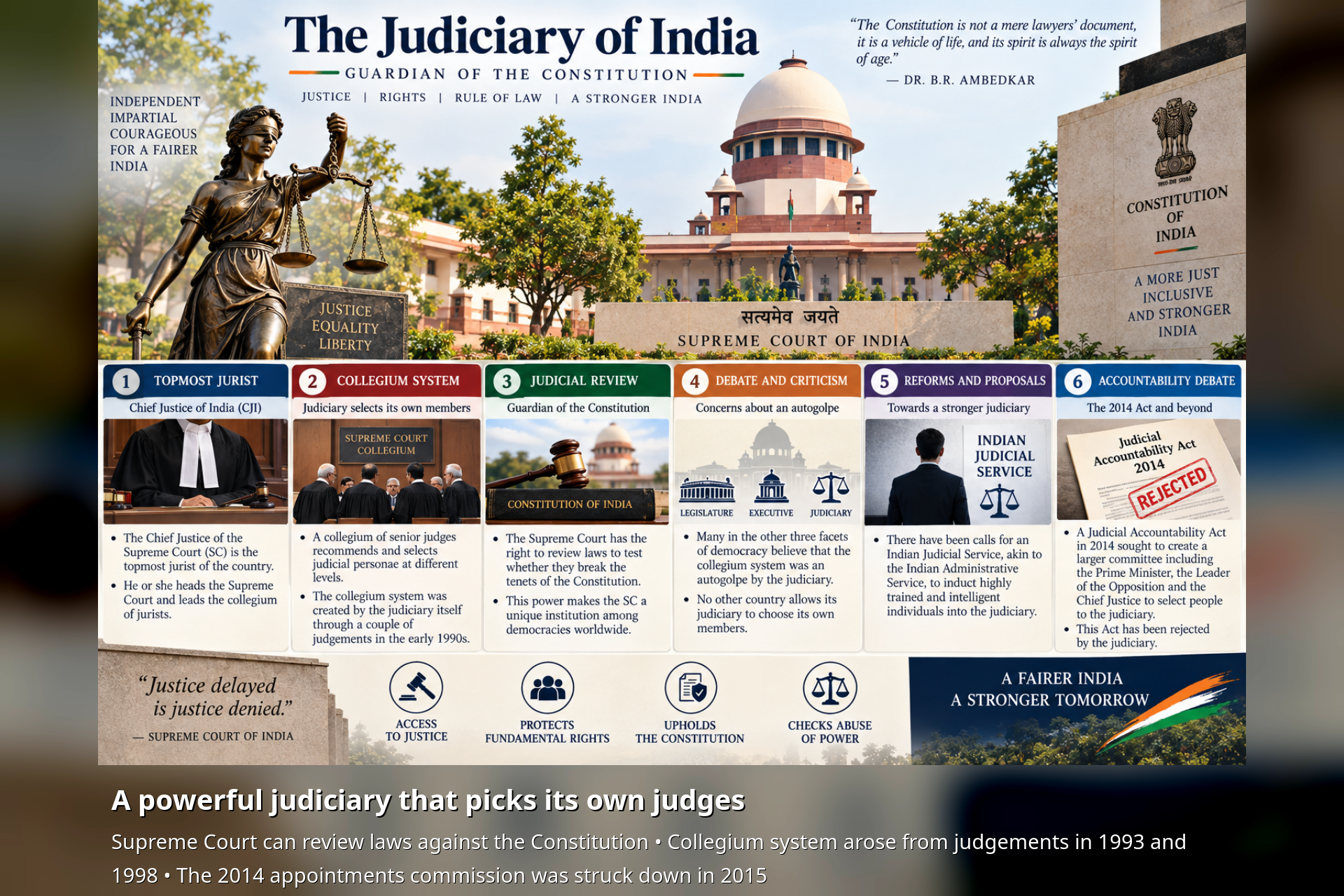
The Judiciary is headed by the Chief Justice of the Supreme Court (SC), who is…
The Judiciary is headed by the Chief Justice of the Supreme Court (SC), who is the topmost jurist of the country. He or she leads a collegium of jurists who select the judges for the Supreme Court and the High Courts. Unlike in most other countries, the SC has the right to review laws to test whether they break the tenets of the Constitution. The collegium system itself was a creation of the judiciary through judgements in 1993 and 1998 (the Second and Third Judges Cases). Many in the other three pillars of the democracy believe that this was an autogolpe (a self-inflicted coup) by the judiciary. No other country allows its judiciary to choose its own members. Recently, there have been calls for an Indian Judicial Service, akin to the Indian Administrative Service, where highly trained and intelligent individuals are inducted into the judiciary. A National Judicial Appointments Commission Act in 2014 (with the 99th Constitutional Amendment) sought to create a six-member commission (the Chief Justice, two senior Supreme Court judges, the Law Minister and two eminent persons chosen by a panel of the Chief Justice, the Prime Minister and the Leader of the Opposition) to select judges—this Act was struck down by the Supreme Court in October 2015.
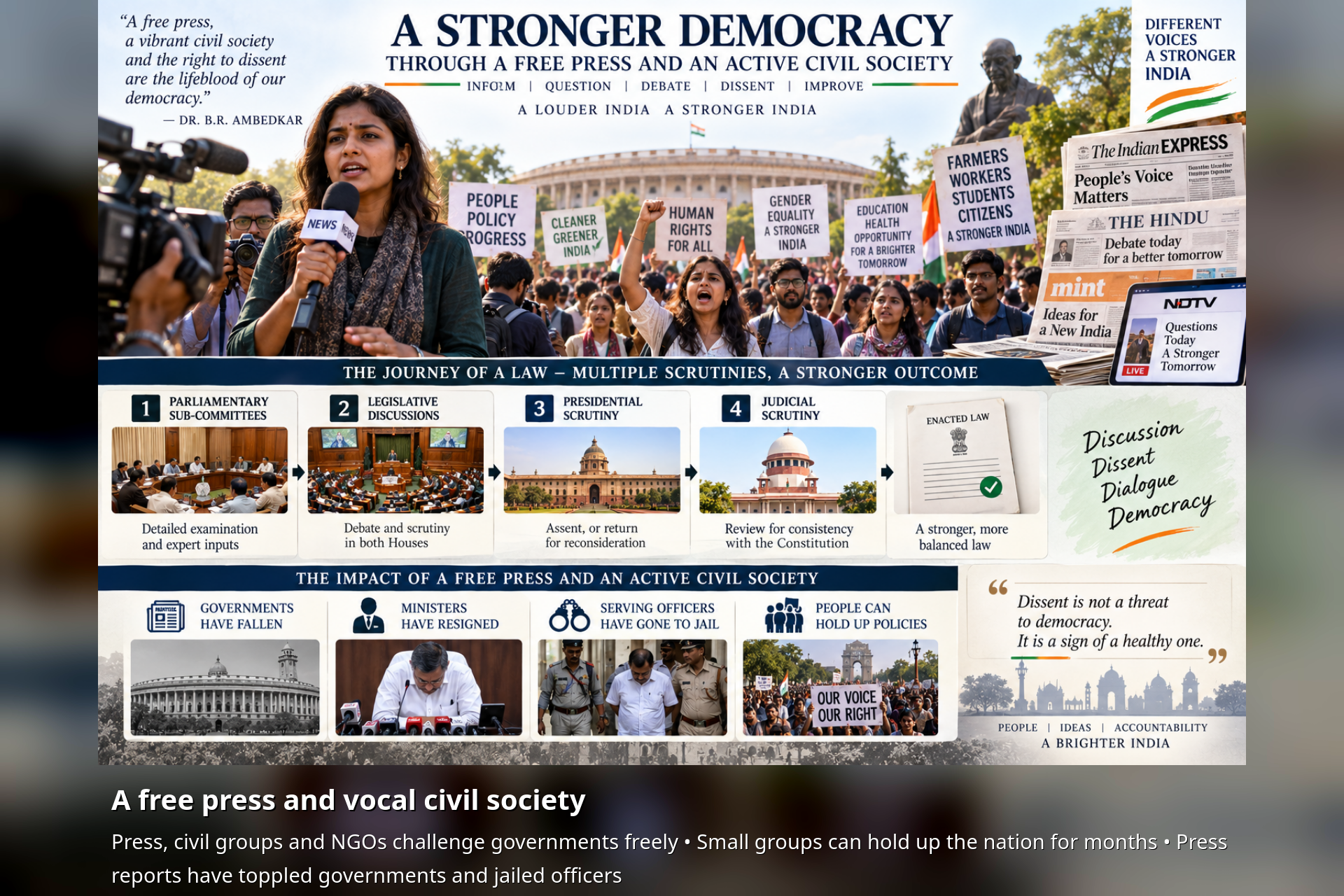
India has a free press, very active civil society groups, and non-government organisations who put various governments on the mat for new laws, regulations, and processes. Even though various western ranking agencies rate India low on free speech and freedom to dissent, these groups have almost unbridled power to say what they want to say on printed, digital, and social media almost to a fault. In some cases, just hundreds of people can hold up the entire nation of 1.48 billion people for months on end because they disagree with some laws that have gone through Parliament sub-committees, legislative discussions, Presidential scrutiny, and even judicial scrutiny. Press reports have caused governments to fall, ministers to resign, and also caused serving officers to go to jail.
Featuring:



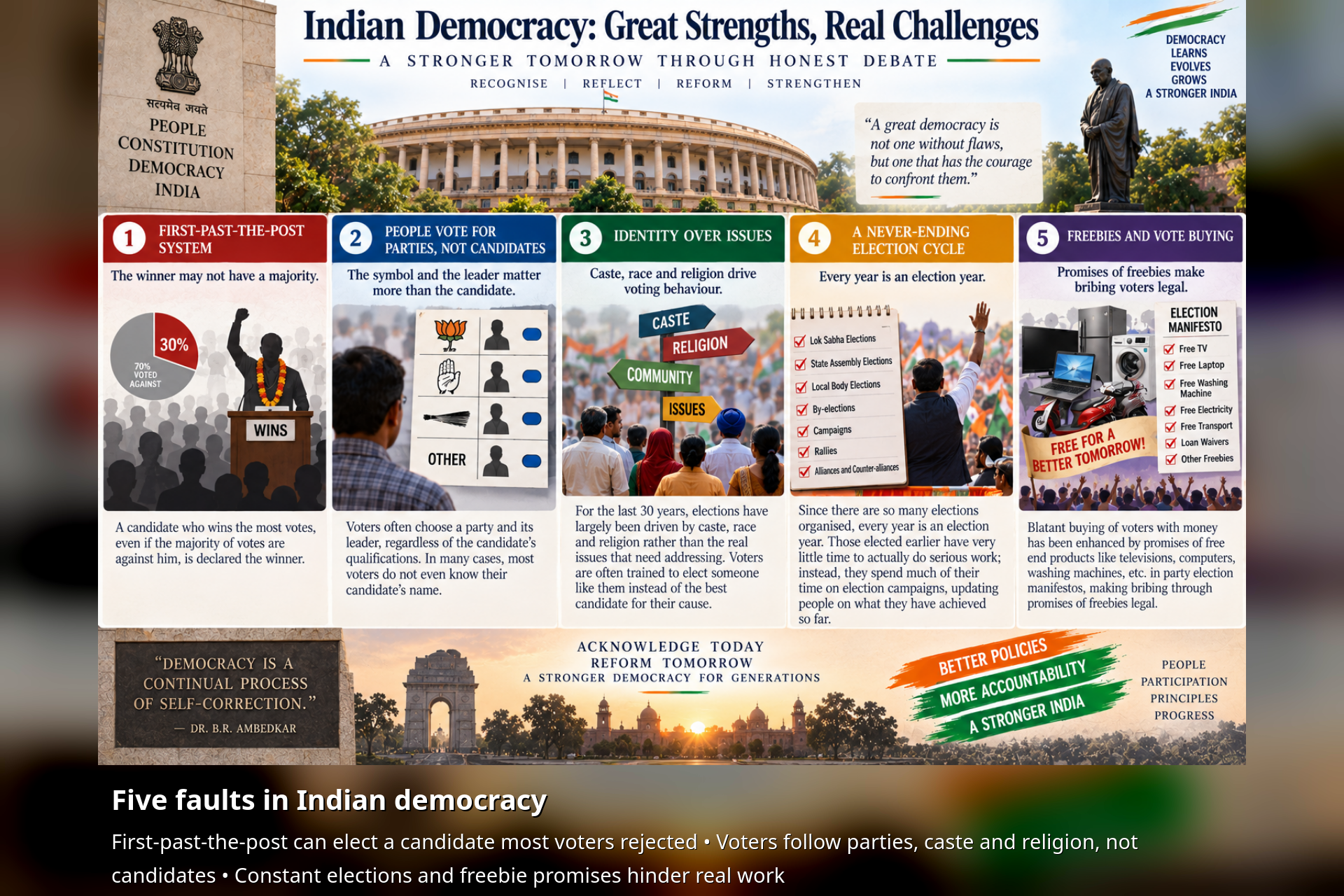
The Indian democracy is not without faults: some of them are architectural and some evolutionary.…
The Indian democracy is not without faults: some of them are architectural and some evolutionary. Firstly, the Indian democracy follows a first-past-the-post model where a candidate who wins the most votes even though most of the votes were cast for other candidates is declared the winner. Secondly, while people are supposed to vote for the candidate based on her qualifications, voters really vote for a party and its leader regardless of the candidate’s qualifications; in fact, most voters do not even know their candidate’s name. Thirdly, the democracy in the last 30 years has been driven by caste and religion, not by issues that need addressing. Hence, voters have been trained to elect someone like them instead of the best candidate for their cause. Fourthly, since there are so many elections organised, every year is an election year and those elected earlier have very little time to actually do some serious work; instead, they spend so much time on election campaigns updating people on what they have achieved so far. Fifthly, blatantly buying voters with money has been compounded by promising free consumer goods like television, computers, washing machines, etc. in party election manifestos making the bribing of voters through promises of freebies legal (the Supreme Court held in 2013 that manifesto promises are not a "corrupt practice" under the Representation of the People Act, though the issue is now before a larger bench).
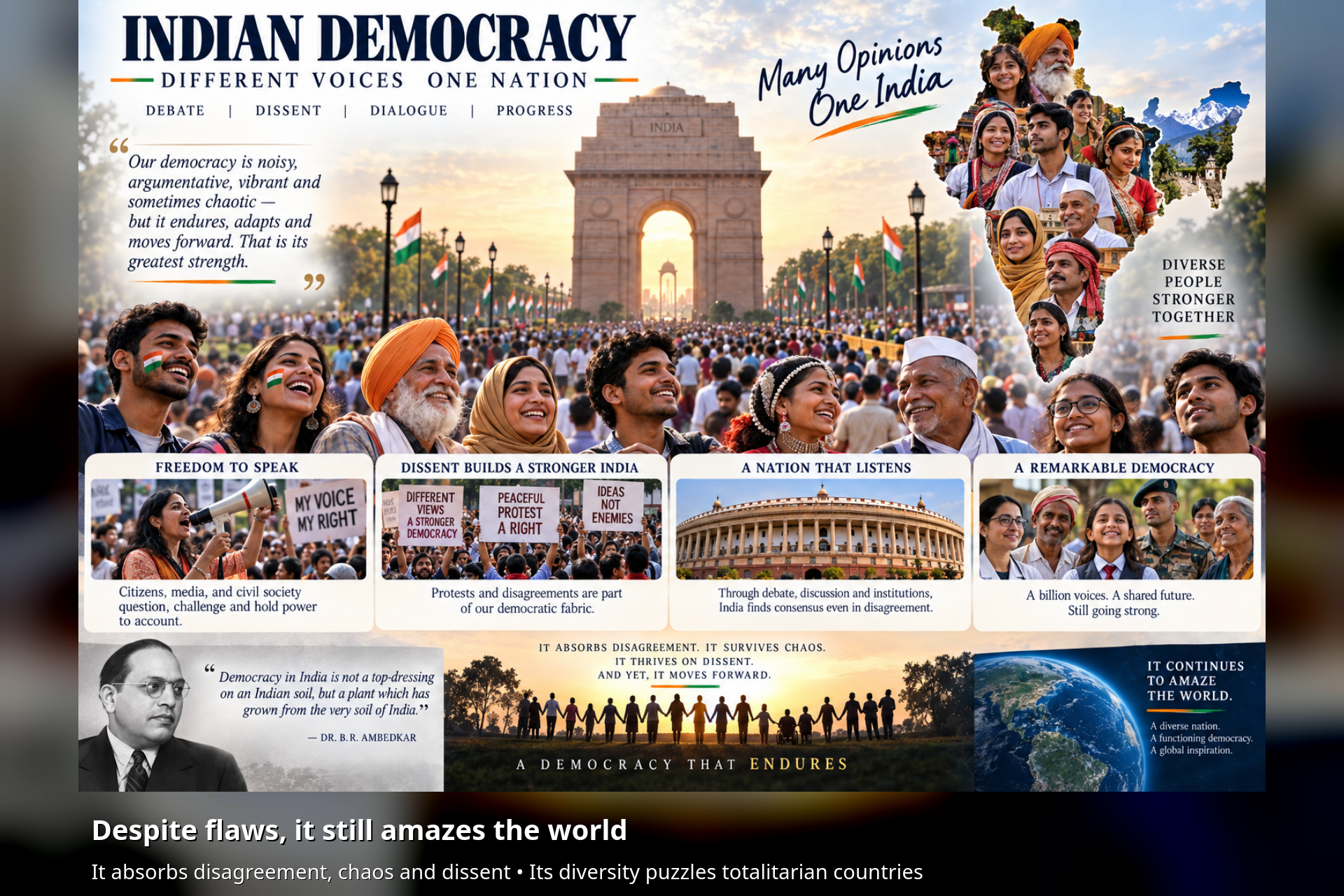
Regardless of these faults, the Indian democracy continues to amaze other democracies for its capacity to absorb disagreement, chaos, and dissent. It continues to flummox totalitarian countries on how such a diverse country could continue to function democratically.