



Kāla is the name Hindus use for time. But it is not a linear concept as the West sees it. Time to Hindus is a cyclical continuum measured on a ladder of units. It spans from the time the sun takes to pass over an atom to the lifespan of the creator. The Purāṇās and the astronomical Siddhāntās build this ladder by steady multiplication, so that each rung is a “day” or “year” of a higher being. From this cyclical time, the Universe manifests, sustains, and withdraws. There is no first beginning or final end. This article climbs the ladder from the Paramāṇu to the Kalpa, then follows the texts further, to the lives of Brahmā, Viṣṇu and Śiva.

The Bhāgavata Purāṇa begins with matter. In Canto 3, chapter 11, verse 4, it says that the Paramāṇu is the indivisible particle and atomic time is the interval the sun takes to pass over one. In verse 5, it says two Paramāṇus make an Aṇu, and three Aṇus make a Trasareṇu, the mote seen rising in a sunbeam. From verses 6 and 7 onwards, the text multiplies upward to the human year.

Featuring:




The modern approximate values are derived by arithmetic, working downward from a 24-hour day of…
The modern approximate values are derived by arithmetic, working downward from a 24-hour day of thirty Muhūrtās. Commentators put the Truṭi at roughly one seventeen-hundredth of a second. The Prahara is six or seven Nāḍikās because watches lengthen and shorten with the seasons.

Two nuances here. First, this Purāṇic Truṭi is not the astronomers’ Truṭi. Bhāskara’s Siddhānta Śiromaṇi counts 100 Truṭis to a Tatpara and 30 Tatparās to a Nimeṣa, a far smaller Truṭi (about 30 microseconds, against several hundred in the Purāṇic reckoning). Second, other texts use a different middle chain. For example, the Viṣṇu Purāṇa, in Book 1, chapter 3, opens with the Nimeṣa. Fifteen of them make a Kāṣṭhā, thirty Kāṣṭhās a Kalā, and thirty Kalās a Muhūrta.

There are several levels above a day. Fifteen days make a fortnight or Pakṣa. The…
There are several levels above a day. Fifteen days make a fortnight or Pakṣa. The period after a new moon is called Śukla Pakṣa or brighter fortnight, and the one after a full moon is called Kṛṣṇa Pakṣa or darker fortnight. Manusmṛti, in chapter 1, verse 66, says that the Śukla Pakṣa is one night of the ancestors or Pitṛs and the Kṛṣṇa Pakṣa is considered one day. Two fortnights make a month or Māsa. Six months make an Ayana, and two Ayanās make a human year. The Viṣṇu Purāṇa, in Book 1, chapter 3, says this corresponds to one day and night of the Devatās. A divine year is therefore 360 human years.

Featuring:

The Sūrya Siddhānta, in chapter 1, verses 15 to 17, says twelve thousand divine years make a Caturyuga or Mahāyuga of 4.32 million human years. This time is divided among four Yugās in the ratio of four to three to two to one. The four Yugās are Kṛta or Satya, Tretā, Dvāpara, and Kali (not Kālī, who is a Devatā).

Each Yuga includes a dawn called Sandhyā and a twilight called Sandhyāṃśa, broadly called a…
Each Yuga includes a dawn called Sandhyā and a twilight called Sandhyāṃśa, broadly called a Sandhi. The dawn and the twilight are each one tenth of the Yuga proper (so that, together, they add one sixth to the Yuga's main period). The shrinking ratio tracks the decline of Dharma. The Sūrya Siddhānta pictures this as Dharma losing one of its four legs in each age.

Seventy-one Mahāyugās make a Manvantara, the reign of one Manu, which lasts 306.72 million human years. The Viṣṇu Purāṇa, in Book 1, chapter 3, says that fourteen Manus reign in succession within one Kalpa. Since fourteen times seventy-one equals only 994, the Sūrya Siddhānta, in chapter 1, verses 18 and 19, confirms that fifteen Sandhis, each as long as a Kṛta age of 1.728 million years, must be accounted for. With this calculation, the total is exactly one thousand Mahāyugās, or 4.32 billion years.

Featuring:


This is the Kalpa, a single daytime of Brahmā. The Bhagavad Gītā, in chapter 8,…
This is the Kalpa, a single daytime of Brahmā. The Bhagavad Gītā, in chapter 8, verse 17, gives the same measure of a thousand Mahāyugās each for Brahmā’s day and night. At dusk the three worlds are dissolved through burning and then flooded. Brahmā sleeps for a night before creating again. The present Kalpa is the Vārāha, and the reigning Manu is the seventh, Vaivasvata.

The Sūrya Siddhānta, in chapter 1, verses 20 and 21, says that Brahmā lives one hundred of his own years, or 311.04 trillion human years. His day and night together are two Kalpās, 8.64 billion years, and 360 of these make his year of about 3.11 trillion years. The Viṣṇu Purāṇa calls the whole span the Para and each half a Parārdha. A full life is also termed a Mahākalpa.
Both texts agree that the first Parārdha has passed, and that the present Vārāha Kalpa…
Both texts agree that the first Parārdha has passed, and that the present Vārāha Kalpa opens the second half of his life. When his century ends, dissolution is no longer the burning and flooding of the three worlds. The Viṣṇu Purāṇa, in Book 6, chapter 3, says that during the Prākṛta Pralaya, the elements themselves fold back into the unmanifest nature until a new Brahmā appears. While the astronomers stopped their calculations there, the Purāṇās went further.

Featuring:
The Pūrva-bhāga of the Vāyavīya Saṃhitā, in chapter 8, verse 24, says one whole lifetime of Brahmā passes in a day of Viṣṇu. One whole lifetime of Viṣṇu is a day of Rudra. In the Rudra Saṃhitā, in the Sṛṣṭi Khaṇḍa, chapter 10, verses 16 to 24, only one year of Brahmā is a day of Viṣṇu, and one year of Viṣṇu a day of Rudra. Under both rules each deity lives a hundred of his own 360-day years. Each lifespan is the day multiplied by 36 thousand, that is, 360 days times 100 years. The table follows the first rule, on which Rudra lives about 403 sextillion human years, or roughly 4 times ten to the power of 23.

The Vāyavīya chain continues upward, with a lifetime of Rudra passing as a day of…
The Vāyavīya chain continues upward, with a lifetime of Rudra passing as a day of Īśvara. The lifetime of Īśvara is a day of Sadāśiva. The Rudra Saṃhitā makes Rudra’s century a single held breath of Sadāśiva, whose breaths are without number.

For the individual striving for Dharmic living, there are two calendars that help them reconcile with nature: the solar or Sauramāna and the lunar or Cāndramāna calendars.

Featuring:



A Tithi, or lunar day, is defined by geometry. It is the time the moon…
A Tithi, or lunar day, is defined by geometry. It is the time the moon takes to increase its distance from the sun by twelve degrees. Since the moon speeds up and slows down along its orbit, an actual Tithi runs anywhere from about 20 to nearly 27 hours. It can begin at any moment of the day or night. A Tithi belongs to the lunar one of the two reckonings that Hindu calendars keep side by side, the other being the solar. The Sūrya Siddhānta lists nine measures or Mānās of time. Among them are the civil or Sāvana, the lunar or Cāndra, and the solar or Saura reckonings. In the Sauramāna, a month is the sun’s passage through one sign of the zodiac, and it begins at the Saṅkrānti, the moment the sun enters the sign. In the Cāndramāna, a month runs from new moon to new moon or, in northern usage, from full moon to full moon.

The two coexist because each tracks something the other cannot. The sun governs the seasons, so the solar year fixes the solstices, the six Ṛtus and the agricultural cycle. The moon is a clock anyone can read in the sky, so rites are timed by its phases. Twelve lunar months fall about eleven days short of the solar year, and neither period divides the other evenly. The Pañcāṅgam, or five-limbed calendar, therefore keeps both and ties them together. A lunar month takes the name of the solar month in which its new moon falls, and when two new moons fall within one solar month, the first lunar month is intercalary or Adhika Māsa. The lunar months thus never drift far from the seasons.

In practice, the two divide the work. Solar months serve as the civil calendar in…
In practice, the two divide the work. Solar months serve as the civil calendar in regions such as Tamil Nadu, Kerala, Bengal, Odisha, Assam and Punjab, and the sun’s course fixes observances such as Makara Saṅkrānti. Lunar months serve as the civil calendar across much of the rest of India, and nearly every fast, festival and ancestral rite called Śrāddha in every region is fixed by Tithi. A household that lives by solar months still consults the lunar day for its rituals.
Featuring:
The months or Māsās of the two reckonings line up with the Gregorian months as follows. A Hindu solar month never begins on the 1st. It begins at the Saṅkrānti, which falls around the 14th to the 17th, so each English month is split between two solar months.
The first half of each English month belongs to the solar month of the row…
The first half of each English month belongs to the solar month of the row above, so the 1st to the 13th of April is still Mīna. The solar names are those of the zodiac signs, as recited in the Saṅkalpam. The start dates can move by a day from year to year. The lunar month shown is the one that begins at the new moon falling within that solar month, so its start date floats. Caitra can begin anywhere from mid-March to mid-April. Where months are counted from full moon to full moon, each lunar month begins a fortnight earlier.

The year’s six seasons or Ṛtus each span two months. The dates shift by a few weeks from year to year with the lunar months. Where the Saṅkalpam follows solar months, each Ṛtu is counted from the solar month instead, so that Vasanta begins with Meṣa in mid-April, up to a month later than in the lunar reckoning.

Featuring:


The Pañcāṅgam describes each day five ways. Every limb measures a different relation among the…
The Pañcāṅgam describes each day five ways. Every limb measures a different relation among the sunrise, the sun, the moon and the stars.

Vāra is a day of the week and is the only limb that ignores the moon. It is the civil day itself, and its seven names follow the planetary lords: Ravi, Soma, Maṅgala, Budha, Guru, Śukra and Śani. The cycle never skips or repeats, so it runs unbroken through solar and lunar calendars alike and is the fixed thread on which the floating limbs are hung. It is sun-based in that sunrise defines it, though the texts class it as Sāvana time, distinct from the Saura month and year.

Everyday speech and ritual use different names for the same seven days. The Saṅkalpam names…
Everyday speech and ritual use different names for the same seven days. The Saṅkalpam names each day as a Vāsara under a formal epithet of its planetary deity. The formal names are epithets. Indu is the moon, Bhauma the “son of the Earth”, Saumya the “son of Soma”, Bhṛgu the sage from whom Śukra descends, and Sthira “the steady one”, for slow-moving Saturn.

Featuring:
The Nakṣatra locates the moon against the stars. The ecliptic is divided into 27 equal mansions of 13 degrees and 20 minutes each, from Aśvinī to Revatī, and the moon crosses one in about a day. The day’s Nakṣatra is the mansion which the moon occupies at sunrise. Where the Tithi records the moon’s distance from the sun, the Nakṣatra records its place in the sky, and the two vary independently. The mansions also name the lunar months, each called after the Nakṣatra near which its full moon falls: Caitra from Citrā, Vaiśākha from Viśākhā. A person’s birth Nakṣatra guides naming and the timing of life rites.

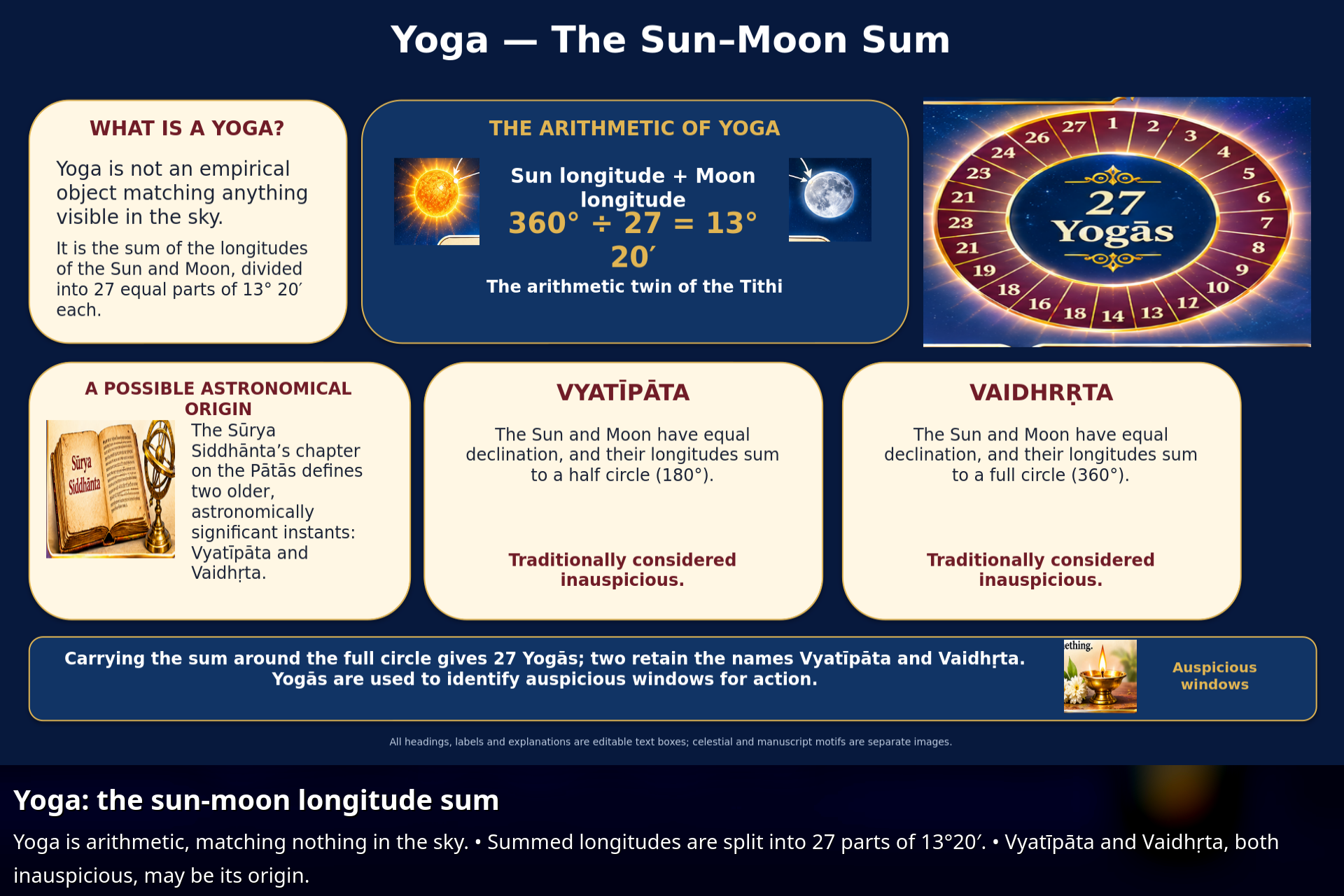
The Yoga is not empirical, matching nothing in the sky. It is the sum of…
The Yoga is not empirical, matching nothing in the sky. It is the sum of the longitudes of sun and moon, divided into 27 parts of 13 degrees and 20 minutes each. It is the arithmetic twin of the Tithi. A plausible origin lies in two older moments that are astronomically significant. The Sūrya Siddhānta’s chapter on the Pātās defines Vyatīpāta and Vaidhṛta as the instants when sun and moon have equal declination. Vyatīpāta is when the longitudes sum to a half circle. Vaidhṛta is the full circle. Both were held to be inauspicious times. Carrying that sum around the whole circle gives the 27 Yogās, two of which still bear those names. Their use is entirely to look for auspicious windows to do something.
Together the five limbs give each moment a five-part signature, and choosing a Muhūrta for a rite means finding a time when all five are favourable.

Featuring:
From the Paramāṇu to the life of Brahmā and beyond, the Hindu concept of time…
From the Paramāṇu to the life of Brahmā and beyond, the Hindu concept of time spans some twenty-seven orders of magnitude, built from a handful of multipliers. Apart from the sheer mathematical complexity, the abstract and cyclical nature of time is beyond most philosophers, mathematicians, and physicists of today. What we have to remember is that these concepts existed for millennia before Christianity. Some date the Sūrya Siddhānta to a much later period. But we must remember that the same concepts exist in chapter 231 of the Śānti Parva of the Mahābhārata, and in the older Manusmṛti. The Sūrya Siddhānta only codified these concepts in a more contemporary language, which continues to be relevant even today.
