|
The Indian Analyst
|
|
South Indian Inscriptions |
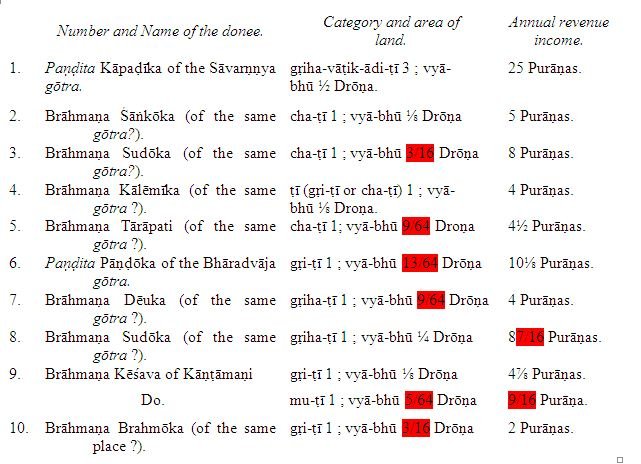
EPIGRAPHIA INDICA in line 32, it speaks only of vā-ṭī 16. In the contraction, vā-ṭī, vā apparently stands for vāstu meaning ‘ homestead land ’.[1] It seems that the unprofitable plots characterised as mu-ṭī were not regarded as proper vāstu land and were left out in the calculation of the total. But in the details of the grant we have specific mention only of 3 mu-ṭīs. We are therefore short of 2 mu-ṭīs. Can it be suggested that the passage gṛiha-vāṭik-ādi-ṭī 3 in line 18 included 1 ṭī of the vāstu=gṛiha-vāṭikā category and 2 of the mu-ṭī class ? Can it further be conjectured that gri-ṭī indicated a mound containing houses and gardens, cha-ṭī a mound containing plantations only and mu-ṭī a mound without houses and gardens and covered with grass or jungle ?[2] But all three appear to have contained, possibly on the borders, small patches of land of the nāla category if not also of any other type such as khila.
For easy reference we quote below the details of the grant portion of the Mehār copper-plate inscription in a table.
_______________________________________________
[1] The contraction vā for vāstu occurs in several records including the Chittagong plate of Dāmōdaradēva himself (N. G. Majumdar, op. cit., p. 181).
| ||||||||||||||||||||||||||||||||||||||||||||||||||||||||||||||||||||||||||||||||||||||||||||||||||||||||||||||||||||||
|
|