|
The Indian Analyst
|




South Indian Inscriptions |
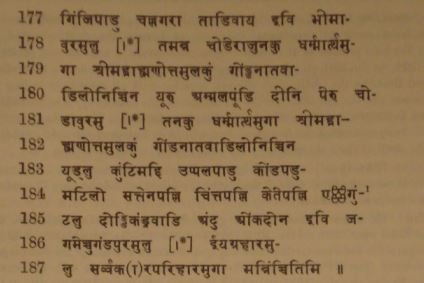
EPIGRAPHIA INDICA ABRIDGED TRANSLATION. Ôṁ. (Verse 1.) “ There is a city (named) Śrî-Dhânyakaṭaka, which is superior to the city of the gods, (and) where (the temple of) Śaṁbhu (Śiva) (named) Amarêśvara is worshipped by the lord of gods (Indra) ; (V. 2.) “ Where god Buddha, worshipped by the Creator, is quite close, (and) where (there is) a very lofty Chaitya, well decorated with various sculptures. (V. 3.) “ In that (city) there is a family of powerful kings, enjoying uninterrupted prosperity, protected by the god Amarêśvara, (and) protected men ; (V. 4.) “ Which (family) was born from the pair of feet─ worshipped by the crowds of lords of gods, lords of demons, and lords of sages,─ of the Creator, the bestower of great bliss.” In this family was born Bhîma (I.) (v. 6). His son was Kêta (I.) (v. 24). His son was Bhîma (II.) (v. 28), whose wife was Sabbamâdêvî (v. 32). Their son was Kêta (II.) (v. 33), a worshipper of Śiva (v. 38). He built alms-houses (sattrâlaya, v. 40) and constructed tanks (taḍâga, v. 41), gardens (ârâma, v. 42), and temples (dêvâlaya, v. 43).
(V. 44.) “ In the Śâka year reckoned by the Yugas (4), the sky (0), the moon (1), and rûpa (1),─ (i.e. 1104),─ in (the month of) Mâgha, on the tenth tithi of the bright (fortnight), on a Thursday,─ the glorious king Kêta, a treasury of virtues, possessing great prosperity, having been raised to the kingdom,[2] gave, for the increase of (his) merit, many excellent villages to the preceptor of all (men), the lord Sugata (Buddha). (Line 108.) “ Hail ! The glorious Mahâmaṇḍalêśvara Kôṭa-Kêtarâja, who was possessed of all the glory of such names as the lord of the district of six-thousand (village) (Shaṭsahasrâvanî) on the southern (bank) of the Kṛishṇaveṇṇâ river, obtained through the favour of the glorious Triṇayana-Pallava, the protector of the whole earth surrounded by the four oceans ; inaccessible to fear and greed ; the lion to the rutting elephants─ the Chôḍa and Châḷukya Sâmantas ; resembling the lord of gods (Indra) in power ; the worshipper of the divine lotus-feet of the holy god Amarêśvara ; the destroyer of hostile armies ; the lord of Śrî-Dhânyakaṭaka, ________________________________________________ | ||||||||||||||||||||||||||||||||||||||||||||||||||||||||||||||||||||||||||||||||||||||||||||||||
| > |
|
>
|