|
The Indian Analyst
|




South Indian Inscriptions |
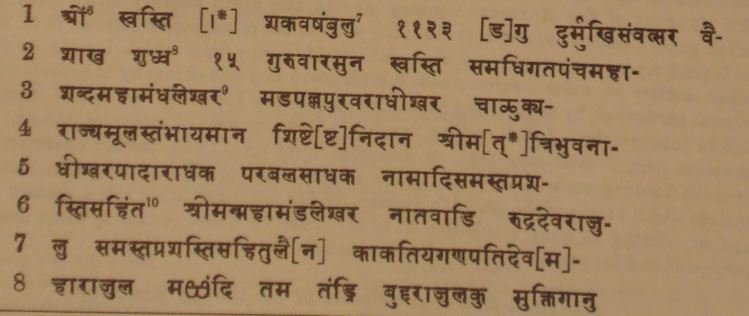
EPIGRAPHIA INDICA (V. 12.) “ In the Śaka year reckoned by tarka (6), the arrows (5), the earth (1), and the moon (1),─ (i.e. 1156),─ in this (cyclic) year called Jaya, in the month Jyêshṭha, on a Thursday, on the day of Mura’s enemy (Vishṇu),[1] in the auspicious bright fortnight,─ this queen [the wife of] Manma-Gêta . . . . . . . gave, for the sake of (her) prosperity, [a lamp] to god Buddha who is pleased to reside at Śrî-Dhânyaghâṭî. (L. 215.) “ Kôṭa-Bayyalamahâdêvi-amma, the daughter of the glorious Mahâmaṇḍalêśvara Rudradêva-Mahârâja of Nâthavâḍi, gave for her own merit to the holy lord Buddha 55 sheep for a perpetual lamp, to last as long as the moon and the sun. Having received these, Guṇṭi-Ane-Bôya with his sons and further descendants has to supply daily one mâna of ghee. Ôṁ.” POSTSCRIPT. In connection with the preceding inscription of Bayyamâmbâ, I publish below a short Telugu inscription of her father on a pillar of the ruined Kanakadurgâ-maṇḍapa at the foot of the Indrakîla hill at Bezvâḍa (No. 279 of 1892). It records the gift of a lamp to the Mallêśvara temple at Bezvâḍa by the Mahâmaṇḍalêśvara Rudradêvarâja of Maḍapalla in Nâtavâḍi, the son of Buddarâja, who was the brother-in-law of the Kâkatiya king Gaṇapati.[2] The date of the grant was Thursday, the 15th tithi of the bright fortnight for Vaiśâkha in Śaka-Saṁvat 1123 (expired), the cyclic year Durmukhi, which is a mistake for Durmati. According to Prof. Kielhorn, “ the date corresponds to Thursday, the 19th April A.D. 1201, when the 15th tithi of the bright half commenced 1 h. 38 m. after mean sunrise.”
The town of Maḍapalla and the district of Nâtavâḍi are identical with Maḍapalli and the district of Nâthavâḍi or Nâthavâṭî in the inscription of Bayyamâmbâ.[3] Mr. Ramayya identifies Maḍapalla or Maḍapalli with a village near Madhira, a station on the Nizam’s State Railway, and Nâtavâḍi with the district of Nat[ṛi]paṭî in the Chikkulla plates.[4] As, however, Lenduḷûra, whence the Chikkulla plates were issued, is the modern Dendulûru near Ellore, Maḍapalla or Maḍapalli might as well be the same as the village of ‘ Madapulli ’ which is mentioned in the Postal Directory of the Madras Circle, p. 746, as being situated near Ellore.
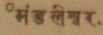
TEXT.[5] ____________________________________________________________ | ||||||||||||||||||||||||||||||||||||||||||||||||||||||||||||||||||||||||||||||||||||||||||||||||
 .
.  .
.  .
.  .
.
| > |
|
>
|