|
The Indian Analyst
|




South Indian Inscriptions |
EPIGRAPHIA INDICA TRANSLATION.
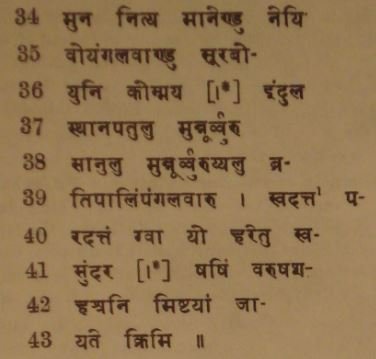
(Line 1.) Hail ! In the 9th year of the increasing and victorious reign of the asylum of the whole world, the favourite of Fortune and of the Earth, Mahârâjâdhirâja, Râjaparamêśvara, Paramabhaṭṭâraka, the front-ornament of the race of the Sun, the crest-jewel of the Chôḷa family, the destroyer of the Pâṇḍya family, the asylum of all kings, Râjarâjéndra, Vîra-Mahêndra, Vikrama-Chôla, he whose ornament is victory, the glorious Râjakésarivarma- Permanaḍi, [the lord of the earth] as far as the Gaṅgâ and the Kâvêrî, the glorious emperor of the three worlds, Vikrama-Chôladêva,─ (L. 14.) On the occasion of an eclipse of the moon in the month of Jyêshṭha in the Plava-saṁvatsara which was the Śaka year 1049,─ (L. 20.) Hail ! the glorious Mahâmaṇḍalêśvara Nambaya, who was possessed of all the glory of such names as the Mahâmaṇḍalêśvara who has obtained the five great sounds ; the lord of Kollipâkâ, the best of cites ; the lion of the principal mountain─ the Durjaya family ; a Hariśchandra in truthfulness ; the lord of the country of six-thousand (villages) on the southern bank of the Kṛishṇaveṇṇâ river ; the lover of the jasmine flower ; (and) the scent-elephant of Malla,─ (Ll. 18-20 and l. 31 f.) gave 50 sheep to the temple of the god Kumârasvâmin at Chembrôlu for a perpetual lamp.
(L. 32.) Having received these (sheep), Kommaya, (the son) of Sûra-Bôya, with (his) descendants in succession, has to tend (them) and to supply daily to the Mahâsêna (temple) one mâna[2] of ghee. (L. 36.) The three-hundred temple servants (sthânapati) (and) the three-hundred dancing-girls of this place have to protect (this grant). [Ll. 39-43 contain one of the usual minatory verses.] B.─ Śevilimêḍu Inscription of the Sixteenth Year. This inscription (No. 43 of 1900) is engraved on the west wall of the Kailâsanâtha temple at Śevilimêḍu, a village on the northern bank of the Pâlâru and about 2 miles south-west of Conjeeveram. __________________________________ | ||||||||||||||||||||||||||||||||||||||||||||||||||||||||||||||||||||||||||||||||||||||||||||||||
| > |
|
>
|