|
The Indian Analyst
|




South Indian Inscriptions |
EPIGRAPHIA INDICA “ This date also is irregular. For Śaka-Saṁvat 1328 expired = Vyaya it would correspond to Wednesday, the 16th June A.D. 1406, when the new-moon tithi of Jyaishṭha ended 6 h. 18 m. after mean sunrise.”─ F. K. 6.─ No. 41 of 1901 ; at Mûḍabidure. Vîra-Bukkarâya, the son of Harihararâya. Śaka-varsha 13[2]9 neya Vyaya-saṁvatsarada Bhâdrapada-śudhdha(ddha) 10 Budhavâradoḷu. “ This date also is irregular. For Śaka-Saṁvat 1329 current = Vyaya it would correspond to Tuesday, the 24th August A.D. 1406, when the 10th tithi of the bright half of Bhâdrapada ended 13 h. 1 m. after mean sunrise. If the figure of the tithi were 11, the date would regularly correspond to Wednesday, the 25th August A.D. 1406.” ─F. K. From manuscripts and coins[1] we know a son of Bukka II. by Tipp[â]mbâ, named Vira-Bhûpati, to whom we have to assign two inscriptions of Vira-Bhûpati-Uḍaiyar, which are noticed by Mr. Venkayya, viz. one of Śaka-Saṁvat 1331 at Śrîraṅgam,[2] and one of Śaka-Saṁvat 1336, the Manmatha year, at Tiruppandurutti.[3]
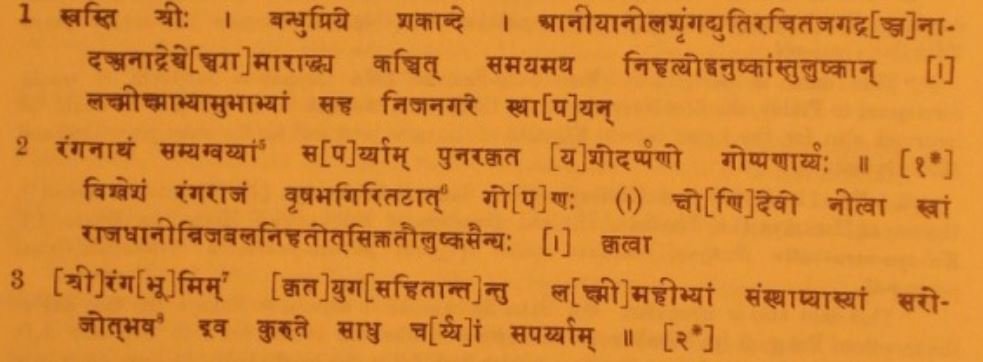
TEXT.[4]
TRANSLATION. Hail ! Prosperity ! In the Śaka year (expressed by the chronogram) bandhupriya (i.e. Śaka-Saṁvat 1293). (Verse 1.) Having brought (the god) from the Añjanâdri (mountain), the splendour of whose darkish peaks gives delight to the world, having worshipped (him) at Cheñchi for some time, then having slain the Tulushkas whose bows were raised,─ Goppaṇârya, the mirror of fame, placing Raṅganâtha together with both Lakshmî and the Earth in his own town,[9] again duly performed excellent worship. (V. 2.) Having carried Raṅgarâja, the lord of the world, from the slope of the Vṛishabhagiri (mountain) to his capital,[10] having slain by his army the proud Taulushka soldiers, having made the site of Śrîraṅga united with the golden age (Kṛitayuga), and having placed there this (god) together with Lakshmî and the Earth,─ the Brâhmaṇa[11] Gôpaṇa duly performs, like the lotus-born (Brahmâ), the worship which has to be practiced. ______________________________________________ | ||||||||||||||||||||||||||||||||||||||||||||||||||||||||||||||||||||||||||||||||||||||||||||||||
 .
. °.
°. .
. .
.| > |
|
>
|