|
The Indian Analyst
|




South Indian Inscriptions |
EPIGRAPHIA INDICA
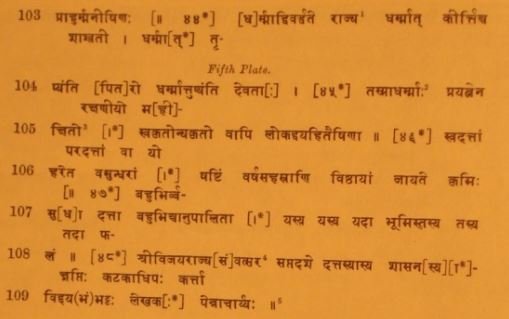
TRANSLATION. [As far as line 36 the text is identical with that of the Piṭhâpuram plates of Vîra-Chôḍa II. 1-43 ; above, Vol. V. pp. 74-77.] (Verse 11.) There were to this chief of kings (viz. Kulôttuṅga I.) (many)virtuous queens. born in the families of renowned princes, always devoted to (him),full of love, (and) gracious,─ as to the ocean (many) holy rivers, sprung from the ranges of lofty mountains, always running towards (it), full of water, (and) limpid. (V. 12.) Rejoicing in the sons (kumâra)who were born (to him) in due course by these queens, who resembled him, (and)who were worthy to be worshipped by princes, this godlike (king)surely laughs at Îśa (Śiva) who has (only)a single Kumâra (Skanda). (V. 13.) Appointing (his) sons in due order to different districts (vishaya), as the soul (directs)the senses to different objects (vishaya), he spake as follows to prince Mummaḍi-Chôḍa :─ (V. 14.) “ Dear child ! Being desirous of conquering the world, I formerly conferred the kingdom of the country of Veṅgî on my paternal uncle, prince Vijayâditya.[6] (V. 15.) “ And, ruling the earth for only fifteen years, this godlike prince, who resembled the five-faced (Śiva) in power, has (now)gone to heaven.”[7] (V. 16.) Out of obedience he (Mummaḍi-Chôḍa) took up that burden (viz. the kingdom of Vêṅgî) which (his) father, the emperor, had given him with these words, though he could not bear the separation from him.[8] _________________________________ | ||||||||||||||||||||||||||||||||||||||||||||||||||||||||||||||||||||||||||||||||||||||||||||||||
 .
. :.
:. .
. .
.| > |
|
>
|