The Indian Analyst
 

South Indian Inscriptions


Contents

Index

Introduction

Contents

Additions and Corrections

Images

Contents

Dr. Bhandarkar

J.F. Fleet

Prof. E. Hultzsch

Prof. F. Kielhorn

Rev. F. Kittel

H. Krishna Sastri

H. Luders

Vienna

V. Venkayya

Index

List of Plates

Other South-Indian Inscriptions 

Volume 1

Volume 2

Volume 3

Vol. 4 - 8

Volume 9

Volume 10

Volume 11

Volume 12

Volume 13

Volume 14

Volume 15

Volume 16

Volume 17

Volume 18

Volume 19

Volume 20

Volume 22
Part 1

Volume 22
Part 2

Volume 23

Volume 24

Volume 26

Volume 27

Tiruvarur

Darasuram

Konerirajapuram

Tanjavur

Annual Reports 1935-1944

Annual Reports 1945- 1947

Corpus Inscriptionum Indicarum Volume 2, Part 2

Corpus Inscriptionum Indicarum Volume 7, Part 3

Kalachuri-Chedi Era Part 1

Kalachuri-Chedi Era Part 2

Epigraphica Indica

Epigraphia Indica Volume 3

Epigraphia
Indica Volume 4

Epigraphia Indica Volume 6

Epigraphia Indica Volume 7

Epigraphia Indica Volume 8

Epigraphia Indica Volume 27

Epigraphia Indica Volume 29

Epigraphia Indica Volume 30

Epigraphia Indica Volume 31

Epigraphia Indica Volume 32

Paramaras Volume 7, Part 2

Śilāhāras Volume 6, Part 2

Vākāṭakas Volume 5

Early Gupta Inscriptions

Archaeological Links

Archaeological-Survey of India

Pudukkottai

EPIGRAPHIA INDICA

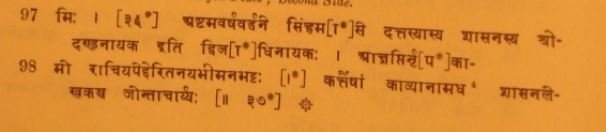
Fifth Plate ; Second Side.

>

TRANSLATION.[5]

[Up to line 36 the text is nearly identical with that of the Chellûr plates (ll. 1-42)].[6]

(Verse 7.) Having expelled this Yuddhamalla from the country and having crushed the other enemies, the terrible Râjabhîma, the younger brother of Ammarâja (I.), protected the earth for twelve years.

(V. 8.) His son Ammarâja (II.), the foremost of princes, before whom enemies prostrated themselves, ruled the country of Vêṅgî for twenty-five years.

(V. 9.) The son of king Râjabhîma (and) brother of king Amma (II.) by a second mother, king Dâna, (who was) skilled in all sciences, ruled for three years the earth to (its) four ends.

(V. 10.) Then after (the reign of) Dânârṇava, through the evil action of fate, the country of Vêṅgî was without a ruler for twenty-seven years.

____________________________________________________
[1] Read :.
[2] Read °.
[3] Read .
[4] Read °.
[5] It is my duty to acknowledge my indebtedness to Dr. Hultzsch for the translation of a number of verses, the meaning of which I could not make out.
[6] See the translation in South-Ind. Inscr, Vol. I. p. 57 f.

Home Page

>
>