



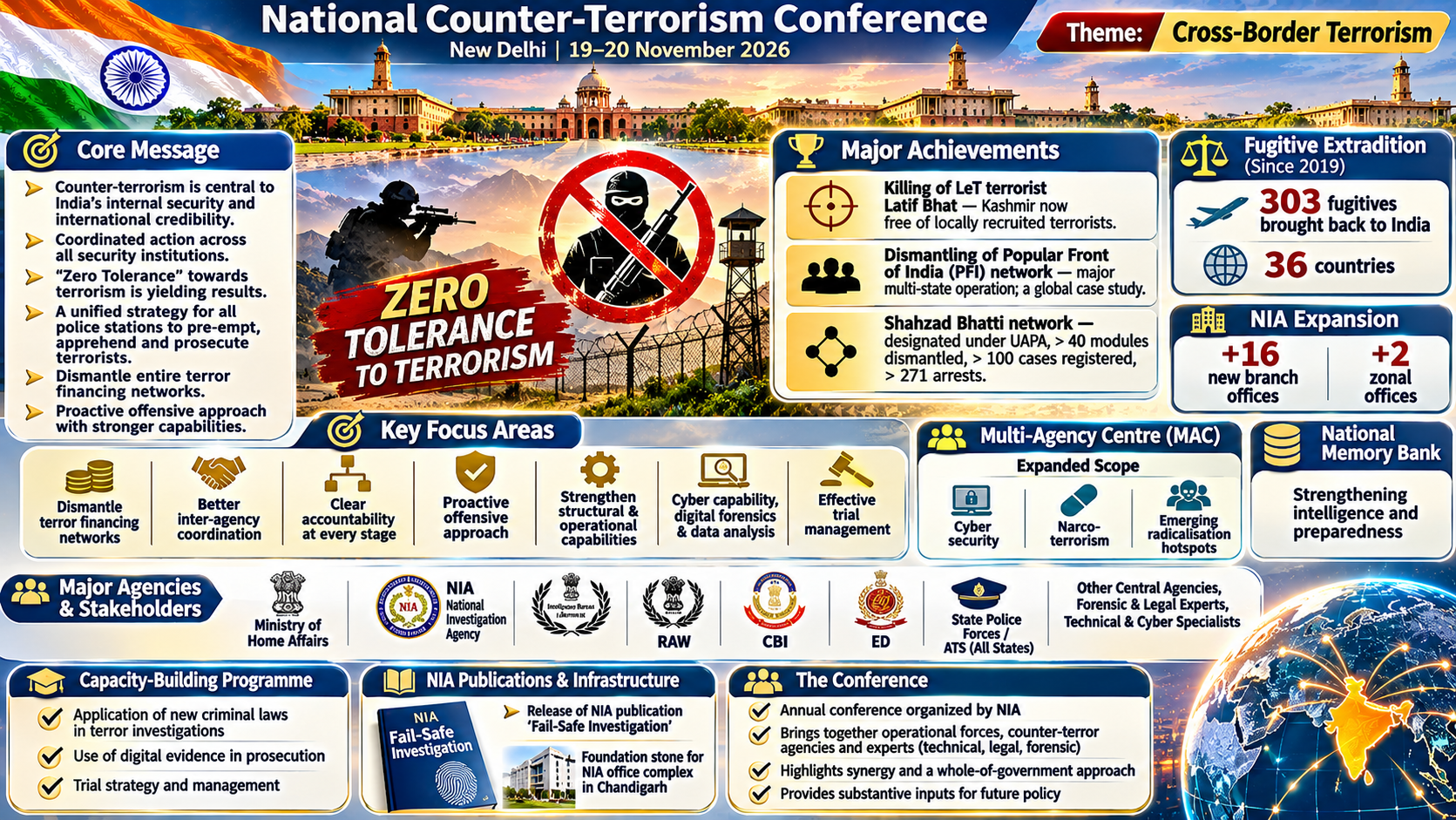
Union Home Minister Amit Shah innaugurated a two-day counter-terrorism conference in New Delhi on 19 November 2026. Making the inaugural session, he said that counter-terrorism is a central part of India's internal security and of its credibility with international partners. Coordinated action across the country's security institutions is the basis of that work.
He said India's ‘Zero Tolerance’ policy towards terrorism, is yielding positive results. He cited the recent killing of Lashkar-e-Taiba terrorist, Latif Bhat, and how that has made Kashmir free of locally recruited terrorists born in India. He called it "a major milestone in the fight against terrorism."
Featuring:





Going forward, he revealed that India is "building a system in which all police stations…
Going forward, he revealed that India is "building a system in which all police stations across the country will work on a unified strategy to combat terrorism." This will help agencies "apprehend terrorists and put them behind bars before they can carry out a terrorist attack." He called on all state police forces to study this model and implement it.
An area that needed more work is to bring back to India offenders hiding abroad. He recalled that since 2019, three hundred and three fugitives have been brought back to India from thirty six countries. He said India sees this as an essential mechanism to completely eliminate terrorism, organized crime, and drug-related problems. Obtaining evidence from foreign jurisdictions has led to such success.
Featuring:




He listed several areas of focus. One, is dismantling entire terror financing networks. To achieve…
He listed several areas of focus. One, is dismantling entire terror financing networks. To achieve this goal, he called for "better coordination" with agencies "responsible for financial investigations." Second, a need for a shared objective and clearly defined accountability at every stage. Third, strengthening the concept of a "proactive offensive approach" in counter-terrorism policy, with additional emphasis on "enhancing structural and operational capabilities." He said that once they discover a compelling case, "investigation must continue until the entire network is dismantled". He emphasized that every state needs a well-empowered and effective Anti-Terroir Squad or ATS that has excellent cyber capabilities, including cyber specialists. This will help garner "digital forensics and data analysis in counter-terrorism investigations" and help with the "effective management of trials."
He warned that "a simultaneous assault on the entire terror network" is essential for success against terrorism. Towards this end, the Union government is expanding the scope of the Multi-Agency Centre called MAC to include cyber security, narco-terrorism, and emerging radicalisation hotspots. With a National Memory Bank, India has laid a new foundation for strengthening our preparedness. Not only has the Government enhanced the legal powers of the National Investigation Agency or NIA, it is also expanding it to "sixteen new branch offices and two zonal offices." The NIA will also have the responsibility to "protect the interests of Indians residing abroad."
Featuring:



He recalled the dismantling of the Popular Front of India or PFI network across the…
He recalled the dismantling of the Popular Front of India or PFI network across the country. This is a significant example of effective coordinated operations by police forces across India. Police forces from eleven states, along with central agencies, jointly dealt a major blow to PFI network in a single night. He said this operation is now a case study for the entire world. He also cited the case of the Shahzad Bhatti network. After designating this as a terrorist organisation under Unlawful Activities (Prevention) Act of 1967 or UAPA, police agencies across the country dismantled more than forty of its modules, registered over hundred cases, and arrested more than two hundred and seventy one people.
During this conference, Shah released NIA publication ‘Fail-Safe Investigation’. Previously, he also laid the foundation stone for NIA office complex in Chandigarh.
Featuring:


This annual conference has steadily grown into a significant event bringing together operational forces, agencies…
This annual conference has steadily grown into a significant event bringing together operational forces, agencies working in the field of counter-terrorism, and experts from the technical, legal, and forensic domains. It offers the agencies and forces an opportunity to collectively examine matters that have bearing on national security and the threats arising from terrorism. As part of the 'whole of government approach,' the conference places particular emphasis on fostering synergy among all stakeholders through formal and informal channels. The conference aims at contributing substantive inputs towards the formulation of future policy by enabling coordinated and concerted action against terrorism. The NIA organizes this conference and this year's theme is "cross-border terrorism."
The conference is not just talk and networking. It will host a capacity-building training programme for state police personnel and practising professionals. The programme has been designed to equip participants in several areas including applying the new criminal laws in terror investigations, using digital evidence in prosecution, and trial strategy and management. Senior police officers of states and Union Territories, officers of central agencies and departments dealing with counter-terrorism, and experts from allied fields including law, forensics and technology are attending this conference.
Featuring:


Source: PIB; Economic Times; AIR; Ministry of Home Affairs
Source: PIB; Economic Times; AIR; Ministry of Home Affairs