


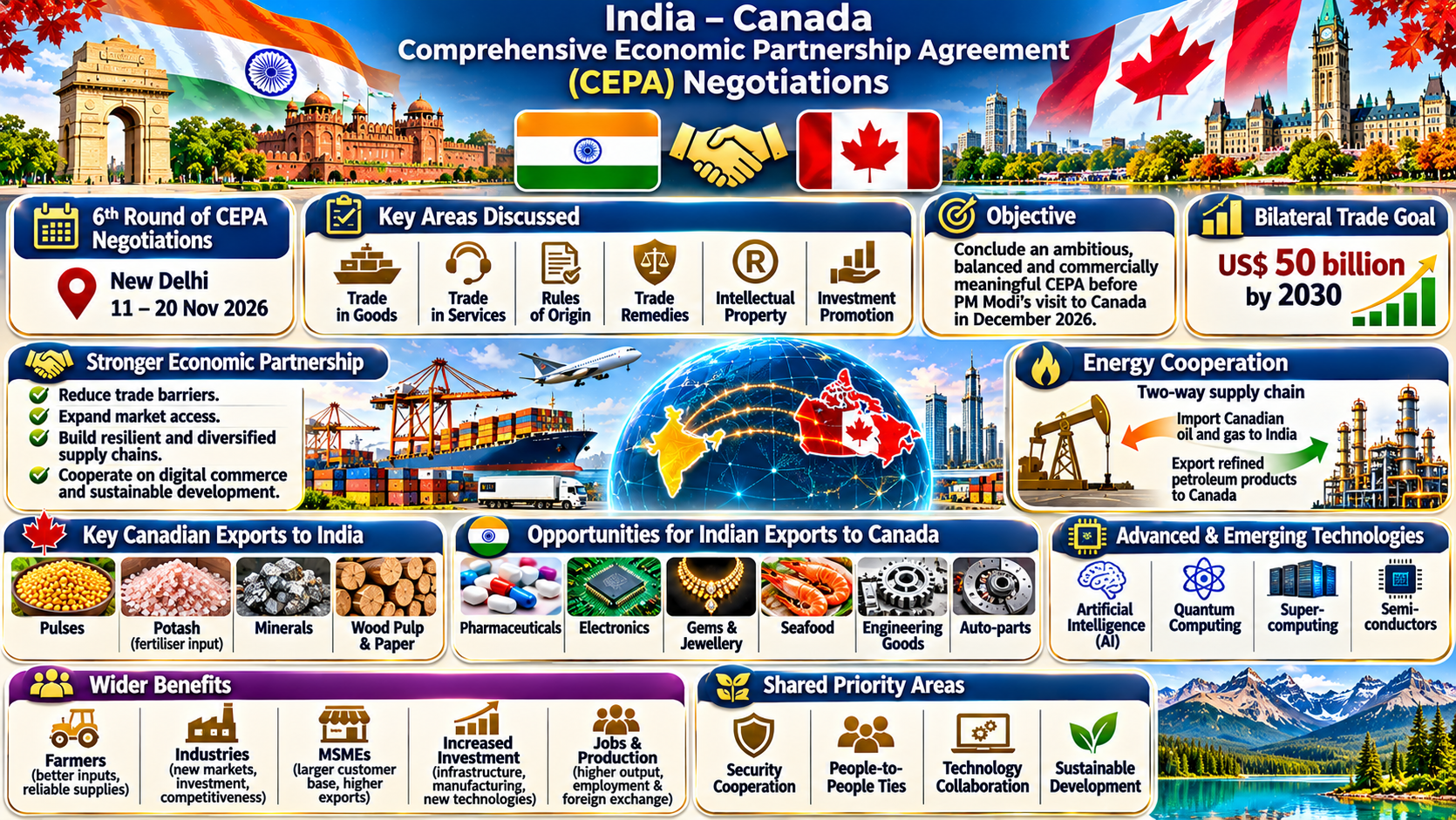
India and Canada finished the sixth round of negotiations for the India-Canada Comprehensive Economic Partnership Agreement or CEPA. Held in New Delhi from 11 to 20 November 2026, the negotiations covered several areas, including "Trade in goods, Trade in services, Rules of origin, Trade Remedies, Intellectual Property and Investment promotion." Both sides are working on very aggressive timelines. An Indian Ministry of Commerce and Industry release said both countries have reaffirmed their "shared commitment to concluding an ambitious, balanced and commercially meaningful agreement that delivers tangible benefits to farmers, industries, businesses and Micro, Small and Medium Enterprises (MSMEs) in both countries." The two countries are looking to conclude discussions before Prime Minister Narendra Modi visits Canada in December 2026.
Hindustan Times reported that the two countries are also exploring closer energy ties. They plan a two-way supply chain in which India would import Canadian oil and gas and export refined petroleum products to Canada. Earlier, the prime ministers of the two countries had agreed to cooperate on trade, energy, technology, security and people-to-people ties. People familiar with the matter said the two countries have reached near consensus on several chapters and concluded some others. The High Commission of India in Ottawa had earlier announced on X that Mr Modi will visit Canada on 11–12 December.
Featuring:





India imports several essential commodities from Canada, including pulses, potash, minerals, wood pulp and paper.…
India imports several essential commodities from Canada, including pulses, potash, minerals, wood pulp and paper. Stronger trade arrangements could help secure more reliable supplies of these inputs, benefiting Indian agriculture, fertiliser availability, manufacturing and infrastructure development. Greater cooperation could also reduce excessive dependence on a limited number of international suppliers.
Indian Ministry sources cited by Swarajya said the proposed CEPA would unlock new opportunities in trade and investment, strengthen resilient and diversified supply chains and further deepen the economic partnership between India and Canada. The agreement aims to reduce trade barriers and expand cooperation beyond traditional merchandise trade to include digital commerce and sustainable development. Reduced trade barriers and improved market access could benefit Indian pharmaceutical companies, electronics manufacturers, gems and jewellery exporters, seafood businesses, engineering firms and auto-parts manufacturers. Canada is already an important source of institutional and portfolio investment for India. A comprehensive trade pact could encourage further capital flows into infrastructure, manufacturing and emerging technology sectors. Smaller exporters and MSMEs could also gain access to a larger overseas customer base, potentially supporting production, employment and foreign exchange earnings. If the proposed CEPA or the wider partnership covers it, cooperation in artificial intelligence, quantum computing, supercomputing and semiconductors could give Indian companies and research institutions access to expertise, partnerships and new investment opportunities.
Featuring:


The two prime ministers have set a goal of taking bilateral trade to US$50 billion…
The two prime ministers have set a goal of taking bilateral trade to US$50 billion by 2030, up from US$8.66 billion in goods trade in FY 2024-25.
Source: PIB; Ministry of Commerce and Industry; Hindustan Times; Swarajya; Jagran Josh; Times of India
Featuring: