|
The Indian Analyst
|




North Indian Inscriptions |
INSCRIPTIONS OF THE SILAHARAS OF KOLHAPUR
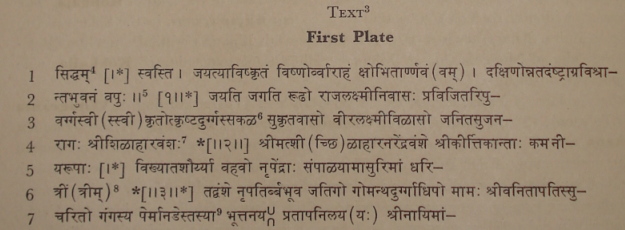
Daṇḍabrahman of Kuṇḍidēśa, but the latter cannot be identified. He is also said to have annexed the beautiful country of the Western King (probably south Koṅkaṇ .. The inscription is dated in the Śaka year 1037, the cyclic year being Manmatha, on Wednesday, the eighth tithi of the bright fortnight of Kārttika. The date can be completely verified. The tithi was current throughout the day on Wednesday, the 27th October A.D. 1115. The cyclic year was Manmatha according to the Southern luni-solar system. It was the day of the Vṛiśchika-saṅkrānti, though this is not stated in the present grant. The saṅkrānti occurred at 8 h. after mean sunrise. ..The object of the inscription is to record the grant, by Gaṇḍarāditya, of the village Ādage, in which two other villages, viz. Aṅkulage and Boppeyavāḍa were incorporated, to his feudatory Nōḷamba. The villages were exempt from the āruvaṇa tax. They were situated in the Miriñja-gampaṇa and Miriñja-dēśa. The grant was made at the King’s residence at Vaḷayavāḍa. ..The genealogy of the donee is given as follows:- In the Nigumba family was born Horima, who patronised the Jaina Saṅghas. His son was Bīraṇa, and the latter’s younger brother was Arikēsarin. Bīraṇa had a son named Kundāti, whose younger brother was Nāyima, who was a supporter of Jainism. Nāyima’s son was Noḷamba, the recipient of the present grant. He had the emblems of the golden fish and the lord of serpents, and had obtained a boon from the goddess Padmāvatī[1]. It is further stated that if the Nārgāvṇḍas of the village do their duty as the Nāyakas of the place, they will not get any (additional) golden coins for their maintenance, but if they fail to do their duty and act as they like, they will not be entitled even to koḍevaṇa[2]. The latter seems to be a cess imposed on the residents of the village.
.. As for the places mentioned in the present grant, Gōmantha, Tagara, and Vēṇugrāma have already been identified. Kuṇḍi-dēśa comprised the region round modern Beḷgaon. Miriñja is clearly Miraj in the Sāṅgalī District. Aṅkulage, which was situated in the gampaṇa or khampaṇa of Miriñja is probably Aṅkalī, about six miles west of Miraj, but no villages corresponding to ancient Ādage and Boppeyavāḍa can be traced in its neighbourhood. For the identification of Vaḷayavāḍa, see below, p. 226.
[1] She is the śāsana-devatā of the Tīrthaṅkara Pārśvanātha.
|
|||||||||||||||||||||||||||||||||||||||||||||||||||||||||||||||||||||||||||||||||||||||||||||||||||||||||||||||||||||
| > |
|
>
|