|
The Indian Analyst
|




North Indian Inscriptions |
INSCRIPTIONS OF THE SILAHARAS OF KOLHAPUR
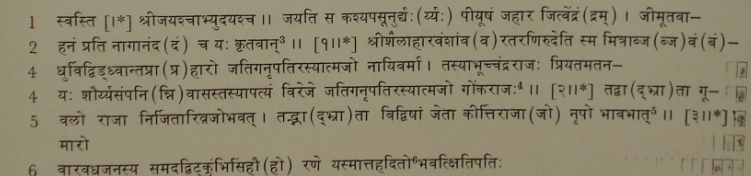
the two occasions mentioned above : (1) sixteen vṛittis (maintenance grants) of three nivartanas each, together with a residential house, in the village Guḍāya, comprising also (the hamlet of) Gālaguṭṭisajayāpallī in the Vakavaṁna ścholla (or territorial division) which he donated to sixteen Brāhmaṇas after getting them married, (and) one vṛitti granted to the Manager who arranged for the feeding of a lakh Brāhmaṇas at Prayāga, and (2) two vṛittis donated as dakshiṇā at the pāraṇā of the Pañchalāṅgala vrata; three nivartanas, one to each of the three gods. viz. Īśvara (Śiva), Buddha and Arhat (Tīrthaṅkara) installed in the temples erected near the tank Gaṇḍasamudra constructed by him in the village of Irukuḍi included in the Miriñjadēśa ; four nivartanas to the headman of the village of Guḍālaya and one vṛitti for maintaining a perpetual lamp in the temple of Guḍālēśvara for the performance of agnishṭikā [1], for the maintenance of a prapā, and for the supply of a tāmbūla of good betel leaves. Besides, he continued the previously made gifts of (1) one nivartana for the worship of Guḍālesvara and (2) half a nivartana for the worship of Mahadeva installed to the west of that village. .. In lines 51-53 the inscription mentions the poet Dāmōdara, who composed this grant, and who is described as proficient in Nyāya, and the scribe Appōja, who wrote it on the plates.
.. Pandit Bhagvanlal did not try to identify the localities mentioned in the present grant. Tagara has already been identified. The village Tīravāḍa, where the king was encamped at the time of the grant, may be Tiravaḍe in the Bhudargaḍ tālukā of the Kolhāpur District. Guḍāya, where the land granted was situated, cannot be definitely identified, but one of its hamlets Gālaguṭṭi may be mōdern Gārgoṭī in the Bhudargaḍ tālukā. Miriñja-dēśa is evi- dently the name of the territory round modern Miraj in the Sāṅglī District. Irukuḍi may be Rukaḍī near Kolhāpur. It has still a large tank. Guḍālaya can be identified with Guḍāla in the Rādhānagarī tālukā of the Kolhāpur District. Finally, Prayāga where Gaṇḍarāditya caused a lakh Brāhmaṇas to be fed is not the well known tīrtha (modern Allāhābād) in North India, but the place of that name, regarded as holy even now, where the Bhōgāvatī and the Kāsārī, two tributaries of the Pañchagaṅgā meet, about four miles north-west of the Kolhāpur City. The other places cannot be identified. TEXT [2]
[1] The agnishṭikā is performed in the cold seasons of Hēmanta and Śiśira. It consists in the kindling of
fire with the recitation of appropriate mantras and the feeding of Brāhmaṇas and suppliants every morning
and evening, commencing on an auspicious day in the month of Mārgaśīrsha. It is believed to yield
great religious merit in the next world as the fire is enjoyed by the people who sit round it in the cold
seasons and talk on all sorts of matters, political, religious and social. References to agnishṭikā occur in
the inscriptions and the literature of the period. See e.g. the Purushottampurī plates of Rāmachandra,
Śaka 1232, line 78. The Līḷācharita, a Mahānubhāva work of the Yādava period, also refers to it. See
Līḷācharita, ed. by Tulpule Pūrvārdha, Līḷā No. 341 ; Uttarārdha, Līḷā No. 240.
|
|||||||||||||||||||||||||||||||||||||||||||||||||||||||||||||||||||||||||||||||||||||||||||||||||||||||||||||||||||||
| > |
|
>
|