|
The Indian Analyst
|




North Indian Inscriptions |
INSCRIPTIONS OF THE SILAHARAS OF NORTH KONKAN
TRANSLATION Success 1 May there be victory and prosperity ! (For the translation of verse 1, see that of v. 1 in the Ṭhāṇā plates of Arikēsarin, No. 8)
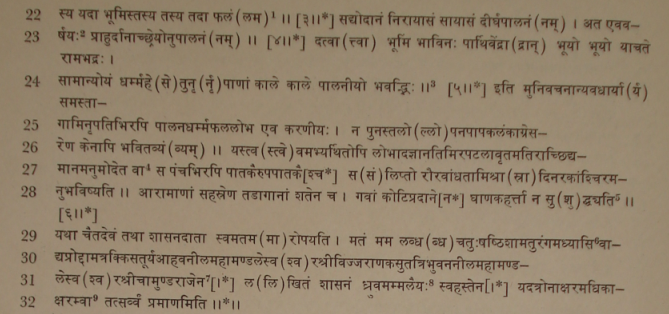
..(Line 2). During the beneficial and victorious rule of the Mahāmaṇḍalēśvara, the illustrious Chhinturāja,[10] who has obtained the right to the five mahāśabdas, who is adorned with all royal titles such Mahāsāmantādhipati, ‘the lord of the City of Tagara’, ‘a king of the Śīlāra family,’ ‘a scion of the family of Jīmūtavāhana,’ ‘(he) who has the ensign of the golden Garuḍa,’ ‘(he) who is an ocean of pride,’ ‘(he) who is an admantine cage to suppliants,’ and so forth , while the illustrious Nāgaṇaiya[11] is his Mahāmātya and the illustrious Vāupaiya is his Mahāsāndhivigrahika, and while the Mahāmaṇḍalēśvar,. the illustrious Chāmuṇḍarāja is governing the Saṁyāna-pattana, which has been made over to him by the Mahāmaṇḍalēśvara Chhinturaja.
..
(Line 6). Now, ,while the Mahāmaṇḍalēśvara, the illustrious Chāmuṇḍarāja, who,
by his religious merit, has obtained the right to the five mahāśabdas, who is adorned with all
princely titles such as Mahāsāmantādhipati, ‘Vikramāditya by his own valour,’ ‘the Chakravartin (foremost) in adventures,’ ‘a serpent (i.e. destroyer) to the chiefs of the circle of his enemies’
‘the destroyer of the rampart and the King of Lāṭa,’ ‘the bolt which obstructs the prosperity
of the enemies’, ‘(he) who brightens (with fame) both the families’[12] ‘the goad to the elephants
that are his enemies,’ ‘an ornament (nīla)[13] of the three worlds’ and so forth, is governing
Saṁyāna, he addresses all persons, whether connected with himself or others, such as the
[1] Metre of verses 3 and 4 : Anushṭubh.
|
|||||||||||||||||||||||||||||||||||||||||||||||||||||||||||||||||||||||||||||||||||||||||||||||||||||||||||||||||||||
| > |
|
>
|