The Indian Analyst
 

North Indian Inscriptions


Contents

Introduction

Preface

Contents

List of Maps and Plates

Abbreviations

Additions and Corrections

Images

Introduction

Political History

The Early Silaharas

The Silaharas of North Konkan

The Silaharas of South Konkan

The Silaharas of Kolhapur

Administration

Religious Condition

Social Condition

Economic Condition

Literature

Architecture and Sculpture

Texts And Translations  

Inscriptions of the Silaharas of North Konkan

Inscriptions of The Silaharas of South Konkan

Inscriptions of The Silaharas of kolhapur

APPENDIX I  

Additional Inscriptions of the Silaharas

APPENDIX II  

A contemporary Yadava Inscription

Index

Other South-Indian Inscriptions 

Volume 1

Volume 2

Volume 3

Vol. 4 - 8

Volume 9

Volume 10

Volume 11

Volume 12

Volume 13

Volume 14

Volume 15

Volume 16

Volume 17

Volume 18

Volume 19

Volume 20

Volume 22
Part 1

Volume 22
Part 2

Volume 23

Volume 24

Volume 26

Volume 27

Tiruvarur

Darasuram

Konerirajapuram

Tanjavur

Annual Reports 1935-1944

Annual Reports 1945- 1947

Corpus Inscriptionum Indicarum Volume 2, Part 2

Corpus Inscriptionum Indicarum Volume 7, Part 3

Kalachuri-Chedi Era Part 1

Kalachuri-Chedi Era Part 2

Epigraphica Indica

Epigraphia Indica Volume 3

Epigraphia
Indica Volume 4

Epigraphia Indica Volume 6

Epigraphia Indica Volume 7

Epigraphia Indica Volume 8

Epigraphia Indica Volume 27

Epigraphia Indica Volume 29

Epigraphia Indica Volume 30

Epigraphia Indica Volume 31

Epigraphia Indica Volume 32

Paramaras Volume 7, Part 2

Śilāhāras Volume 6, Part 2

Vākāṭakas Volume 5

Early Gupta Inscriptions

Archaeological Links

Archaeological-Survey of India

Pudukkottai

INSCRIPTIONS OF THE SILAHARAS OF NORTH KONKAN


Senior Treasury Officer, was Mahāpradhāna Lakshmaṇaiyaprabhu[1] and his Junior Treasury officer was Chhitamaiyaprabhu. The Senior Treasury Officer Lakshmaṇaiya wrote the present grant.

..As for the localities mentioned in the present grant, the donated village Vaḍavalī still retains its ancient name and is situated six miles north of Ṭhāṇā. Karakūṭa, the principal town of the vishaya (district) in which it was situated, cannot now be traced. The Vareṭikā vishaya, in which the donated field was situated, must have comprised territory not far from Vaḍavālī, as the Brāhmaṇa resident of Vaḍavalī was ‘to enjoy’ it, but it cannot now be traced in its neighbourhood. Similarly, the village Mōra, in which the donated field was situated, cannot also be identified now.

>

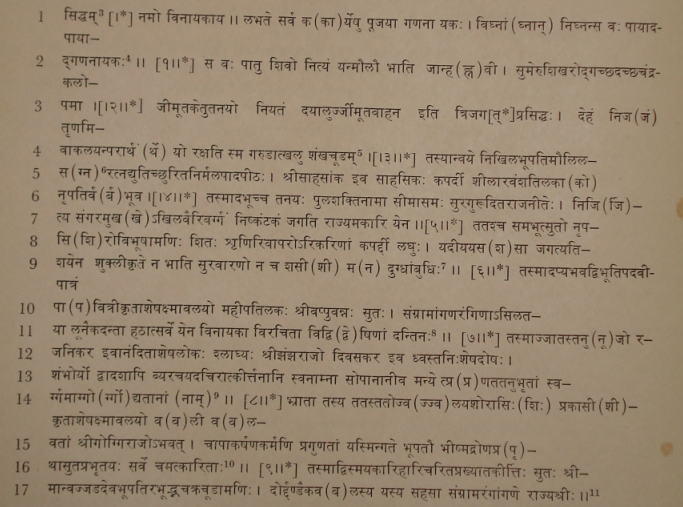
TEXT[2]
First Plate

images/111

_________________________________________________

[1] He is mentioned in No. 21, line 9, No. 22, line 7, and No. 23, line 45.
[2] From the facsimiles in J.B.B.R.A.S., Vol. XXI (1902), pp. 505 f.
[3] Expressed by a symbol.
[4] Metre of verses 1 and 2 : Anushṭubh.
[5] Metre of verses 3-5 : Vasantatilakā.
[6] Read नूत्न as in the cognate plates.
[7] Metre : Pṛithvī.
[8] Metre : Śārdūlavikrīḍita.
[9] Metre : Sragdharā.
[10] Metre of verses 9 and 10 : Śārdūlavikrīḍita.
[11 This mark of punctuation is redundant.


<< - 167 Page

>
>