The Indian Analyst
 

North Indian Inscriptions


Contents

Introduction

Preface

Contents

List of Maps and Plates

Abbreviations

Additions and Corrections

Images

Introduction

Political History

The Early Silaharas

The Silaharas of North Konkan

The Silaharas of South Konkan

The Silaharas of Kolhapur

Administration

Religious Condition

Social Condition

Economic Condition

Literature

Architecture and Sculpture

Texts And Translations  

Inscriptions of the Silaharas of North Konkan

Inscriptions of The Silaharas of South Konkan

Inscriptions of The Silaharas of kolhapur

APPENDIX I  

Additional Inscriptions of the Silaharas

APPENDIX II  

A contemporary Yadava Inscription

Index

Other South-Indian Inscriptions 

Volume 1

Volume 2

Volume 3

Vol. 4 - 8

Volume 9

Volume 10

Volume 11

Volume 12

Volume 13

Volume 14

Volume 15

Volume 16

Volume 17

Volume 18

Volume 19

Volume 20

Volume 22
Part 1

Volume 22
Part 2

Volume 23

Volume 24

Volume 26

Volume 27

Tiruvarur

Darasuram

Konerirajapuram

Tanjavur

Annual Reports 1935-1944

Annual Reports 1945- 1947

Corpus Inscriptionum Indicarum Volume 2, Part 2

Corpus Inscriptionum Indicarum Volume 7, Part 3

Kalachuri-Chedi Era Part 1

Kalachuri-Chedi Era Part 2

Epigraphica Indica

Epigraphia Indica Volume 3

Epigraphia
Indica Volume 4

Epigraphia Indica Volume 6

Epigraphia Indica Volume 7

Epigraphia Indica Volume 8

Epigraphia Indica Volume 27

Epigraphia Indica Volume 29

Epigraphia Indica Volume 30

Epigraphia Indica Volume 31

Epigraphia Indica Volume 32

Paramaras Volume 7, Part 2

Śilāhāras Volume 6, Part 2

Vākāṭakas Volume 5

Early Gupta Inscriptions

Archaeological Links

Archaeological-Survey of India

Pudukkottai

INSCRIPTIONS OF THE SILAHARAS OF NORTH KONKAN
 

images/48

>
_____________________________________________________

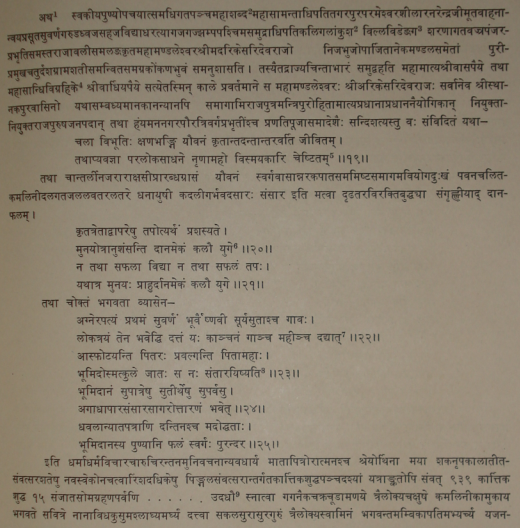
[1] This draft of the formal portion of the grant occurs mutatis mutandis in the Berlin Museum plates of Chhittarāja and several later grants of the Śilāhāras.
[2] The translator, who did not understand this biruda, translated it as ‘when extended fame had been attained’.
[3] The English translation has ‘an elephant hook in the forehead of the world, pleased with increasing vice a flamingo bird in the pool decked with flowers like those in paradise’. Nothing corresponding exactly to this occurs in any Śilāhāra grants. This and the next expression have been taken from the Janjirā plates (Set I) of Aparājita (No. 5).
[4] The translator, who did not understand this title, rendered it as ‘the very religiously purfied;. A MahāSāndhivigrahika is usually named in connection.
[5] Metre : Vaṁśastha.
[6] Metre of verses 20 and 21 : Anushṭubh.
[7] Metre : Indravajrā.
[8] Metre of verses 23-27 : Anushṭubh.
[9] The English translation has ‘in the opposite sea resembling the girdle round the waist of the female Earth, tinged with a variety of rays like many exceedingly bright rubies, pearls and other gems with water whose mud had become musk through the frequent bathing of beautiful goddesses’. Nothing like this occurs in any Śilāhāra grant.


<< - 65 Page

>
>
