|
The Indian Analyst
|




North Indian Inscriptions |
INSCRIPTIONS OF THE SILAHARAS OF SOUTH KONKAN
known as Laṅkā or Siṁhala. There are other references also supporting this identification.[1] So the Śilāhāras of South Kōṅkaṇ probably had their original home in the Goā territory. ..Ambhojaśambhu, whose disciple Ātrēya received the present grant, is described as having belonged to the Karkarōṇī branch of the Mattamayūra clan. Karkarōṇī has not been identified, but Mattamayūra was a celebrated centre of Śaivism in that period.[2] The Āchāryas of this place belonged to the Śaiva, as distinguished from the Pāśupata, school of Śaivism. Their names, like that of Ambhōjaśambhu of the present plates, ended in śiva or ṡambhu as those of the Pāśupatas ended in rāśi. Mattamayūra was probably the ancient name of modern Kadwāhā in Central India, where there are remains of monas- trey and not less than fourteen Brāhmaṇical temples, all belonging to the 10th century A.D. As Mr. Garde, Director of the Archaeological Survey, Gwalior State, has remarked, ‘such a large group of temples is found at no other single place in the Gwalior State. Kadwāhā thus deserves to be styled the Khajurāhō or Bhuvanēśvara of Gwālior. Ambhōjaśambhu thus seems to have come to South Kōṅkaṇ from that distant place in Central India. We have other instances of the Āchāryas of the Mattamayūra clan having gone to even farther places for the propagation of their sect. .. Of the localities mentioned in the present plates, Siṁhala has already been identified with the Gōa island. Chandrapura, the chief town in the Chandramaṇdala, is Chāndor on the Parodā river, south of Goā. Chēmūlya is Chaul in the Kolābā district, about 30 miles south of Bombay. Balipattana is probably the ancient name of modern Khārepāṭaṇ. Most of the donated villages and the places forming their boundaries cannot be identified now in the Ratnāgiri District, but Gavahaṇa may be Gavhāṇe in the Dēvgaḍ tālukā, and Vyaṅgarula, modern Vēṅgurlē, the chief town of the Vēngurle mahāl of the Ratnāgiri District.
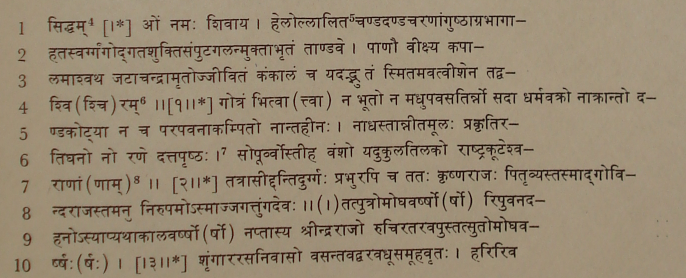
TEXT[3]
[1] Ep. Ind., Vol. XIII, p. 369. Some Śilāhāra kings assumed the biruda Niś-śaṅka-Laṅkēśvara evidently to
indicate their conquest of the Goā territory.
|
|||||||||||||||||||||||||||||||||||||||||||||||||||||||||||||||||||||||||||||||||||||||||||||||||||||||||||||||||||||
| > |
|
>
|