The Indian Analyst
 

North Indian Inscriptions


Contents

Introduction

Preface

Contents

List of Maps and Plates

Abbreviations

Additions and Corrections

Images

Introduction

Political History

The Early Silaharas

The Silaharas of North Konkan

The Silaharas of South Konkan

The Silaharas of Kolhapur

Administration

Religious Condition

Social Condition

Economic Condition

Literature

Architecture and Sculpture

Texts And Translations  

Inscriptions of the Silaharas of North Konkan

Inscriptions of The Silaharas of South Konkan

Inscriptions of The Silaharas of kolhapur

APPENDIX I  

Additional Inscriptions of the Silaharas

APPENDIX II  

A contemporary Yadava Inscription

Index

Other South-Indian Inscriptions 

Volume 1

Volume 2

Volume 3

Vol. 4 - 8

Volume 9

Volume 10

Volume 11

Volume 12

Volume 13

Volume 14

Volume 15

Volume 16

Volume 17

Volume 18

Volume 19

Volume 20

Volume 22
Part 1

Volume 22
Part 2

Volume 23

Volume 24

Volume 26

Volume 27

Tiruvarur

Darasuram

Konerirajapuram

Tanjavur

Annual Reports 1935-1944

Annual Reports 1945- 1947

Corpus Inscriptionum Indicarum Volume 2, Part 2

Corpus Inscriptionum Indicarum Volume 7, Part 3

Kalachuri-Chedi Era Part 1

Kalachuri-Chedi Era Part 2

Epigraphica Indica

Epigraphia Indica Volume 3

Epigraphia
Indica Volume 4

Epigraphia Indica Volume 6

Epigraphia Indica Volume 7

Epigraphia Indica Volume 8

Epigraphia Indica Volume 27

Epigraphia Indica Volume 29

Epigraphia Indica Volume 30

Epigraphia Indica Volume 31

Epigraphia Indica Volume 32

Paramaras Volume 7, Part 2

Śilāhāras Volume 6, Part 2

Vākāṭakas Volume 5

Early Gupta Inscriptions

Archaeological Links

Archaeological-Survey of India

Pudukkottai

INSCRIPTIONS OF THE SILAHARAS OF SOUTH KONKAN


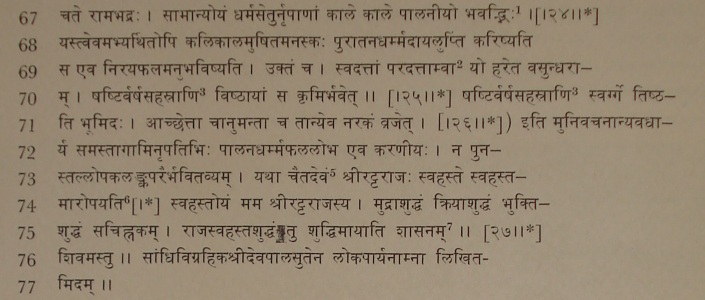
images/169

TRANSLATION

Success ! Om ! Obeisance to Siva !

..(Verse 1). May that smile of Śiva afford you protection for a long time‒(the smile which appeared on his face) when he saw at the time of his tāṇḍava (dance) that the skull in his hand had collected the pearls dropping from cavities of the oyster-shells turned up from the heavenly Gaṅgā, whose stream was struck by the tip of the large toe of his mighty staff-like leg raised sportively, and that the skeleton on his body had marvellously come to life by the dripping of nectar from the moon in his matted hair !

>

..(V. 2). Wonderful is that vaṁśa (family)[8] of the Rāshṭrakūṭa lords, which is the ornamental mark of the race of Yadu−which, unlike the ordinary vaṁśa (bamboo), has not risen to power after destroying (other members of ) the family unlike the ordinary bamboo (vaṁṡa) which comes out after splitting the ground; which gives no shelter to drunkards as the bamboo does to the bees; which is never opposed to religion as the bamboo is curved by nature; which is never overwhelmed even by a crore of army-men as the bamboo can be bent by the (curved) tip of a stick; which is (never) terrified by the enemy as the bamboo is shaken by wind; which is not endless[9] as the bamboos are innumerable; which has not caused loss to its own original territory as the bamboo strikers roots deep into the ground; which, by its nature, takes pleasure in enjoyment as the bamboo is not thick by nature; (and) which never shows its back to the enemy in fighting as the bamboo falls down (on the ground).

..(V. 3). There was (first) the king Dantidurga; thereafter, there flourished his uncle Kṛishṇarāja (I); after him, Gōvindarāja (II); he was followed be Nirupama (Dhruva), and after him, Jagattuṅga (Gōvinda III). His son was Amōghavarsha (I), who was like fire to the forest of his enemies; then Akālavarsha (Kṛishṇa II); then his grandson, the illus-
_________________

[1] Metre : Salini.
[2] Read परदत्तां वा.
[3] Read षष्टिं वर्षसहस्राणि.
[4 Metre of verses 25 and 26 : Anushṭubh.
[5 ]Read तथा after चैतदेवम्.
[6] Usually the reading in the inscriptions of the Śilāhāras of North Koṅkaṇ in a similar context is] लेखकहस्तेन स्वहस्तमारोपयति.
[7] Metre : Anushṭubh.
[8] A comparison is made here between the vaṁsa (family) of the Rāshṭrakūṭas and vaṁśa (a bamboo) by means of paranomastic adjectives.
[9] The Rāshṭrakūṭa family had come to an end at this time. However, as Kielhorn has shown, the reference to its downfall is inappropriate in the context.


<< - 16 Page

>
>