|
The Indian Analyst
|




North Indian Inscriptions |
INSCRIPTIONS OF THE SILAHARAS OF SOUTH KONKAN
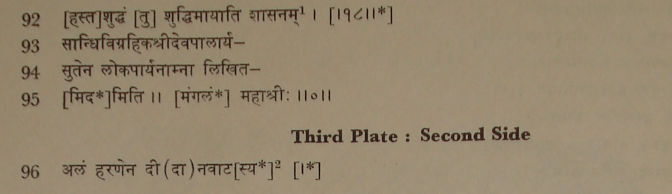
TRANSLATION Success ! Hail ! ..(Verse 1). May the fortune of living beings who perform the religious observances which are the most important in their worldly existence, be in abundance by the grace of their favourite deity ! .. (For the translation of verses 2-12, see that of verses 11-21 in the Khārepātaṇ plates.) .. (Line 32). In prosperous Balipaṭṭana situated in the kingdom of Mahāmāṇḍalika Raṭṭarāja, which is increasing and venerable like the Sun and the Moon— .. Raṭṭarāja, having called together the residents of the five great Maṭhas, guilds, artisans and the chief Amātyas, informs them as follows :â
.. âBe it known to you. On the occasion of the Uttarāyaṇa Saṅkrānti, on Sunday, the first tithi of the dark fortnight of Pushya (i.e. Pausha) in the (cyclic) year Sādhāraṇa in the years nine hundred increased by thirty-two, which have elapsed by the era of the Śaka King, in figures also 932, the illustrious Raṭṭarāja, adorned with all royal titles, has, by pouring water his own hand on the hand (of the donee), granted to Saṅkamaiya, son of the Brāhmaṇa Sēṇāvaї Nāgamaiya, a rice-field yielding two crops annually in the rice-village of Kalvāla, with . . . .[3] an orchard of areca-nuts was also given to him as a means of livelihood[4] of a Brāhmaṇa named Chhāṭhavaiya, (son of?) Kuṁvaraiya, grandson of the Brāhmaṇa Sañjhaiya, residing in the hamlet named Āvaḍi, situated to the west of the agrahāra village Palaürē, for (the religious merit of) his grand-daughter Annaṇā,. . . the well-known boundaries of the orchard being as follows—on the east, a stone temple; on the south the river ; on the west, the sea near Vōribhāṭhā; on the north, (the village) Gōvōma. .. (Line 61). The sons and grandsons of the illustrious Raṭṭarāja, should preserve this gift as tax-free, with all the exemptions in favour of the sons and grandsons of the Brāhmaṇa. If this gift is confiscated, there would be a great sin. And it has been said by the sagesâ ..(Here follow three benedictory and imprecatory verses.) .. (Line 75). He who, though thus entreated, will confiscate this old religious gift, his mind being clouded by the Kali Age, will experience the effect of his action in a hell. .. (Here follow two similar verses.) ..(Line 84c). Having understood these saying of the sages, all future kings should covet only the religious reward of the preservation of this gift and should not incur any infamy due to its confiscation.
..In confirmation of this gift, the illustrious Raṭṭarāja puts his hand to his signature.
[1] Metre : Anushṭubh.
|
|||||||||||||||||||||||||||||||||||||||||||||||||||||||||||||||||||||||||||||||||||||||||||||||||||||||||||||||||||||
| > |
|
>
|