|
The Indian Analyst
|




South Indian Inscriptions |
EPIGRAPHIA INDICA NANDSA YUPA INSCRIPTIONS
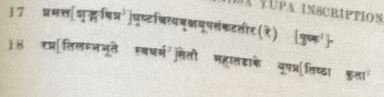
TRANSLATION (References are to the lines in inscription B.) Line 1 Be it auspicious ! On the full-moon day of (the month) of Chaitra (of the year) 282 by the Kṛita (era). Ll. 1-4 On the afore-mentioned (day), king [Śrī ]sōma, having caused by means of his valour, remarkable on account of the qualities of his prowess, the great Ēkashshṭirātra sacrificial session, (a source of) incalculable merit, to descend down to the country of the Mālava republic,─(the sacrificial session, which was as welcome) as the sight of the new moon. Ll. 4-5 having supported the yoke (of administration) descending down from (his) father and grandfather, Ll. 5-6 having covered (i.e. filled) the ample space between the sky and the earth with his unsurpassable fame, Ll. 6-7 having made the great prosperity produced by the richness (i.e. excellence) of his karman (i, bravery, ii, religious merit) (appear like the result of) his own spiritual power,
Ll. 7-8 having offered on the sacrificial ground in Agnivaiśvānara fires, Brāhmaṇas (by caste), Vasōr=dhārā oblation series,[3] magical as it were, (as it produces the satisfaction of) the stream of all desires,[4] Ll. 14-16 a fee of several hundreds of thousands of cows (was offered) by [Śrī ?]sōma, the leader of the Sōgis, son of Jayasōma, grandson of Prabhāgra(?)vardhana, dancer at victory, born in Mālava stock, as famous as the royal stock of the Ikshvākus, Ll. 12-14 (king [Śrī ?] sōma), who was experiencing (i.e., having), on account of the extent of his excellent qualities, genuine human qualities in no way different form (i.e. inferior to) (those of) Manu. Ll. 9-12 who had formed a continuous (i.e., standing) resolution to follow the footsteps of the ancient royal sages in connection with the full protection of his subjects, the (construction of) white (i.e., splendid) assembly halls and rest-houses, (the digging of) wells and tanks, (the erection of) temples, (the grant of) gifts at sacrifices, and (the telling of) truth, and who had thus left no room for sin, Ll. 8-9 (and) who had given space (i.e., building sites or lands) to the temples (literally, establishments) of Brahmā, Indra, Prajāpati, the great sages and Vishṇu. Ll. 16-18 The (stone) yūpa pillar (was erected at the end of the sacrificial session) in the great tank, which is a landmark of Dharma,[5] which is (as it were) a censure (i.e., a rival) of Pushkara (lake) and the bank of which is full of yūpas of holy trees against which bulls with full youthful vigour scratch their horns. _______________________________________________
[1] The letters in the brackets are supplied from the text of the inscription A. | ||||||||||||||||||||||||||||||||||||||||||||||||||||||||||||||||||||||||||||||||||||||||||||||||||||||||||||||||||||||||||||||||||||||||||||||||||
| > |
|
>
|