|
The Indian Analyst
|
|
South Indian Inscriptions |
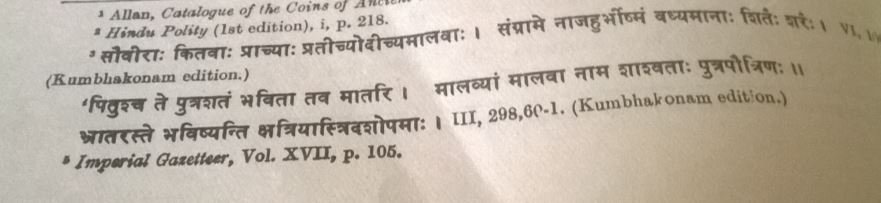
EPIGRAPHIA INDICA NANDSA YUPA INSCRIPTIONS reproduce parts of the legend Mālavānāṁ jayaḥ, as Mr. Allan has recently suggested,1 or they may be contraction of Mahārāja followed by his individual name as Jayaswal had thought.2 It has to be admitted that neither explanation is convincing. There is, however, no doubt that the Mālavas were a people of great antiquity in ancient India, and that they were enjoying a high status and respectability even in the epic period. In the great war between the Pāṇḍavas and the Kauravas, they had thrown in their lot with the latter. And on several critical occasions their battalions had saved Bhīshma himself.3 The mother of Kichaka was a Mālava princess and so was the wife of the Madra king Aśvapati, the father of famous Sāvitrī. Yama, the god of death, informed Sāvitrī that the hundred sons that would be born to her father and Mālavī mother as a result of one of his boons, would be known as Mālavas.4 The political geography of the present version of the Mahābhārata generally holds good for the period between 300-100 B.C. The above statement of Yama would therefore lead us to infer that during this period the Mālavas were closely allied to the Madras. The latter are known to have been in the occupation of the Central Punjab ; the Mālavas were most probably their southern neighbors.
The Mālava-gaṇa-vishaya or the country of the Mālava tribe, which is referred to in the present inscriptions was, however, not located in the Southern Punjab. It was obviously a portion of Eastern Rajputana, where Nāndsā is situated. The fact is that during the different periods of Indian history different tracts were known as Mālava country. Besides Mālwā, the well known province in Central India, even to-day a large part of the Southern Punjab, comprising the districts of Ferozepore and Ludhiana and the Indian States of Jīnd, Patiāla, Nābhā and Mālerkoṭlā is known as Mālwā. There is no doubt a tradition to the effect that this name is a modern one, the title of Mālava Singh having been conferred upon the Sikhs of this tract by Banda Bairāgi in the 18th century, who promised that the tract would be as fruitful as Mālwā.5 There does not seem to be any truth in this tradition. We have already seen that one of the boons given to Sāvitrī clearly shows that the Mālavas were close allies and neighbours of the Madras, probably occupying the territory to the south of the latter’s. It is precisely this territory that is now being occupied by the Mālava Sikhs. The Mahābhārata, however, refers to the Mālavas of the east, the north and the west.3 It would therefore appear that the Southern Punjab was not the only tract occupied by them in c. 300 B.C. In numerous places in the epic the Mālavas are closely associated with the Kshudrakas ; the dvandva compound, Kshudraka-Mālavāḥ is usually used to denote them. Thus the Kshudrakas and the Mālavas had come together to offer tribute to Yudhishṭhira at the time of his Rājasūya sacrifice (II, 78,90) ; in the disposition of the Kaurava forces on the eve of the great war, the battalions of the Kshudrakas and the Mālavas were grouped together (V, 57, 18) ; both of them suffered severely when Arjuna had launched a heavy attack on the Kaurava forces on the third day of the great war (VI, 59,139). This close association of the Kshudrakas and the Mālavas, disclosed by the great epic, is confirmed by the Greek historians of Alexander the Great. They describe how the leaders of these tribes, whom they name as Oxydrakai and Malloi, had decided to offer a joint resistance to Alexander the Great, and how Alexander smashed the _______________________________________________
| ||||||||||||||||||||||||||||||||||||||||||||||||||||||||||||||||||||||||||||||||||||||||||||||||||||||||||||||||||||||||||||||||||||||||||||||||||
| > |
|
>
|