|
The Indian Analyst
|
|
South Indian Inscriptions |
EPIGRAPHIA INDICA the Mēsha-saṅkrānti falling in Chaitra. The grant was evidently made to the Brāhmaṇa for reciting certain sacred texts on the occasion of the vishuva or Mēsha-saṅkrānti.[1] The Supratishṭha āhāra in which the village Vēlusuka was situated is already known from two other Vākāṭaka charters, viz., the Poona plates[2] of Prabhāvatīguptā and the Kōṭhūraka grant[3] of Pravarasēna II. Its location was uncertain until the discovery of the Kōṭhūraka grant. I have already shown in connection with the identification of the places mentioned in that grant that the āhāra roughly corresponded to the modern Hiṅgaṇaghāṭ tahsil of the Wardhā District. The present grant indicates that the āhāra extended a little southwards and comprised the northern parts of the Warorā and Yeotmāl tahsils of the Chāndā and the Yeotmāl Districts respectively. The village Vēlusuka in which the donated land was situated cannot now be traced, but it seems to have occupied the same position as modern Chiñchmaṇḍal which lies just on the south of the elbow of the Wunnā, for all the boundary villages mentioned in the present charter can be traced in the vicinity of it in the respective directions. Thus Gṛidhra-grāma is Gadeghāṭ about 8 miles to the west and Nīlī-grāma is Nīljai about 5 miles to the east of Chiñchmaṇḍal. Kadambasaraka is Kōsara about 2 miles to the north. Kōkilā is modern Khairi which lies about 4 miles to the north-west. The read from Marḍi to Khairi passes by Chiñchmaṇḍal at a distance of only about a mile to the south. All the boundary villages can thus be satisfactorily identified in the vicinity of Chiñchmaṇḍal. It is again noteworthy that Chiñchmaṇḍal lies only about 5 miles to the south of Waḍgaon where the plates were found. The river Hiraṇyā is the modern Erai which flows from north to south in the Warorātahsiland ultimately joins the Wardhā. Ēkārjunaka where the done resided is probably Arjuni on the left bank of the Erai, about 16 miles north-east of Warorā the chief town of the Warorā tahsil.
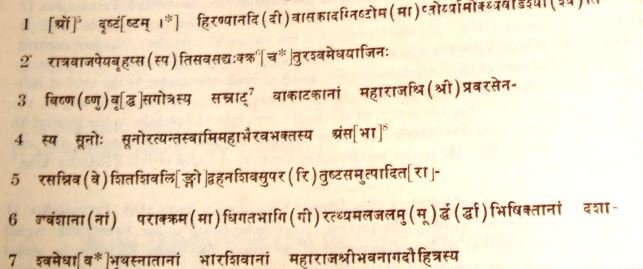
TEXT4 First Plate
____________________________________
[1] Had this epithet not been used, the grant might have been supposed as made on the occasion of the Daśaharā-vrata which is performed on the tenth tithi of the bright fortnight of Jyēshṭha. But it is doubtful it the vrata was
in vogue as early as the fifth century A.D. [This may be only the donee’s epithet and may have no reference to
any recitation at any particular vishu.─Ed.] | ||||||||||||||||||||||||||||||||||||||||||||||||||||||||||||||||||||||||||||||||||||||||||||||||||||||||||||||||||||||||||||||||||||||||||||||||||
| > |
|
>
|