|
Contents |
|
Index
|
|
Introduction
|
|
Contents
|
|
List of Plates
|
|
Additions and Corrections
|
|
Images
|
|
Contents |
|
Altekar, A. S
|
Bhattasali, N. K
|
|
Barua, B. M And Chakravarti, Pulin Behari
|
|
Chakravarti, S. N
|
|
Chhabra, B. CH
|
|
Das Gupta
|
|
Desai, P. B
|
|
Gai, G. S
|
|
Garde, M. B
|
|
Ghoshal, R. K
|
|
Gupte, Y. R
|
|
Kedar Nath Sastri
|
|
Khare, G. H
|
|
Krishnamacharlu, C. R
|
|
Konow, Sten
|
|
Lakshminarayan Rao, N
|
|
Majumdar, R. C
|
|
Master, Alfred
|
|
Mirashi, V. V
|
|
Mirashi, V. V., And Gupte, Y. R
|
|
Narasimhaswami, H. K
|
|
Nilakanta Sastri And Venkataramayya, M
|
|
Panchamukhi, R. S
|
|
Pandeya, L. P
|
|
Raghavan, V
|
|
Ramadas, G
|
|
Sircar, Dines Chandra
|
|
Somasekhara Sarma
|
|
Subrahmanya Aiyar
|
|
Vats, Madho Sarup
|
|
Venkataramayya, M
|
|
Venkatasubba Ayyar
|
|
Vaidyanathan, K. S
|
|
Vogel, J. Ph
|
|
Index.- By M. Venkataramayya
|
|
Other
South-Indian Inscriptions
|
|
Volume
1
|
Volume
2
|
|
Volume
3
|
Vol.
4 - 8
|
|
Volume 9
|
Volume 10
|
|
Volume 11
|
Volume 12
|
|
Volume 13
|
Volume
14
|
|
Volume 15
|
Volume 16
|
|
Volume 17
|
Volume 18
|
|
Volume
19
|
Volume
20
|
|
Volume 22
Part 1
|
Volume
22
Part 2
|
|
Volume
23
|
Volume
24 |
|
Volume
26
|
Volume 27 |
|
Tiruvarur
|
Darasuram
|
|
Konerirajapuram
|
Tanjavur |
|
Annual Reports 1935-1944
|
Annual Reports 1945- 1947
|
|
Corpus Inscriptionum Indicarum Volume 2, Part 2
|
Corpus Inscriptionum Indicarum Volume 7, Part 3
|
|
Kalachuri-Chedi Era Part 1
|
Kalachuri-Chedi Era Part 2
|
|
Epigraphica Indica
|
Epigraphia Indica Volume 3
|
|
Epigraphia
Indica Volume 4
|
Epigraphia Indica Volume 6
|
|
Epigraphia Indica Volume 7
|
Epigraphia Indica Volume 8
|
|
Epigraphia Indica Volume 27
|
Epigraphia Indica Volume 29
|
|
Epigraphia Indica Volume 30
|
Epigraphia Indica Volume 31
|
|
Epigraphia Indica Volume 32
|
Paramaras Volume 7, Part 2
|
|
Śilāhāras Volume 6, Part 2
|
Vākāṭakas Volume 5
|
|
Early Gupta Inscriptions
|
|
Archaeological
Links
|
|
Archaeological-Survey
of India
|
|
Pudukkottai
|
|
|
EPIGRAPHIA INDICA
and Hēmachandra calls it Chēdi-nagarī ‘ the capitlal of the Chēdi country’. The surrounding
country called Traipura is mentioned in the Mahābhārata[1]and the Matsyapurāṇa.[2] The Tripurī
vishaya (the district of Tripurī) is mentioned in the Betul plates of Saṅkshōbha as situated in the
Ḍabhālā (i.e., Ḍāhala) country, which was under the rule of the Parivrājaka kings down to A. D.
528 at least. It is, however, not known who was ruling the country when Vāmarāja invaded it
and annexed it to his kingdom.
Two or three generations seem to have separated Vāmarāja from Śaṅkaragaṇa. We do not
know the names of the princes who ruled in the meanwhile. Perhaps Māyurāja, the author of the
Sanskrit play Udāttarāghava was one of them. He is described by Rājaśēkhara as the best Kalachuri poet.[3] Another Sanskrit poet Bhīmaṭa whom Rājaśēkara mentions as the lord of Kālañjara perhaps belonged to the same royal family. Rājaśēkhara tells us that he composed five plays
of which Svapnadaśānana was judged to be the best.[4]
Śaṅkaragaṇa during whose reign the present inscription was put up belonged to the main
Tripurī branch of the great Kalachuri dynasty. He must therefore be distinguished from the
homonymous princes mentioned in the Kasiā stone inscription and the Kahlā plates, who were ruling
over the Gorakhpur District. This Śaṅkaragaṇa is, again, the earliest prince of this name in the
Tripurī branch and may therefore be called Śaṅkaragaṇa I. Two other princes of the same name
ruled at Tripurī, viz., (i) Śaṅkaragaṇa II who bore the birudas Mugdhatuṅga, Prasiddhadhavala
and Raṇavigraha[5] and was the son and successor of Kōkalla I, and (ii) Śaṅkaragaṇa III6 who
was the son and successor of Lakshmaṇarāja II and the elder brother of Yuvarājadēva II. The
former may be referred to the period circa A. D. 890─910 and the latter to circa A. D. 970─980.
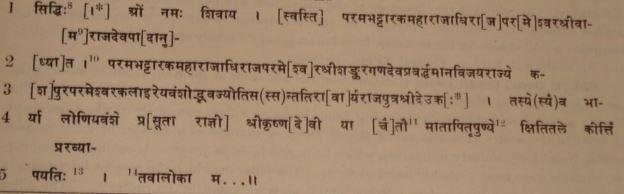
TEXT7
_____________________________________
[1] Sabhāparvan (Chitraśālā Press), adhyāya, XXXI, v. 60.
[2]Matsyapurāṇa, adhyāya 114, v. 53.
[3]Sūktimuktāvali (Gaekwad’s Oriental Series), p. 46 ; Ind. Ant. Vol. XLI, pp. 139 ff.
[4]Sūktimuktāvali, p. 46.
[5] He is called Śaṅkaragaṇa and Raṇavigraha in some Rāshṭrakūṭa records. His birudas Mugdhatuṅga and
Prasiddhadhavala are mentioned in the Bilhāri stone inscription and the Benares plates respectively.
[6]He is mentioned in the Kārītalāī stone inscription of Lakshmaṇarāja II as well as in the Benares plates.
See also above, Vol. XXV, p. 280.
[7] From the original stone and inked estampages. I am obliged to Dr. B. Ch. Chhabra and Mr. N. L. Rao for
the readings of a few words in this transcript.
[8] Expressed by a symbol.
[9] The loop on the left of this akshara has now become somewhat indistinct, but it is there.
[10] This daṇḍa is superfluous.
[11] The context requires a reading like ch=aitan=mātā-pitṛi …
[12]One would expect a reading like puṇy-ārthaṁ here.
[13] This visarga is superfluous. Notice that a similar visarga occurs at the end of the Chhoti Deori record, below,
p. 172.
[14] I am not certain about these eight aksharas at the end of the present record.
|




