|
The Indian Analyst
|
|
South Indian Inscriptions |
EPIGRAPHIA INDICA Verse 29 states that, being convinced that human life in transitory and full of sorrows and that wealth is very unsteady, Purushōttama became intent on acquiring religious merit. He raised several groves, erected many maṭhas and maṇḍapas (temples) and excavated a deep tank at Ratnapura. He also built the five-shrined temple of Śiva where the present inscription was put up, and laid out a pleasure-garden near it. From v. 35 we learn that Pṛithvīdēva (II) donated the village Salōnī to Purushōttama on the occasion of a solar eclipse. Verse 37 eulogises Kāśala, the poet who composed the present praśasti. He is said to have been proficient in various arts and sciences including those of medicine and elephants. He had also mastered the āgamas of the Buddha and others. The description is interesting as it clearly indicates that though Buddhism which was once flourishing in that part of Chhattisgarh ceased to have any followers there, its religious and philosophical works continued to be studied in Dakshiṇa Kōsala down to the 12th century A.D. It may be noted that the earlier Ratanpur stone inscription of Jājalladēva dated K. 866 also mentions a Śaiva ascetic named Rudraśiva as proficient in the works of Diṅnāga and others. [1]
The last verse (38) records two gifts, one of four plough-measures of land made to the gods installed in the temple and the other of two plough-measures made to the Brāhmaṇa Vāsudēva who was evidently a priest of the temple. As for the localities mentioned in the present praśasti, Tummāna still retains its old name in the form Tumān and lies about 45 miles north of Ratanpur, in the Bilaspur District.[2] Khimmiṇḍi may be identical with modern Kimeḍi Zamindari in the Ganjam District. Talahāri seems to have comprised the country round Mallār in the Bilāspur and Jānjgir tahsīls. Its ancient name seems to have been Taraḍaṁśakabhukti mentioned in an old copper-plate grant[3] of Mahāśivagupta-Bālārjuna, found near Mallār. Khijjiṅga[4] and Daṇḍapura cannot be identified. Daṇḍabhukthi is mentioned in several old records and probably comprised parts of the Midnapur District.[5] Finally, Salōnī, the village granted to Purushōttama, may be identical with Saraoni which lies only about a mile and a half south by west of Koni where the present record was discovered. TEXT [Metres : Vv. 1, 8, 10, 12, 13, 17, 19, 20, 27, 29 and 34 Śārdūlavikrīḍita ; vv. 2, 9, 11, 36, and 37 Sragdharā : vv. 3─5, 7, 14, 21─23, 26 and 28 Vasantatilakā ; vv. 6 and 32 Mandākrāntā ; v. 15 Hariṇī ; vv. 16 and 18 Mālinī ; vv. 24, 25, 30 and 38 Anushṭubh ; vv. 31, 33 and 35 Āryā.]
_______________________________________________
[1] Above, Vol. I, p. 36. | ||||||||||||||||||||||||||||||||||||||||||||||||||||||||||||||||||||||||||||||||||||||||||||||||||||||||||||||||||||||||||||||||||||||||||||||||||
| > |
|
>
|




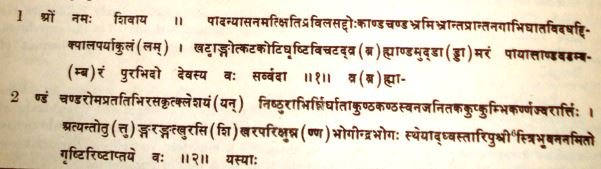
 -, but the compound should correctly be
  -
according to Pāṇini, V, 4, 74. This would not however suit the metre.
-
according to Pāṇini, V, 4, 74. This would not however suit the metre.