|
Contents |
|
Index
|
|
Introduction
|
|
Contents
|
|
List of Plates
|
|
Additions and Corrections
|
|
Images
|
|
Contents |
|
Altekar, A. S
|
Bhattasali, N. K
|
|
Barua, B. M And Chakravarti, Pulin Behari
|
|
Chakravarti, S. N
|
|
Chhabra, B. CH
|
|
Das Gupta
|
|
Desai, P. B
|
|
Gai, G. S
|
|
Garde, M. B
|
|
Ghoshal, R. K
|
|
Gupte, Y. R
|
|
Kedar Nath Sastri
|
|
Khare, G. H
|
|
Krishnamacharlu, C. R
|
|
Konow, Sten
|
|
Lakshminarayan Rao, N
|
|
Majumdar, R. C
|
|
Master, Alfred
|
|
Mirashi, V. V
|
|
Mirashi, V. V., And Gupte, Y. R
|
|
Narasimhaswami, H. K
|
|
Nilakanta Sastri And Venkataramayya, M
|
|
Panchamukhi, R. S
|
|
Pandeya, L. P
|
|
Raghavan, V
|
|
Ramadas, G
|
|
Sircar, Dines Chandra
|
|
Somasekhara Sarma
|
|
Subrahmanya Aiyar
|
|
Vats, Madho Sarup
|
|
Venkataramayya, M
|
|
Venkatasubba Ayyar
|
|
Vaidyanathan, K. S
|
|
Vogel, J. Ph
|
|
Index.- By M. Venkataramayya
|
|
Other
South-Indian Inscriptions
|
|
Volume
1
|
Volume
2
|
|
Volume
3
|
Vol.
4 - 8
|
|
Volume 9
|
Volume 10
|
|
Volume 11
|
Volume 12
|
|
Volume 13
|
Volume
14
|
|
Volume 15
|
Volume 16
|
|
Volume 17
|
Volume 18
|
|
Volume
19
|
Volume
20
|
|
Volume 22
Part 1
|
Volume
22
Part 2
|
|
Volume
23
|
Volume
24 |
|
Volume
26
|
Volume 27 |
|
Tiruvarur
|
Darasuram
|
|
Konerirajapuram
|
Tanjavur |
|
Annual Reports 1935-1944
|
Annual Reports 1945- 1947
|
|
Corpus Inscriptionum Indicarum Volume 2, Part 2
|
Corpus Inscriptionum Indicarum Volume 7, Part 3
|
|
Kalachuri-Chedi Era Part 1
|
Kalachuri-Chedi Era Part 2
|
|
Epigraphica Indica
|
Epigraphia Indica Volume 3
|
|
Epigraphia
Indica Volume 4
|
Epigraphia Indica Volume 6
|
|
Epigraphia Indica Volume 7
|
Epigraphia Indica Volume 8
|
|
Epigraphia Indica Volume 27
|
Epigraphia Indica Volume 29
|
|
Epigraphia Indica Volume 30
|
Epigraphia Indica Volume 31
|
|
Epigraphia Indica Volume 32
|
Paramaras Volume 7, Part 2
|
|
Śilāhāras Volume 6, Part 2
|
Vākāṭakas Volume 5
|
|
Early Gupta Inscriptions
|
|
Archaeological
Links
|
|
Archaeological-Survey
of India
|
|
Pudukkottai
|
|
|
EPIGRAPHIA INDICA
GUNJI ROCK INSCRIPTION OF KUMARAVARADATTA
name of the tīrtha which was evidently so called after Śiva’s bull (Ṛishabha) Nandi, lends colour
to this conjecture. Though Bhagavat (the Lord), when not connected with any specific name,
is usually taken to denote Vishṇu, it occasionally occurs also as an epithet of Śiva and other
deities.[1] It seems likely, therefore, that the Bhagavat mentioned here was the god Śiva.
This is the earliest inscription mentioning a royal name, found in Chhattisgarh
and as such has great historical importance. Unfortunately it mentions neither the family
nor any ancestors of the king Kumāravaradatta. The records at Kirāri and Rāmgarh which,
belonging as they do to the same part of the country and the same age as the present inscription,
might have been expected to throw light on this matter, afford no help ; for the name of the reigning king is irretrievably lost in the former, while the records at the latter place contain no royal
name. We have therefore no further information about the king Kumāravaradatta.
TEXT2
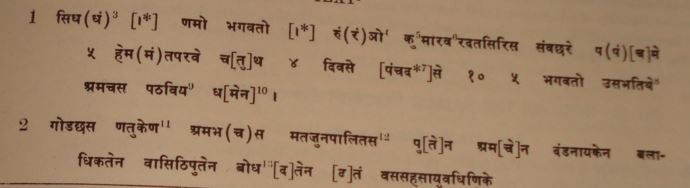
[1]See Fleet, Gupta Inscriptions, p. 28, n. 5.
[2]From an inked estampage and the facsimile facing p. 193 in the Gazetteer of Chhattisgarh Feudatory States.
[3] There are two ornamental figures before this word, the first resembling the Roman figure V. Similar
ornamental figures appear to have been incised in the beginning of the Nāṇāghāṭ inscription of Nāganikā also.
See the facsimile in Arch. Surv. West. Ind., Vol. V.
[4] The form raṁño occurs on early coins of Sātavāhana and Sēbaka. J. N. S. I., Vol. VII, pp. 1 f. and 94 f.
[5] What looks like an anusvāra on ku may be due to a fault in the rock.
[6]This akshara looks like ma, but is probably a double-triangled va noticed by Bühler, above, Vol. II, p. 201.
No. 12, and p. 207, No. 32. See his Indian Palaeography (English translation), p. 40. See also v in ll. 6, 7 and
10 of the inscription (VII) on a door-jamb from Mathurā, above Vol. XXIV, pl. facing p. 195. Dr. D. R.
Bhandarkar read the king’s name as Vasanta, but what he read as sa represents two aksharas ra and da.
_________________________________
[7] These threeaksharas are lost by the peeling off of the surface of the rock.
[8]Sanskrit, Ṛishabhatīrthē. The vertical stroke below sa is not an u-sign ; for the latter, the right limb of the
letter is lengthened. For the reading of this word I am obliged to Dr. B. Ch. Chhabra and Mr. N. L. Rao.
[9] Sanskrit, pṛithivyām. According to Prakrit grammarians, the form should be puhaviya or puḍhaviya.
The Nāṇāghāṭ inscription of Nāganikā has pathaviya.
[10] The second akshara of this word is now completely damaged. With the expression used here, compare
pathaviya pathama vīrasa in l. 3 of Nāganikā’s inscription.
[11] Sanskrit, naptṛikēṇa. Hēmachandra (VIII, 1, 137) gives nattiena and nattuena, both of which (without
the conjunct) are used in the present inscription.
[12] Sanskrit, Mātṛi-jana-pālitasya. The interchange of vowels here is as in viṁchhuo. See Vararuchī, I, 15.
[13]Dh is roundish here as in Dha[me]na in l. 1 and in vadhiṇike, further on in this line.
|




