|
The Indian Analyst
|




North Indian Inscriptions |
RELIGIOUS CONDITION
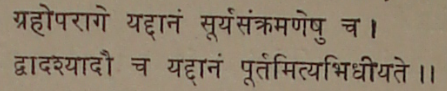
honour of Hindu gods,[1] and twenty-one those to Brāhmaṇas.[2] The former relate to the erection, completion or repairs of the temples of gods, provision for their regular worship, maintenance of a perpetual lamp in their sanctums, and of sattras for ascetics and students, and the performance of periodical rites and ceremonies. One grant was made to the royal Parishad that advised the king in regard to religious and judicial matters.[3] The remaining inscriptions record grants to Brāhmaṇas on a sacred tithi or an eclipse for the performance of their religious duties and the maintenance of their families.[4] The sacred occasions on which gifts were made to gods and Brāhmaṇas are mentioned in the following verse of Jātūkarṇya cited in the commentary of Aparārka[5] :- ..This verse tells us that eclipses (of the sun and the moon), the saṅkrāntis and the twelfth and other tithis in certain months are sacred occasions on which charitable gifts should be made. The Śilāhāra inscriptions record gifts made on all these occasions. ..Eclipses−Grants of land were made on both the solar and the lunar eclipses. .. Solar eclipses-As many as ten grants were made on the occasion of the eclipses of the sun.[6] It is perhaps a coincidence that most of them were made by the Śilāhāras of North Koṅkaṇ. These inscriptions describe that the kings used to bathe in the water of the ocean, worship the Sun with flowers etc., and then make the grants. The dates of all of them can be verified.
.. Lunar eclipses−Śilāhāra inscriptions record ten gifts made on the occasion of a lunar eclipse. Seven of these were made by the Śilāhāras of North Koṅkaṇ,[7] and four by those of Kolhapur.[8] .. Saṅkrāntis−Several gifts were made on the Saṅkrāntis, which were regarded as very sacred. Of the Saṅkrāntis, the Mēsha Saṅkrānti or Uttarāyaṇa and the Karkaṭa Saṅkrānti or the Dakshiṇāyana were regarded as very holy. As many as five land grants are recorded as made on the occasion of the Uttarāyaṇa Saṅkrānti.[9] .. The number of grants made on the occasion of the Dakshiṇāyana Saṅkrānti was less, viz., two.[10] One grant seems to have been made on the Mēsha, and another on the Vṛiśchika Saṅkrānti, though there is no explicit mention of them.[11]
..
Gifts were made on some sacred tithis also. The Śilāhāras of North Koṅkaṇ were ardent
devotees of Śiva. They regarded the tithi Māgha. va. di. 14 (Śivarātri) very sacred. Hence we
find that the Chaudharpāḍā stone inscription records the grant made by the Śilāhāra king
Kēśidēva II on that tithi.[12] Some other grants also were made on the fourteenth tithi of the
bright or dark fortnights of other months.[13]
Another sacred tithi mentioned in the Śilāhāra records is Vaiśākha śu. di. 3, called
Akshaya-tṛitīyā, when Mallikārjuna appointed Suprayā the Daṇḍādhipati of Panāla-nagara. On
[1] Nos. 7, 12, 17, 31, 32, 34, 35, 39, 41, 45, 52, 58 and 65.
|
||||||||||||||||||||||||||||||||||||||||||||||||||||||||||||||||||||||||||||||||||||||||||||||||||||||||||||||||||||||
| > |
|
>
|